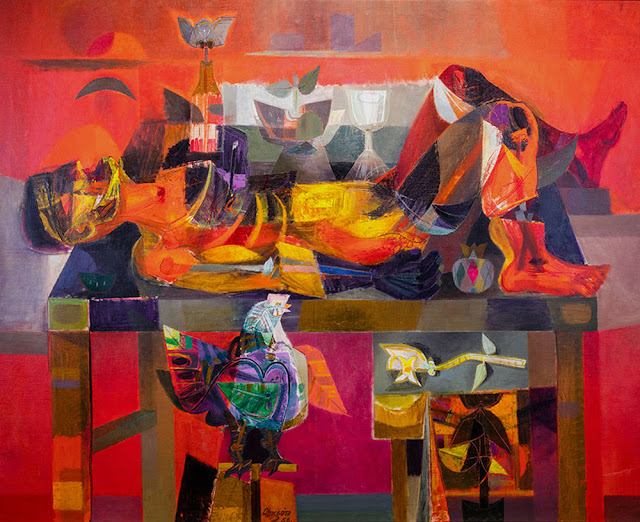
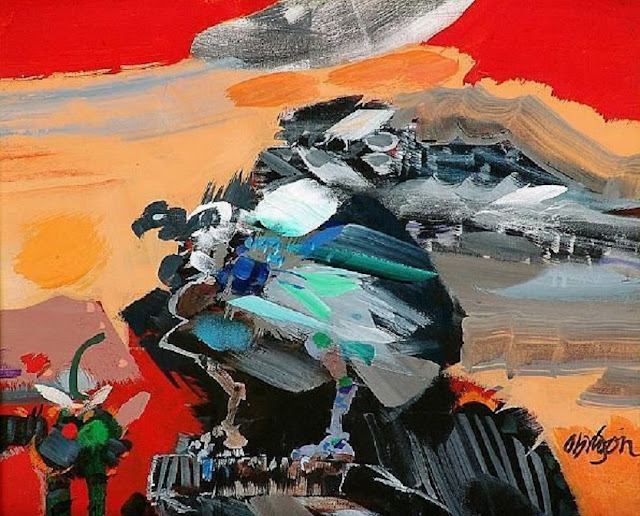
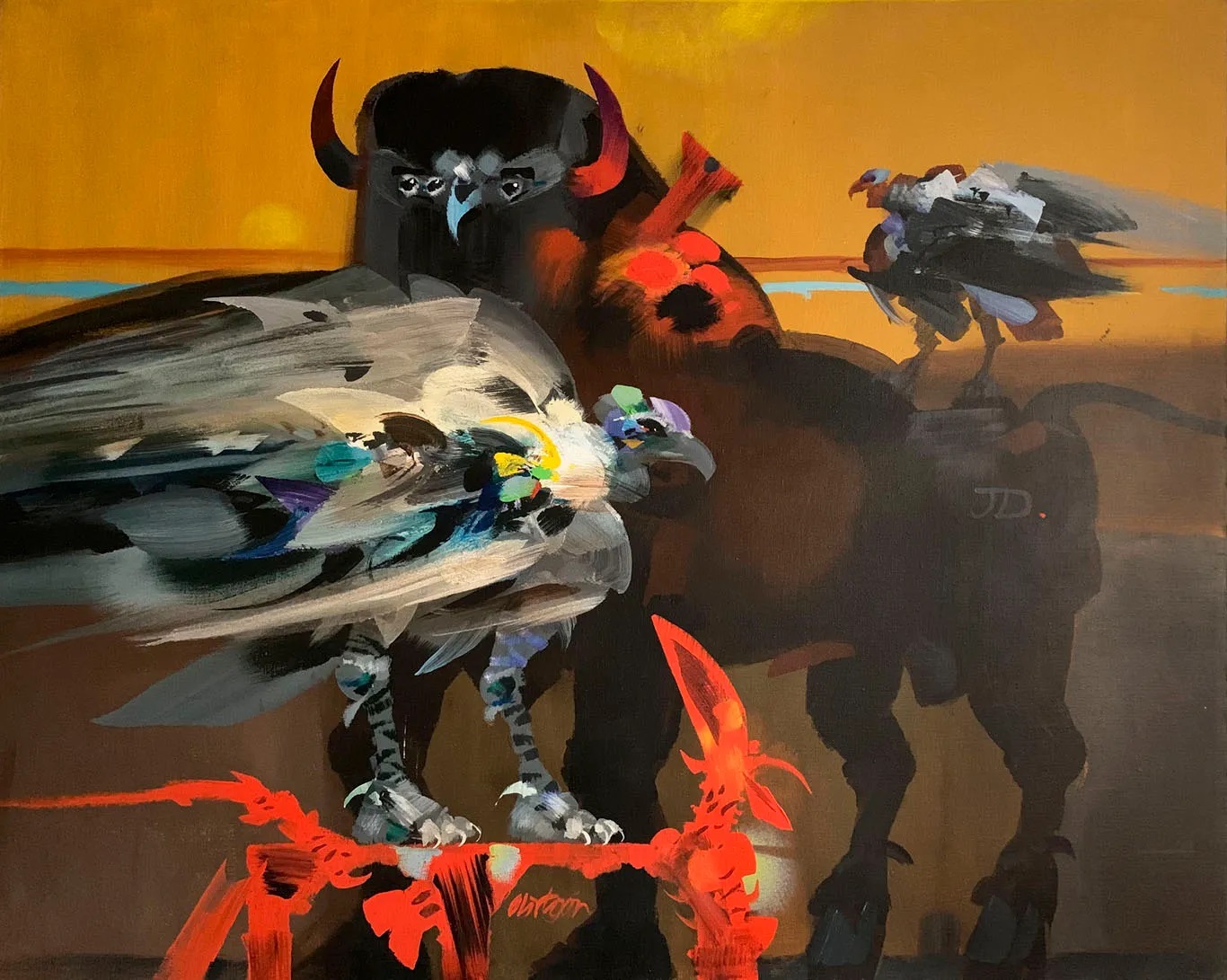
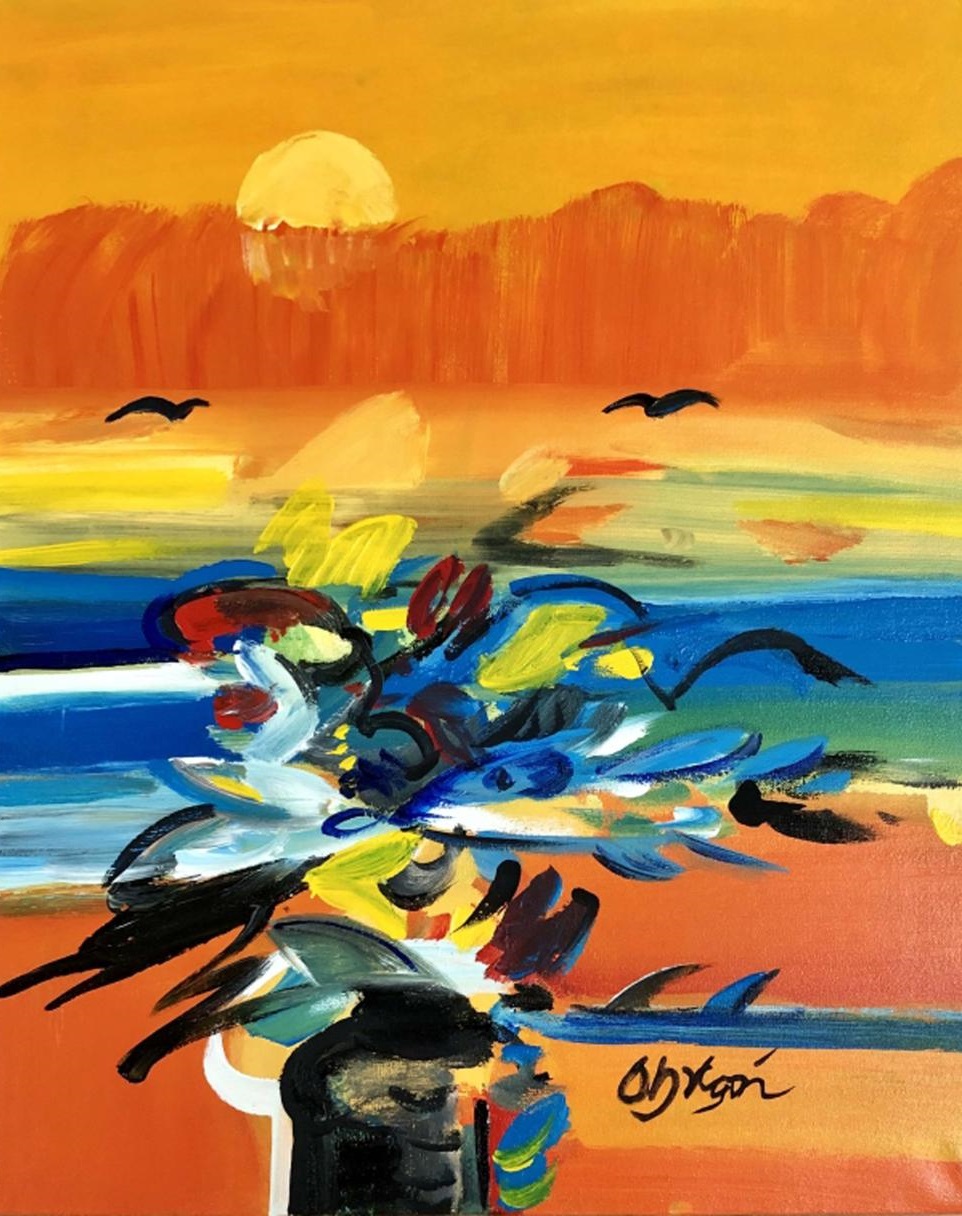
Alejandro Obregon (1920 - 1992), Colombian artist. Born in Barcelona, Spain, Obregón always considered himself self-taught although he studied art in England, the United States, and France. His career was difficult at its inception because of his inability to master pictorial techniques. In 1943 he had his first solo show and launched his career. He developed special symbols—like the falcon and colorful flowers—to depict the Colombian landscape and its inhabitants. His figures are painted in large and strong brush strokes.
A geometrical and rational Obregon with constructivist tendencies developed between 1947 and 1959, when another more expressionistic and irrational Obregon evolved. With undoubted daring, the artist has since combined emotion with dynamic equilibrium in his figures, radically changing the habitual Colombian colors of blacks and greys to his vivid tones.
But it was the condors and the bull-condors, like that of 1961, which would doubtlessly reign over the artist’s new universe. Obregón had seen his first condor in a cage at the National University. “He looked like a Jesuit priest, all covered with brilliant black and with a white collar.” He patted the bird’s head and then pulled out a tail feather, receiving several pecks that left a scar Obregon still has. At least 40 condors have been painted by the artist, and they placed Obregon at the head of Colombian art, making the 60s his decade.Critic Marta Traba identified a series of characteristic elements in Obregon's work: personal poetic values; self-sufficiency in regard to reality, indeed starting from it; expressive intention; freedom of form; search for identity based on the landscape, zoology, and flora; elliptic space people by magic elements; and contempt for urban culture.Also unique to Obregon is that instead of faithfully painting what he sees, he made extensive use of his personal imagination and vitality.From his still lifes of the 1950s to his landscapes of the sky, the sea and the buildings of Cartagena de Indias, where he worked until his death, Obregón's work is multifaceted. He conveys his feeling for the geography and wildlife of Colombia, his love of family and his passion for women. His subjects remind the viewer of loyalty, friendship, memory and ultimately of the wonder of life, however insignificant it may seem in terms of the cosmos.