Exposition Art Blog: poet
Showing posts with label poet. Show all posts

Max Ernst - The Master of Surrealism


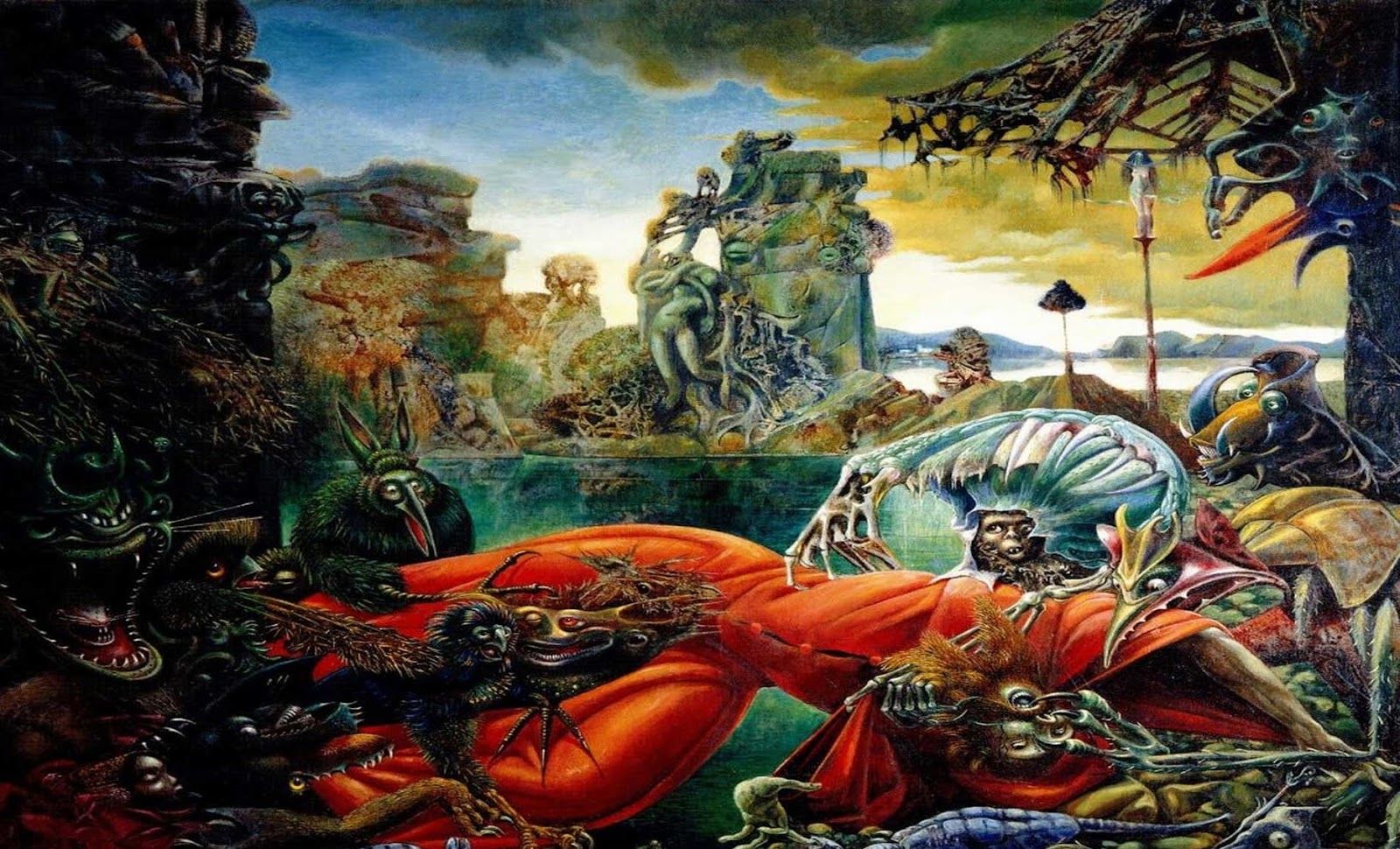
Max Ernst (1891 –1976) was a German  painter, sculptor, graphic artist, and poet. A prolific artist, Ernst was a primary pioneer of the Dada movement and surrealism. He had no formal artistic training, but his experimental attitude toward the making of art resulted in his invention of frottage—a technique that uses pencil rubbings of objects as a source of images—and grattage, an analogous technique in which paint is scraped across canvas to reveal the imprints of the objects placed beneath. He is also noted for his novels consisting of collages.
"Ernst is most closely associated with Surrealism, an artistic and literary movement in Paris in the 1920s that prized the irrational and the unconscious over order and reason. A key contribution to this movement was his invention of frottage, a technique of placing paper over a textured material, such as wood grain or metal mesh, and rubbing it with a pencil or crayon to achieve various effects. The Surrealists prized this practice—which produced compositions like Forest and Sun—for both the serendipity of the resulting imagery and the passivity it encouraged, bypassing the constraints of the artist’s rational mind. Having little control over the resulting patterns, Ernst marveled that he “came to assist as spectator at the birth of all my works.”1 Eventually, he translated the method from paper to painting, using the word grattage to describe this technique of scraping wet paint off of the canvas to achieve similar patterned effects.
The fragmented logic of collage, which Ernst referred to as “the culture of systematic displacement,” persists in his paintings, whose subjects are disjointed even if their surfaces are smooth. In these foreboding dreamscapes, headless bodies and body-less hands appear incongruously amid lush forests or on deserted beaches. In the years leading up to World War II, and during his time as an émigré to the United States from 1941 to 1953, Ernst made work that once again reflected the menacing atmosphere of war."(www.moma.org)


Marjorie Cameron Mystery Babylon


Marjorie Cameron Parsons Kimmel (April 23, 1922 – June 24, 1995), who professionally used the mononym Cameron, was an American artist, poet, actress, and occultist. A follower of Thelema, the new religious movement established by the English occultist Aleister Crowley, she was also the wife of rocket pioneer and fellow Thelemite Jack Parsons..Born in Belle Plaine, Iowa, Cameron volunteered for services in the United States' Navy during the Second World War, after which she settled in Pasadena, California, where she met Parsons, who believed her to be the "Elemental woman" that he had invoked in the early stages of a series of sex magic rituals called the Babalon Working. They entered a relationship and were married in 1946. Their relationship was often strained, although Parsons sparked her involvement in Thelema and occultism. After Parsons' death in an explosion at their home in 1952, Cameron came to suspect that her husband had been assassinated and began rituals to communicate with his spirit. Cameron's recognition as an artist increased after her death, when her paintings made appearances in exhibitions across the U.S. As a result of increased attention on Parsons, Cameron's life also gained greater coverage in the early 2000s, while in 2011 a biography of Cameron authored by Spencer Kansa was published.

Cameron's occult beliefs closely impacted her artworks.According to The Huffington Post, Cameron's artwork merges "Crowley's occult with the surrealism and symbolism of French poets, yielding dark yet whimsical depictions buzzing with otherworldly power".The art curator Philippe Vergne described her work as being situated on "the edge of surrealism and psychedelia", embodying "an aspect of modernity that deeply doubts and defies cartesian logic at a moment in history when these values have shown their own limitations".
Cameron's biographer Spencer Kansa was of the opinion that Cameron exhibited parallels with the Australian artist and occultist Rosaleen Norton, both in terms of her physical appearance and the similarities between their artistic styles.Harrington also saw similarities in the work of Cameron and the artists Leonora Carrington and Leonor Fini.On the website of the Cameron Parsons Foundation, Michael Duncan expressed the view that Cameron's work rivals that of "fellow surrealists" like Carrington, Fini, Remedios Varo, and Ithell Colquhoun, while also appearing "fascinatingly prescient" of the works by later artists Kiki Smith, Amy Cutler, Karen Kilimmck, and Hernan Bas.In later years, Cameron would often be erroneously labelled a Beat artist because she inhabited many of the same social circles as prominent Beat poets and writers.Rejecting this label, Kansa instead described Cameron as "a pre-Beat bohemian, whose heart lay in Romanticism"Wikipedia


Issa Samb - African Culture - Dada Africa

Issa Samb, also known as Joe Ouakam (31 December 1945 – 25 April 2017) was a Senegalese painter, sculptor, performance artist, playwright and poet. Issa Samb was born on 31 December 1945 in Dakar, Senegal.He graduated from the University of Dakar, where he studied philosophy and the law.
Samb took up the pseudonym Joe Ouakam. He did inter-disciplinary work that encompasses sculpture, performance, painting and theatre. His work was considered to draw from both African tradition and the European avante-garde movements such as Dada, Surrealism, Situationism and Fluxus.Samb was one of the founding members of the seminal Laboratoire Agit'Art in 1973. His work was exhibited at Whitechapel Gallery, London in its ‘Seven Stories of Modern Art in Africa’ exhibition in 1995 and the 2008 the Biennale de l’Art Africain Contemporain, Dak'Art in Dakar. In 2010, a retrospective of his work was held at the National Art Gallery, Dakar.[5] His work was also exhibited at the 2012 documenta in Kassel, Germany. By 2014, InIVA, an art gallery in London, curated 'Issa Samb: From the Ethics of Acting to the Empire without Signs


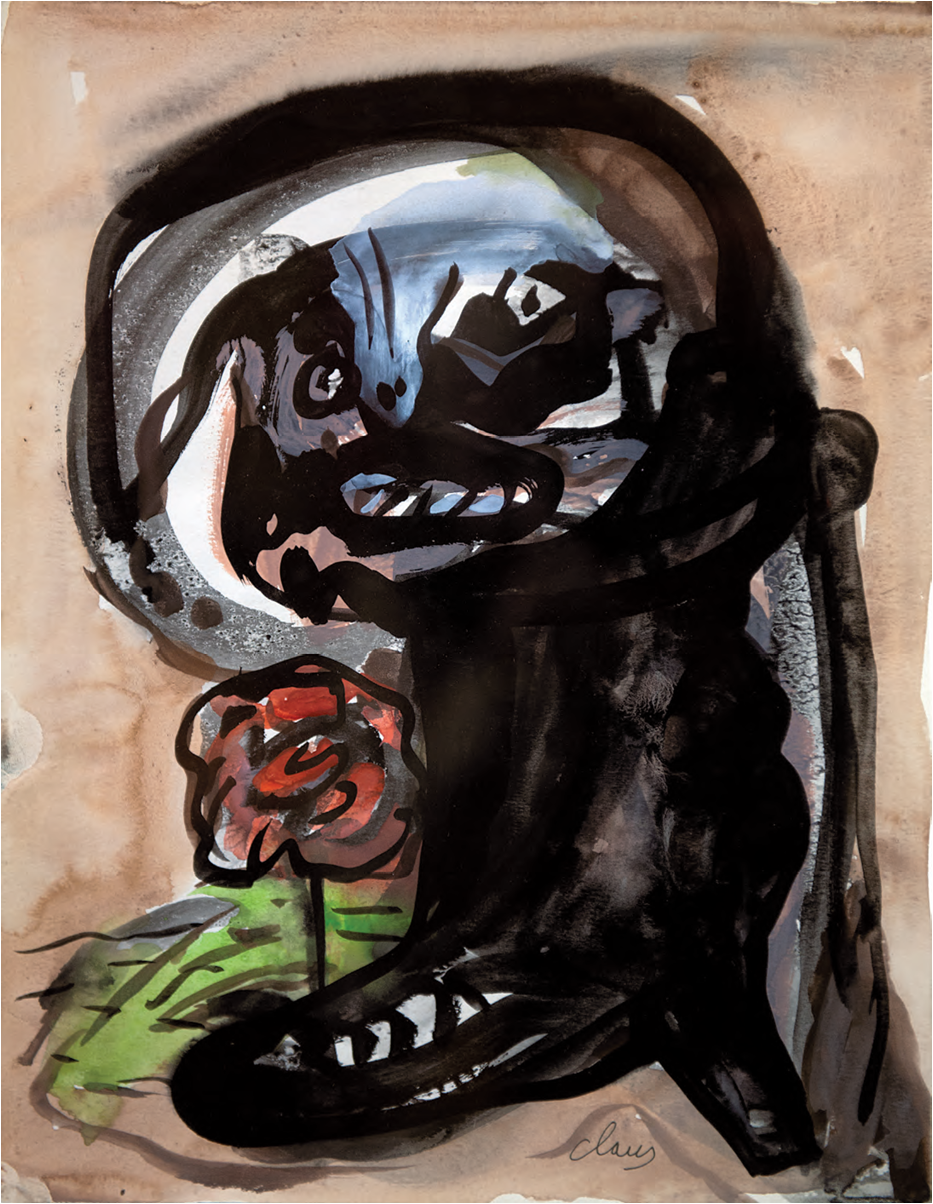
Hugo Claus - European avangard art - CoBrA group

Hugo Maurice Julien Claus ( 5 April 1929 – 19 March 2008) was a leading Belgian author who published under his own name as well as various pseudonyms. Claus' literary contributions spanned the genres of drama, the novel, and poetry; he also left a legacy as a painter and film director. He wrote primarily in Dutch, although he also wrote some poetry in English.His death by euthanasia, which is legal in Belgium, led to considerable controversy. As a painter, Claus was a participant in the CoBrA art movement from 1950. He had developed friendships with some of its members, and illustrated a book by Pierre Alechinsky in 1949. He collaborated with key figures in the movement including Karel Appel and Corneille and participated in some exhibitions.