Exposition Art Blog: European culture
Showing posts with label European culture. Show all posts

Juan Ponc - Surrealism


 Juan Ponç (1927 - 1984) was a Catalan artist and member of the avant-garde group Dau al Set.Joan Ponç was born in the Sarría neighborhood of Barcelona, Spain to Gumersindo Pons and Dolors Bonet.He attended the Colegio Salesiano San Antonio de Padua de Mataró boarding school from 1940-1942, during which time he decided to pursue an interest in painting. In 1946, Ponç presented his first solo art exhibition at the Sala Arte de Bilbao, and met fellow Dau al Set contributors Joan Brossa, J.V. Foix, and Arnau Puig. Over the next couple of years, Ponç actively interacted and collaborated with forerunners of the Catalan avant-garde, such as Modest Cuixart and Joan Miró. Though the Dau al Set group ultimately disbanded in 1954, Ponç continued presenting his own artwork until 1980. On April 4, 1984, Ponç died of a heart attack while at his home in Saint-Paul-de-Vence, France. Four days later, he was returned to his residence and workshop in La Roca del Vallès, near Barcelona, for burial.Wikipedia


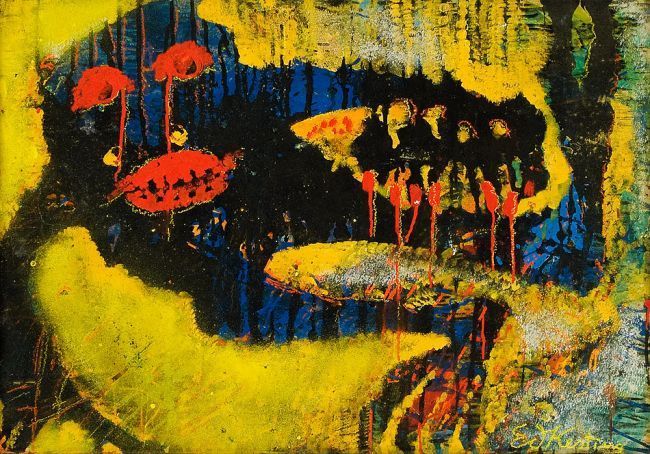
Edmund Kesting - European Avant-Garde Art


 Edmund Kesting ( 1892 –1970 ) was a German photographer, painter and art professor.
He studied until 1916 at the Dresden Academy of Fine Arts before participating as a soldier in the First World War, upon returning his painting teachers were Richard Müller and Otto Gussmann and in 1919 he began to teach as a professor at the private school Der Weg. In 1923 he had his first exposition in the gallery Der Sturm in which he showed photograms. When Der Weg opened a new academy in Berlin in 1927, he moved to the capital.He formed relations with other vanguardists in Berlin and practiced various experimental techniques such as solarization, multiple images and photograms, for which reason twelve of his works were considered degenerate art by the Nazi regime and were prohibited. He participated in the controversy between socialist realism and formalism that took place in the German Democratic Republic, therefore his work was not realist and could not be shown in the country between 1949 and 1959. In 1955 he began to experiment with chemical painting, making photographs without the use of a camera and only with the use of chemical products such as the developer and the fixer and photographic paper, for which he made exposures to light using masks and templates. Between 1956 and 1967 he was a professor at the Academy of Cinema and Television of Potsdam.His artistic work was not recognized by the authorities of the German Democratic Republic until 1980, ten years after his death.Wikipedia


Joan Miró


 Joan Miró (1893 –1983) was a Spanish painter, sculptor, and ceramicist born in Barcelona. A museum dedicated to his work, the Fundació Joan Miró, was established in his native city of Barcelona in 1975, and another, the Fundació Pilar i Joan Miró, was established in his adoptive city of Palma de Mallorca in 1981.
Earning international acclaim, his work has been interpreted as Surrealism but with a personal style, sometimes also veering into Fauvism and Expressionism. He was notable for his interest in the unconscious or the subconscious mind, reflected in his re-creation of the childlike. His difficult to classify works also had a manifestation of Catalan pride. In numerous interviews dating from the 1930s onwards, Miró expressed contempt for conventional painting methods as a way of supporting bourgeois society, and declared an "assassination of painting" in favour of upsetting the visual elements of established painting.(Wikipedia)
"Via his own Surrealism-inspired exploration, Miró invented a new kind of pictorial space in which carefully rendered objects issuing strictly from the artist's imagination became juxtaposed with basic, recognizable forms. His use of interior emotion to drive abstract expression would become a great influence on the Abstract Expressionists.Even though he pared his forms to abstract schematics or pictorial signs and gestures Miró's art never settled into complete non-objectivity. Rather, he devoted his career to exploring various means by which to dismantle traditional precepts of representation.Miró balanced the kind of spontaneity and automatism encouraged by the Surrealists with meticulous planning and rendering to achieve finished works that, because of their precision, seemed plausibly representational despite their considerable level of abstraction.Miró often worked with a limited palette, yet the colors he used were bold and expressive. His chromatic explorations, which emphasized the potential of fields of unblended color to respond to one another, as well as his flat backgrounds with mild gradations of color, were valuable resources, providing inspiration for Color Field painters such as Helen Frankenthaler.Miró was a modern renegade who refused to limit himself to visual exploration in a single medium. While he explored certain themes such as that of Mother and Child repeatedly throughout his long career, he did so in a variety of media from painting and printmaking to sculpture and ceramics, often achieving surprising and disparate results."(theartstory.org)\

Inspirations


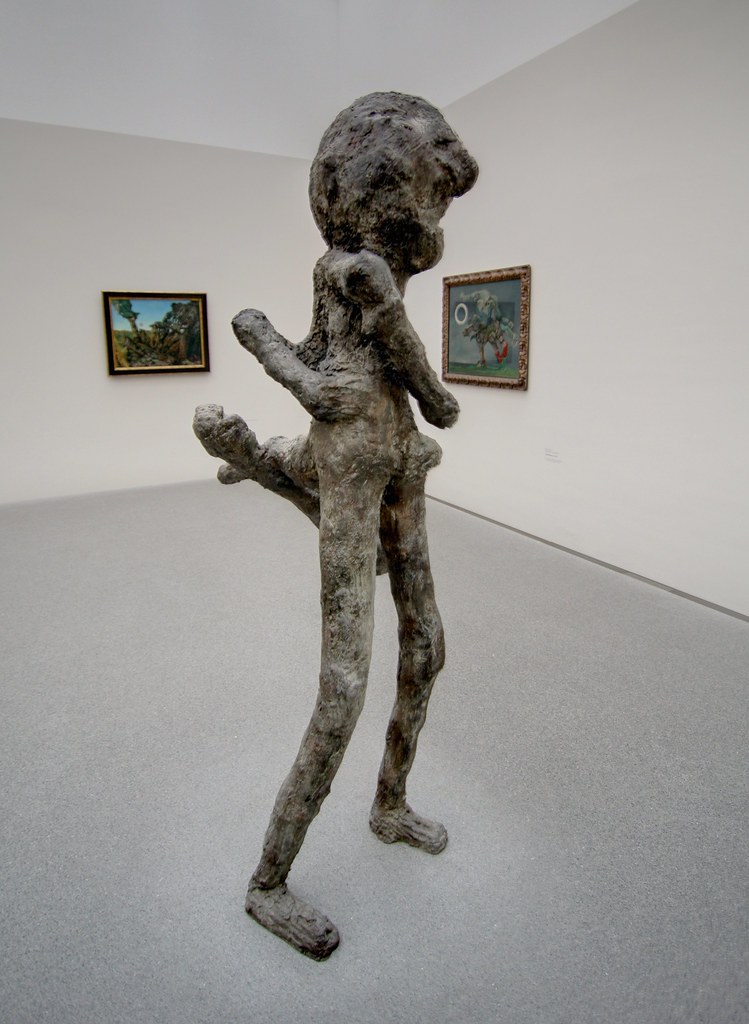
Martin Disler - Neo-Expressionism Art


Martin Disler (1949 -1996 ) was a Swiss painter, draughtsman and writer.Martin Disler was a Swiss painter best known for his naïve, expressive paintings and sculptures. With affinities to various avant-garde movements such as CoBrA, Neue Wilde, and Art Brut, Disler drew on psychological and mythical archetypes to further convey the angst evident in the formal construction of his works.


https://milenaolesinska.blogspot.com/p/blog-page_50.html