Exposition Art Blog: expressionism
Showing posts with label expressionism. Show all posts

Richard Konvička


Richard Konvička was born on April 30, 1957, in Prague – Died, 6 August 2021. 1973 to 1977, he studied at the Secondary School of Fine Arts in Prague and later at the Academy of Fine Arts (AVU) in Prague under the guidance of Professor Jan Smetana (1977-1983).

In 1990, he received a grant from The Pollock-Krasner Foundation, Inc., New York, to study abroad for half a year. Since 1997 he has been a member of Umělecká beseda arts association."Richard Konvička's work was and is up-to-date and is not easy to understand. He has his informed interprets (e.g. Richard Drury, Ivan Neumann), who have written the most important about it. Probably, even I can join them. Every new attempt at his ”portrait“ cannot avoid once already written. The author paints and also destructs. This seemingly ironic expression gives a true picture of the art program his work, points out the essential expressionistic and content components of his paintings, where sensuality softens (disturbs?, corrects?) the mind. Konvička´s art is stormy, stimulates, provokes; but it is also kind and especially human to be always contemporary in all these levels.His art attacks human senses and provides also testimony about his own turbulent spirit, which is too open for the surrounding world. Richard Konvička belongs to a relatively small group of artists, who are not afraid to get down searching for the new ways of art expression. It is historically nothing new that many soon used all the optimism of their Prometheus energy and integrated into the ”middle“ classic stream in art. Others have fallen through the professional routine and became uncreative epigones of their idols. Only a few remained and focused their attention on the search in themselves, with their own eyes, opinions and life. From their family comes also Richard Konvička, direct by nature, lustily tempered, robust (by art, not by his fi gure) painter. "(richardkonvicka.cz)
 
 More works on the website devoted to avant-garde art


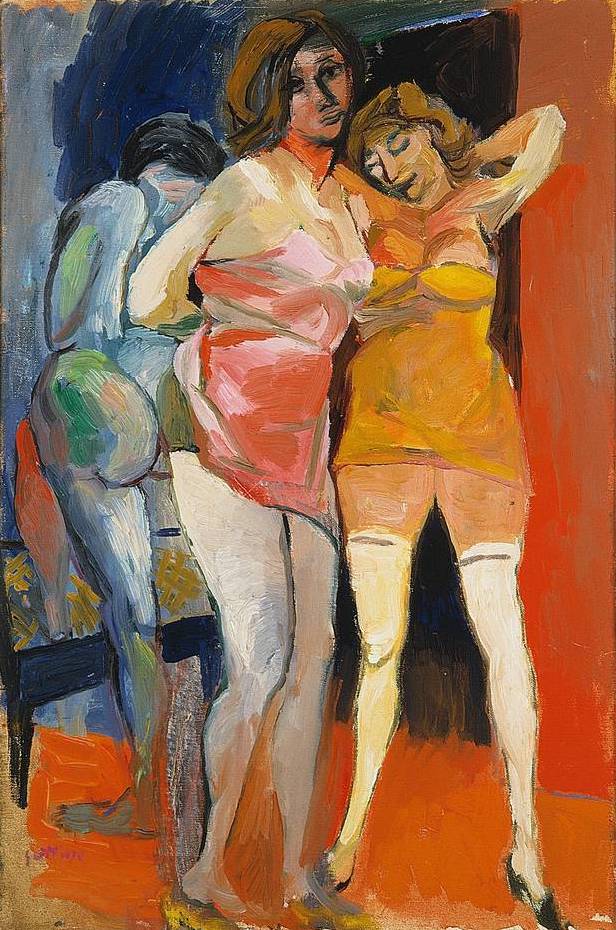
Renato Guttuso

 
Renato Guttuso (1911-1987) was an Italian artist known for his association with the Socialist Realism movement popular in the Soviet Union. A fervent opponent of Fascism and a devoted communist, Guttuso’s works carried a strong political message, as seen in his troubling Execution by Firing Squad in the Countryside (1938), a painting depicting the violent assassination of the Spanish poet Federico Garcia Lorca by fascist militia. His expressive brushstrokes and rich use of warm reds and browns, can be seen in his painting La Vuicciria (1974), a scene of a bustling market in Palermo. Born on December 26, 1912 in Bagheria, Sicily, he gave up studying law at Palermo University to pursue a career as an artist. Having shown an aptitude for drawing at a young age, his early style reflected the influence of Giorgio de Chirico. The artist went on to exhibit two of his paintings in 1931 at the showcase, Prima Quadriennale d’Arte Nazionale de Roma. Guttuso died January 18, 1987 in Rome at the age of 75. 


Raquel Forner - Expressionism


Raquel Forner (1902-1988) was an Argentine painter known for her expressionist works.
Forner's work demonstrated an interest in current events, and from the beginning of the Spanish Civil War in 1936 this took a dramatic and tragic tone. She borrowed ideas from surrealism during the 1940s, adapting its esthetic of distortion without seeking to reproduce a dream state. In 1942 she took first place at the Argentine National Salon competition.During the 1940s through most of the 1950s she produced several series on similar tragic themes in a primarily expressionist mode. Forner often portrayed strong female figures, but not as specific explorations into gender norms.
Beginning in 1957, coinciding with the space race, Forner's attention turned to imagined scenes of interplanetary travel.With her Space Series, which exhibited in Europe and earned recognition, she became one of the earliest fine artists to portray scenes of outer space. This period is characterized by a more vibrant use of color and a personal cosmic mythology of her own creation Forner's artistic portrayals of space travel continued until the 1970s.Wikipedia


https://milenaolesinska.blogspot.com/p/blog-page_50.html

Philippe Vandenberg


Philippe Vandenberg was born in Ghent in 1952. It is in the Museum of Fine Arts of his native city that his encounter with work by Bosch and Gustave Van de Woestijne sparks off his fascination with painting. In 1972 when he decides to devote himself full-time to the study of painting and in 1976 he graduates with a degree from the Royal Academy of Fine Arts in Ghent.
Text and image have grown intimately entwined in Philippe Vandenberg's oeuvre.
"The work of the eminent Belgian painter, draftsman and writer Philippe Vandenberg is characterised by an inner quest in which various literary, philosophical and art-historical references induce a temporary state of wonder. Using images, words and symbols, Vandenberg challenged the ethical context of the artwork. In so doing, his paintings and drawings remain rooted in the here and now, while also establishing a visually recognisable dialogue with the society in which they were created. Over the years, he endeavoured to transcend the tangible and to convert paint into light. In the works of Vandenberg, universal themes such as war, religion, movement, sexuality and death are crucially transformed."(philippevandenberg.be)
"Vandenberg wasn’t concerned with rules or originality. He was famous in the 1980s (he showed in New York at Denise Cadé Gallery) and then stopped in the 1990s, turning his back on the art world for a decade or so. He believed in the phoenix as a way for the progression of art—that is, out of the repetition and destruction of one artwork grew the next. It was a continual rewriting and redrawing process involving self-destruction."(artnews.com)
"He would begin by layering cartoonish figurative elements atop his signature abstract compositions – like a grinning man pushing a wheelbarrow full of cash, or a likeness of Yasser Arafat floating above a dog that appears to be defecating sausage links. Needless to say, some formerly supportive critics and collectors were not pleased.
From there, Vandenberg would gleefully follow his practice wherever it led him: to monochromes, text drawings, violently surreal figurative scenes, deceptively cheerful scenes incorporating swastikas, and soothing geometric compositions. ‘For him, a style was completely irrelevant,’ Hélène says. ‘In his career, he took a motif, he worked on it, and once he had the feeling that he’d become immobile – he destroyed it to start a new one.’"(hauserwirth.com)


https://milenaolesinska.blogspot.com/p/blog-page_50.html