Exposition Art Blog: German artist
Showing posts with label German artist. Show all posts

Otto Piene - Experimental Abstract Painting


 German artist specializing in kinetic and technology-based art, often working collaboratively. He lived and worked in Düsseldorf, Germany; Cambridge, Massachusetts; and Groton, Massachusetts.
"Otto Piene ( 1928 -2014 ) studied at the Academy of Art in Munich and later during the late 1950s at the Kunstakademie Düsseldorf where he met Heinz Mack and co-formed the highly influential Group Zero in 1957, latterly joined by Gunther Uecker. ZERO, in contrast to Abstract Expressionism, emphasized art void of colour, emotion, and individual expression.
Piene was highly experimental and motivated by non-traditional art materials and techniques. Best known for his paintings made with smoke and fire (Rauchbilder), Piene applied solvent to pigmented paper and lit it on fire, developing organic images in the residual soot. The “raster” (grid) paintings of stencilled paint, also cast in ceramic, inspired The Light Ballet; a series of sculptural installations in which light was projected from moving globes and brass columns through grids allowing the light to ‘dance’ on the wall.
His technological exploration into light continued with holograms, lasers and strobing, and Piene become the first fellow of the MIT Center for Advanced Visual Studies in 1968. Piene went on to serve as the director of the MIT Center for Advanced Visual Studies from 1974 to 1993. His works can be found in numerous museum collections around the world, including The Museum of Modern Art in New York, the Walker Art Center in Minneapolis, the National Museum of Modern Art in Tokyo, the Stedelijk Museum in Amsterdam, and the Centre Georges Pompidou in Paris. In 2014, the Guggenheim Museum in New York opened a large-scale historical survey of the work of the ZERO group."(mayorgallery.com)


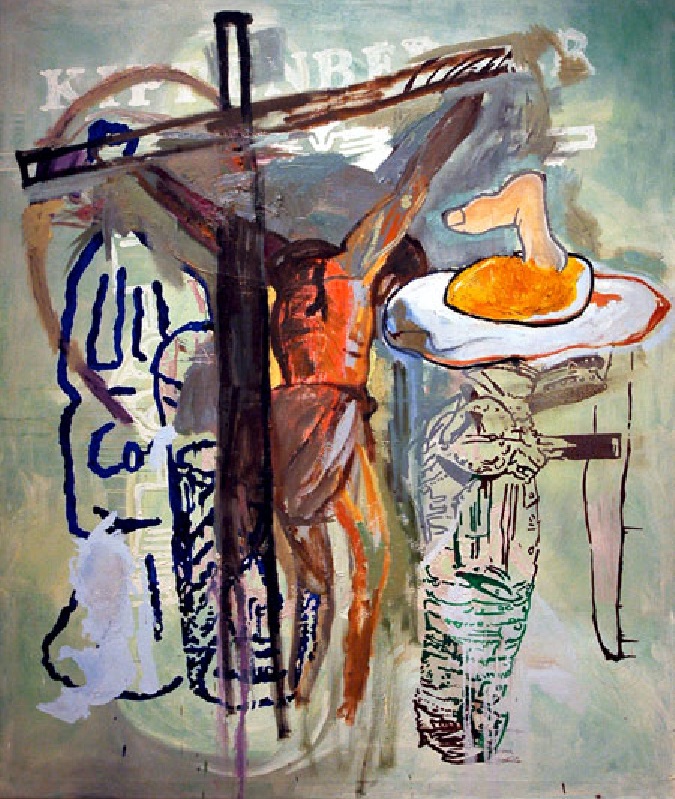
Martin Kippenberger


 Martin Kippenberger (1953 – 1997) was a German artist and sculptor known for his extremely prolific output in a wide range of styles and media, superfiction as well as his provocative, jocular and hard-drinking public persona.
Kippenberger was "widely regarded as one of the most talented German artists of his generation," according to Roberta Smith of the New York Times. He was at the center of a generation of German enfants terribles including Albert Oehlen, Markus Oehlen, Werner Büttner, Georg Herold, Dieter Göls, and Günther Förg.
Martin Kippenberger was one of the most influential German artists of his generation. Emerging alongside Albert Oehlen and Günther Förg, Kippenberger’s work often featured caustic commentary on the art world and reactionary takes on iconic art-historical tropes. “My style is where you see the individual and where a personality is communicated through actions, decisions, single objects and facts, where the whole draws together to form a history,”
Kippenberger’s refusal to adopt a specific style and medium in which to disseminate his images resulted in an extremely prolific and varied oeuvre which includes an amalgam of sculpture, paintings, works on paper, photographs, installations, prints and ephemera.


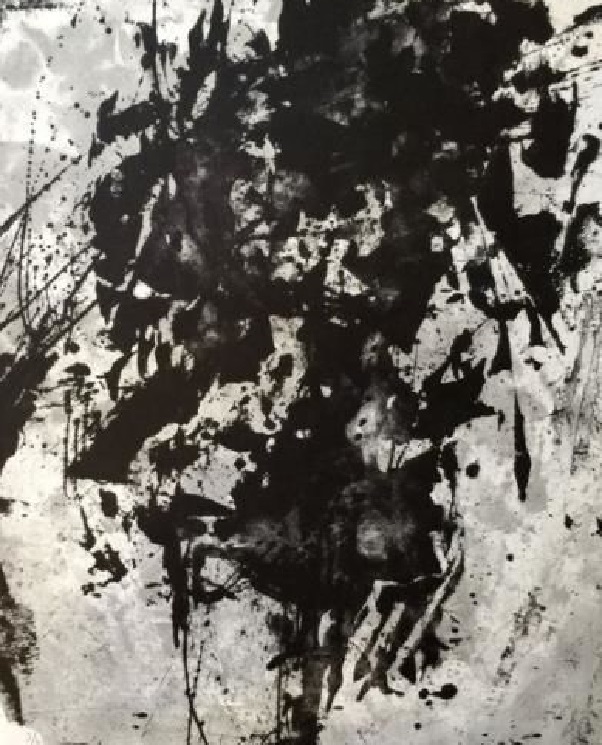
Fred Thieler - European Abstract Art - Art Informel & Abstract Expressionism Painting


"Born Fritz Wilhelm Richard Thieler on March 7, 1916 in Konigsberg, East Prussia, the artist was drafted by the German army in 1939, assisting the invasions of Poland and France. Upon learning of his Jewish heritage, the Nazis released the artist from military service and he instead contributed to the underground resistance in Munich. After World War II, Thieler received formal training at the Academy of Fine Arts in Munich, where he became a member of the Zen 49 group of abstract painters, working alongside artists Fritz Winter, Willi Baumeister, and Rupprecht Geiger."(artnet.com)
"To be a painter means to me to lead the existence of a contemporary,
who spends the bulk of his life trying to the impulses of his life:
suggestions like depression, Intuitions like calculating considerations,
To show reactions of single experiences like creating adventure chains -or win in the painting process. "
Fred Thieler was a German painter known for his engagement with Art Informel styles of painting, including lyrical and expressive abstraction. The artist’s paintings showcased the fluidity of the medium through long, dramatic brushstrokes and watery splashes of pigment , creating a sense of movement across the canvas.


https://milenaolesinska.blogspot.com/p/blog-page_50.html