Exposition Art Blog: Israeli artist
Showing posts with label Israeli artist. Show all posts

Uri Lifschitz - Israeli Contemporary Art


Uri Lifschitz ( 1936 – 2011) was an Israeli painter.
Uri Lifschitz was born on Kibbutz Givat HaShlosha. He served in the Israel Defense Forces paratrooper Unit 101 under Ariel Sharon. He began painting in the 1950s. In the 1960s and 1970s he was one of the founders of the 10 Plus group which posed an alternative to the lyrical abstract style of the New Horizons movement.
 "His artistic oeuvre marks aparting with the lyrical abstract, with painting which turns to the collective, toward figurative, personal painting. In this sense he is close to other artists born in the 1930s, such as Moshe Gershuni and Igael Tumarkin.His best-known series include The Schizophrenics—one of the most beautiful series ever created in Israeli painting, whose free, wild expression,which nevertheless struggles for its cohesion, epitomizes the unity of language and content.."(gordongallery)


https://milenaolesinska.blogspot.com/p/blog-page_50.html

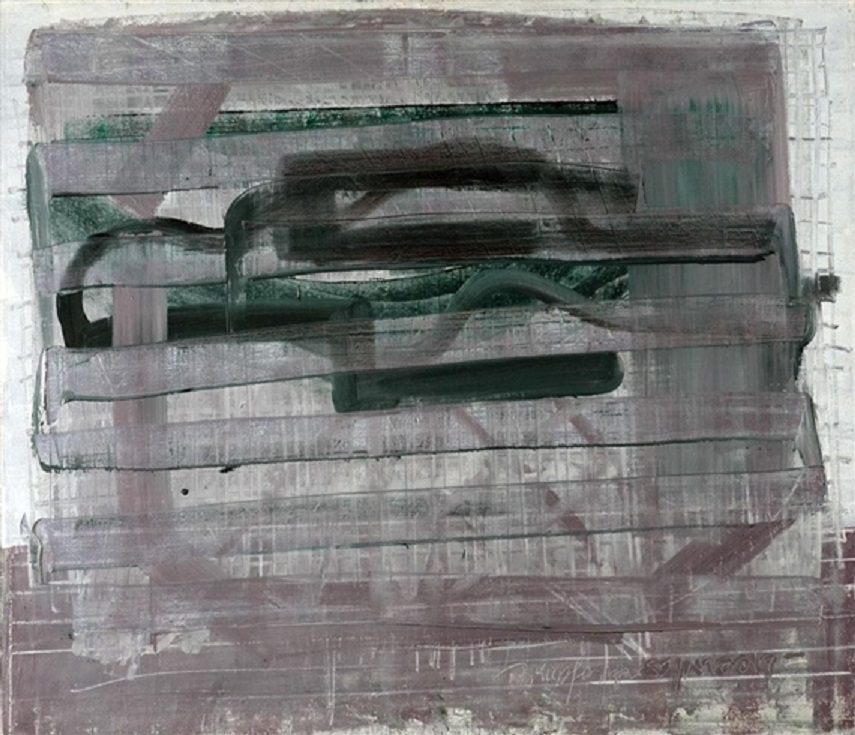
Moshe Kupferman - Introspections

Moshe Kupferman (1926-2003) was an Israeli artist. .Moshe Kupferman was born on 12 August 1926 in Jarosław, Poland. In 1941, he was exiled with his family to camps in the Urals and in Germany.Moshe Kupferman's work links recent lyric abstraction to the modernistic. It is the result of a process beginning with free, uncritical expression bordering on personal confession, and continuing with critical painting, in which the artist "erases" his "confession". The final result testifies to the preceding stages, and to the inherent conflicts in his work, between expressive drama and introspection, form and atmosphere, destruction and construction. The contradictions he succeeded in integrating in his work placed Kupferman in the front ranks of Israeli art.Moshe Kupferman died on 20 June 2003 in Israel, in the Lohamei HaGeta'ot – kibbutz, which he had founded and where he lived and worked as artist for many years. Wikipedia


Genia Berger - Ceramics and Painting

Genia Berger (1907–2000) was an Israeli artist, born in the Russian Empire. Genia Berger was born in Kharkov in 1907, modern day Ukraine, to a traditional and zionist family.In 1925 she moved to Germany, where she studied art. In 1926 she immigrated to Palestine and began to simultaneously study architecture at the Technion Montefiore and painting in Yitchak Frankel's studio in Tel Aviv. In the end of 1929, she returned to Berlin, where she began to study painting and set design at the Academy of Fine Arts. In 1933, she returned to Palestine and began to make a living by designing stage sets. From 1935 to 1937 she resided in Paris, France. In 1953 she became one of the founders of the artists' village of Ein Hod in Northern Israel.
Berger's early work, influenced by French art, was in the post-impressionist painting style. Nonetheless, between the ages of 40 and 60, she focused mainly on theater set design for theater and the opera theater in Israel. Her designs were influenced considerably by Russian Modernist decorative art. Her works include set design for "The King Solomon and the Cobbler" (Ohel Theater, 1943), "Bar Kokhba" (Ohel Theater, 1945), "Khovanshchina" (Israel National Opera, 1952), "Kazmirov Brothers" (Habima, 1956) and more. In the 1950s, Berger returned to painting and began sculpting and creating ceramic reliefs. Her works are characterized by a decorative aspect.Wikipedia


Yechiel Shemi - Abstract Painting and Sculpture

Yechiel Shemi ‎(1922-2003) was an Israeli sculptor. His environmental sculptures are displayed in open spaces around the country.In 1959-1961, Yechiel Shemi studied art in Paris. In 1977-1979, he taught sculpting and lectured on environmental sculpture at Oranim Teachers College. He also taught at the Technion in Haifa and the Ein Hod artist's colony. Shemi was a member of New Horizons group.After a show in the United States in the 1960s, the Museum of Modern Art acquired his work. Shemi was the first Israeli artist to have his work purchased by the MoMa.Shemi won the Sandberg Prize in 1981 and the Israel Prize for sculpture in 1986. In 1966 and 1997, the Tel Aviv Museum of Art mounted exhibitions of his work
In 1962 Shemi began to create expressive works. The raw material used in these sculpture was mostly scrap metal. During the 1960s Yehiel Shemi introduced his assemblage sculpture in the solo exhibitions at Centre for Fine Arts, Brussels in 1964. Yehiel Shemi had additional solo exhibitions at the Tel Aviv Museum of Art in 1966 and at the Israel Museum in 1967. Shemi also created at this time two large public statues. In 1966 Shemi moved to Kibbutz Gadot for a half year.
In the late 1960s and throughout the 1970s Shemi changed the technique used in his sculptures. Instead of using ready-made objects, he reduced his art to geometric shapes. In 1981 Shemi was awarded the Sandberg Prize from the Israel Museum. In 1986, the Israel Prize for sculpture, together with Batya Lishansky. In 1988 Adam Baruch published the book "Yehiel Shemi: Sculptures" and a solo exhibit was help in the Ramat Gan Museum of Art.Wikipedia