Exposition Art Blog: Abstract Sculptures
Showing posts with label Abstract Sculptures. Show all posts

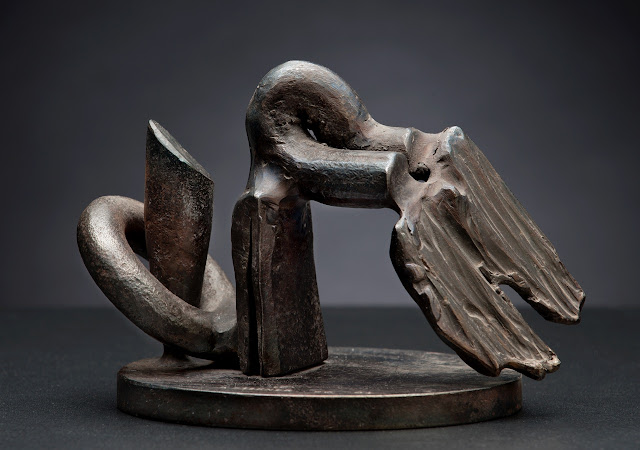
Dimitri Hadzi - Abstract Sculpture


Dimitri Hadzi (1921 – 2006) was an American abstract sculptor who lived and worked in Cambridge, Massachusetts, and also taught at Harvard University for over a decade.Hadzi was born to Greek-American immigrant parents in Greenwich Village, New York City on March 21, 1921. As a child, he attended a Greek after-school program, where he learned language, mythology, history, and theater. He also won a prize for drawing. After graduating from Brooklyn Technical High School, he worked as a chemist, while continuing his studies in chemistry by night.In 1942, he signed up for the Army Air Force, serving in the South Pacific region while continuing to draw in his spare time. After his service, he returned to New York to study painting and sculpture at Cooper Union.Hadzi taught studio arts at Harvard University, from 1975 to 1989.Wikipedia


Karl Stirner - Abstract Metal Sculptures


Karl Stirner (November 14, 1923 – February 18, 2016) American sculptor known internationally for his metalwork
"Karl Stirner brings new life to metal that has been discarded, whether from Bethlehem Steel, shipwrecks, or from his favorite scrapyard. He fuses natural materials with manmade, and juxtaposes smooth surfaces with rough and pitted ones to form organic shapes. Stirner creates a drama of contradiction, playing thick against thin, flexible against inflexible.
The German-born Stirner, who grew up in Philadelphia, was fascinated by frogs, birds, insects, crystals and shells. Watching his father work as a fine jeweler got him interested in metal, and he started his art career at age 23. An industrial designer who served in World War II, Stirner held teaching positions at Tyler School of Art at Temple University and at Moore and Swarthmore colleges, although he himself is self-taught. He operated a metal arts studio, designing and making contemporary metal furniture and ecclesiastical items, such as lighting fixtures, altar railings, architectural sculpture, ornamental panels, screens, and lamps."(karlstirner.com)
Much of Karl Stirner's work is considered to embody an abstract style. Stirner used his metalwork and steel sculptures to translate and express many of his inner feelings and thoughts. Stirner's sculptures typically fall into two subcategories of the abstract: expressionism and constructivist. His expressionist sculptures have been described as "anxiety-ridden" while his constructivist sculptures have been described as "depressive". This is because they appear to elicit depressive emotions and feelings of internal conflict. The "dream-like" aspect of his work is supposedly inspired by Stirner's unconscious state. 


Richard Stankiewicz- Abstract Sculptures

Richard Stankiewicz (1922–1983) was an American sculptor, known for his work in scrap metal.Stankiewicz was born in Philadelphia, but spent his formative years in Detroit. He began painting and sculpting while in the United States Navy, in which he served from 1941 until 1947.
"Originally trained in engineering, Stankiewicz established his reputation in the 1950s as a master of witty junk assemblages. By 1969, however, he was using newly fabricated industrial elements such as cylinders and I-beams to fashion comparatively restrained abstractions. Australia No. 9, 1969, another work by Stankiewicz in Storm King’s collection, marks this turning point in his career. The sculpture is a result of a three-month visit to Australia, during which he had an opportunity to create work in a steel plant in Sydney. The experience provided Stankiewicz with an understanding of industrial steel manufacturing and new welding techniques, which profoundly impacted his practice. The artistic process was paramount for Stankiewicz, who once commented, “It isn’t the thing; it’s making the thing. Because in making the thing you are making yourself, and after you have made it you are a little bit changed and that’s the product, and the thing, it can go into the world.”(stormking.org)