Exposition Art Blog: expressive painting
Showing posts with label expressive painting. Show all posts

Alejandro Jesus Obregon


Alejandro Obregon (1920 - 1992), Colombian artist. Born in Barcelona, Spain, Obregón always considered himself self-taught although he studied art in England, the United States, and France. His career was difficult at its inception because of his inability to master pictorial techniques. In 1943 he had his first solo show and launched his career. He developed special symbols—like the falcon and colorful flowers—to depict the Colombian landscape and its inhabitants. His figures are painted in large and strong brush strokes.
A geometrical and rational Obregon with constructivist tendencies developed between 1947 and 1959, when another more expressionistic and irrational Obregon evolved. With undoubted daring, the artist has since combined emotion with dynamic equilibrium in his figures, radically changing the habitual Colombian colors of blacks and greys to his vivid tones.
But it was the condors and the bull-condors, like that of 1961, which would doubtlessly reign over the artist’s new universe. Obregón had seen his first condor in a cage at the National University. “He looked like a Jesuit priest, all covered with brilliant black and with a white collar.” He patted the bird’s head and then pulled out a tail feather, receiving several pecks that left a scar Obregon still has. At least 40 condors have been painted by the artist, and they placed Obregon at the head of Colombian art, making the 60s his decade.Critic Marta Traba identified a series of characteristic elements in Obregon's work: personal poetic values; self-sufficiency in regard to reality, indeed starting from it; expressive intention; freedom of form; search for identity based on the landscape, zoology, and flora; elliptic space people by magic elements; and contempt for urban culture.Also unique to Obregon is that instead of faithfully painting what he sees, he made extensive use of his personal imagination and vitality.From his still lifes of the 1950s to his landscapes of the sky, the sea and the buildings of Cartagena de Indias, where he worked until his death, Obregón's work is multifaceted. He conveys his feeling for the geography and wildlife of Colombia, his love of family and his passion for women. His subjects remind the viewer of loyalty, friendship, memory and ultimately of the wonder of life, however insignificant it may seem in terms of the cosmos. 


Carlos Almaraz


Carlos Almaraz (October 5, 1941 – December 11, 1989) was a Mexican-American artist and an early proponent of the Chicano street arts movement.
"Almaraz was born in 1941 in Mexico City, but his parents quickly moved … first to Chicago, then to East LA in 1950. His experience of these widely differing environments probably inflected his vision of the world. He attended Garfield High, went on to CalState LA, Loyola, and Otis; tried to make it in the New York art scene for five years; then returned to LA in 1970. In between New York and East Los was a brief visit to Mexico to learn about its art, to explore what he increasingly saw as his Chicano heritage. ..His technique ranges from the literally figurative to almost abstract blurs and splatters, sometimes all in the same painting. There is a sense of layered meaning, and an immensely singular use of color, but his figures are usually representative and even sensual.His new fascination appeared to be with ideas based on world myths, transplanted into his own personal LA, whose nocturnal Echo Park flaunted purple lagoons with peaked bridges and small craft like paper boats, whose bright lit skyscrapers sway in a giant, concrete cumbia …
Where prim little Eastside bungalows can offer the solace of home and hearth or can just as easily burst into fiery explosion … Where terrifying car crashes offer all the colors of a garden in springtime… Where stag-headed buck-dancers flit through twilight landscapes of drifting symbols…
Where sinister magicians hold forth on mystic stages… All in a gathering darkness that seems increasingly to enfold his work until his tragic death by AIDS in 1989..."(.scpr.org )


Abstract painting Gilda Snowden

Gilda Snowden (1954 - 2014)was an African-American artist, educator and mentor from Detroit, Michigan.Snowden was born in Detroit in 1954. She attended Cass Technical High School with a focus on fashion design. Between 1972-1979 Snowden earned her earned her BFA in Advertising Design and Painting, MA in Painting, and MFA in Painting from Wayne State University. In 1985 she became a professor in Department of Fine Arts at the College for Creative Studies, Detroit. She was also gallery director of the Detroit Repertory Theatre prior to her death in 2014
Gilda Snowden's works are predominately abstracts that utilize vivid color. The city of Detroit sparked several bodies of work. Her Flora Urbana series features abstracted floral forms, in encaustic, inspired by the gardens now tended by Detroit citizens on plots where buildings once stood. City Album: Department of Railways 1929 is an example from a series of charcoal rubbings she made of the Detroit manhole covers she discovered riding though the city on her bicycle.
Snowden describes all of her works as autobiographical including an extensive series Self-Portrait of over one hundred self-portraits of the back of her head and shoulders. She has cited her experience of race, gender and fears she felt as a child as the inspiration for this series. She began again with the series after growing her hair out in the 2000s and using computer projections to help create her pieces. Monument [1988], found at the Detroit Institute of Arts, as "a chronicle of my family on their travels from Alabama to Detroit. We are all looking for something, all traveling from here to there."Wikipedia


Theo Tobiasse

" Theo was born in Israel of Lithuanian parents. Before he turned seven, his family moved to Paris due to financial difficulties. In Paris, Theo felt like a fish out of water. He didn't quite fit in.Between the years of 1942 and 1944, the Germans occupied Paris . He and his family were forced to live in solitary confinement with the constant fear of being discovered. The only things that kept Theo sane were his books and his drawings. By the time it was safe to come out of hiding, he had quite a portfolio put together.
He attributes his works to his real life experiences. He believes that because of these experiences, he has reached a place of perfect contentment and harmony. This is apparent in his works through the use of colors and textures.
In 1950 Theo moved to Nice where he continued to paint. He had his first
exhibition at the Palais de le Mediterranee in 1961 where he also won the grand prize. This helped him to make the decision to quit his other career and devote his time entirely to art.


 In 1960, his work was noticed at an exhibition of young artists at the Palais de la Mediterranee in Nice and he won first prize. From then on art galleries and collectors continued to show interest in his work and by 1962 Theo Tobiasse was finally able to devote himself entirely to painting. In 1970, he moved into his studio on Quai Rauba-Capeu, overlooking the Port of Nice. In 1976 he moved again to St. Paul-de-Vence where he rediscovered both the sky of Jerusalem and that of Florence. It was in Nice, the city he had adopted on leaving Paris, that his pictorial expression came into its own. Initially profane and close to certain bestiaries, his subjects rapidly evolved towards reminiscences about his childhood: buses that he had caught sight of on his journey to France, boats with wheels on the Nieman in Lithuania, tea kettles, the warmth of the fireside, the trains when he arrived in Paris at dawn, the smokiness of railway stations, etc. All of these symbols were combined, quite extraordinarily, with Biblical or erotic fantasies and also with the theme of exile which had become his main interest over the previous few years. Often visible in his more recent work, the theme of exile took on a more dramatic dimension when it began to encompass not only past and present exiles, but the fear of exiles still to come. This background subject, currently his main preoccupation, is woven out of women, children, crowds, but also candelabra, which represent the glow of hope.


 Since 1980, Theo Tobiasse has travelled a great deal in the United States. On a detour, via Mexico, he discovered the impressive Aztec sites of the Yucatan, whose sculptures and engraved stones left their mark on him for a certain period. Fascinated by New York, he decided to find a place where he could work for several months every year. Thus, he now divides his time between St. Paul-de-Vence and New York. Many exhibitions and one-man shows have been held throughout the world, providing milestones for his work that is to be found in the catalogues of many International museums. Theo Tobiasse has created monumental works such as the fountain entitled "L'Enfant fou" for the Arenas Business Centre at Nice Airport, and stained-glass windows for various institutions in Strasbourg and Nice. He also designed costumes and stage-set models for Bernard Shaw's "Pygmalion". He has filled many sketchbooks, some of which have been published, and created illustrated works for lovers of fine books, plus etchings and engravings. Theo Tobiasse also discovered a passion for ceramics, producing pottery and dishes, as well as a series of small bronze sculptures. Several monographs have been published on Theo Tobiasse's work.His works have been on exhibition throughout the western world and Japan.Tobiasse has also worked in etching, lithography and many more mediums."( rogallery.com/Tobiasse )


Renato Guttuso

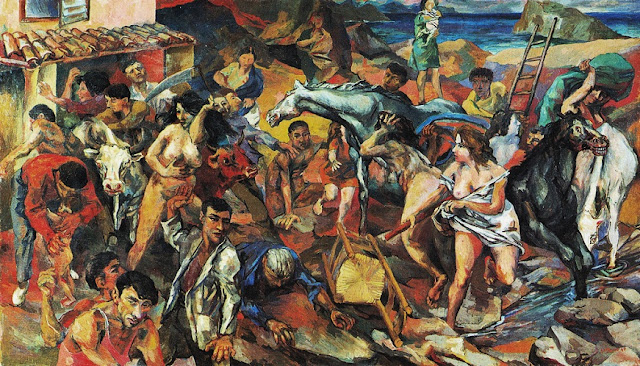
Renato Guttuso (26 December 1912 – 18 January 1987) was an Italian painter. His best-known works include Flight from Etna (1938–39), Crucifixion (1941) and La Vucciria (1974). Guttuso also designed for the theatre (including sets and costumes for Histoire du Soldat, Rome, 1940) and did illustrations for books. Those for Elizabeth David’s Italian Food (1954),introduced him to many in the English-speaking world. A fierce anti-Fascist, "he developed out of Expressionism and the harsh light of his native land to paint landscapes and social commentary."


 In 1950, Guttuso joined the project of the Verzocchi collection (in the civic Pinacoteca of Forlì), sending, a self-portrait, and the work "Sicilian labourer". He succeeded in astonishing his audience, alternating between the luminous and full vision of colour of "Bagheria on the Gulf of Palermo" to the "Battle of the Bridge of the Admiral", in which he depicted his grandfather Ciro as a Garibaldine soldier. He painted also a series from live about the fights of peasants for the occupation of lands, the zolfatari, or glimpses of landscape between cactus and prickly pears, as well as portraits of men of culture like Nino Garajo and Bruno Caruso.


 Fascinated by Dante's model, in 1961 he made a series of colour drawings, published in 1970, as Il Dante di Guttuso, depicting the characters of Hell as examples of human history, confirming the versatility of his talent. In the late 1960s and 1970s he completed a suite of paintings devoted to the feminine figure, a motif that became as dominant in his painting as it was in his life: "Donne stanze paesaggi, oggetti" (1967) was followed by a series of portraits of Marta Marzotto, his preferred muse of many years. His most famous "palermitano" painting is the "Vucciria" (the name of Palermo's market), in which, with raw and bloody realism, he expressed one of the many spirits of the Sicilian city.


Mimise Dotti-Guttuso died on 6 October 1986. Guttuso was soon to follow his wife. He died in Rome of lung cancer at the age of 75 on 18 January 1987. On his deathbed, he allegedly embraced again the Christian faith with which he had been critical. However, there are doubts as to what really happened — in his last months, when he was bedridden, a circle of politicians and priests excluded his oldest friends from his villa. He donated many of his works to his hometown Bagheria, which are now housed in the museum of the Villa Cattolica.Wikipedia