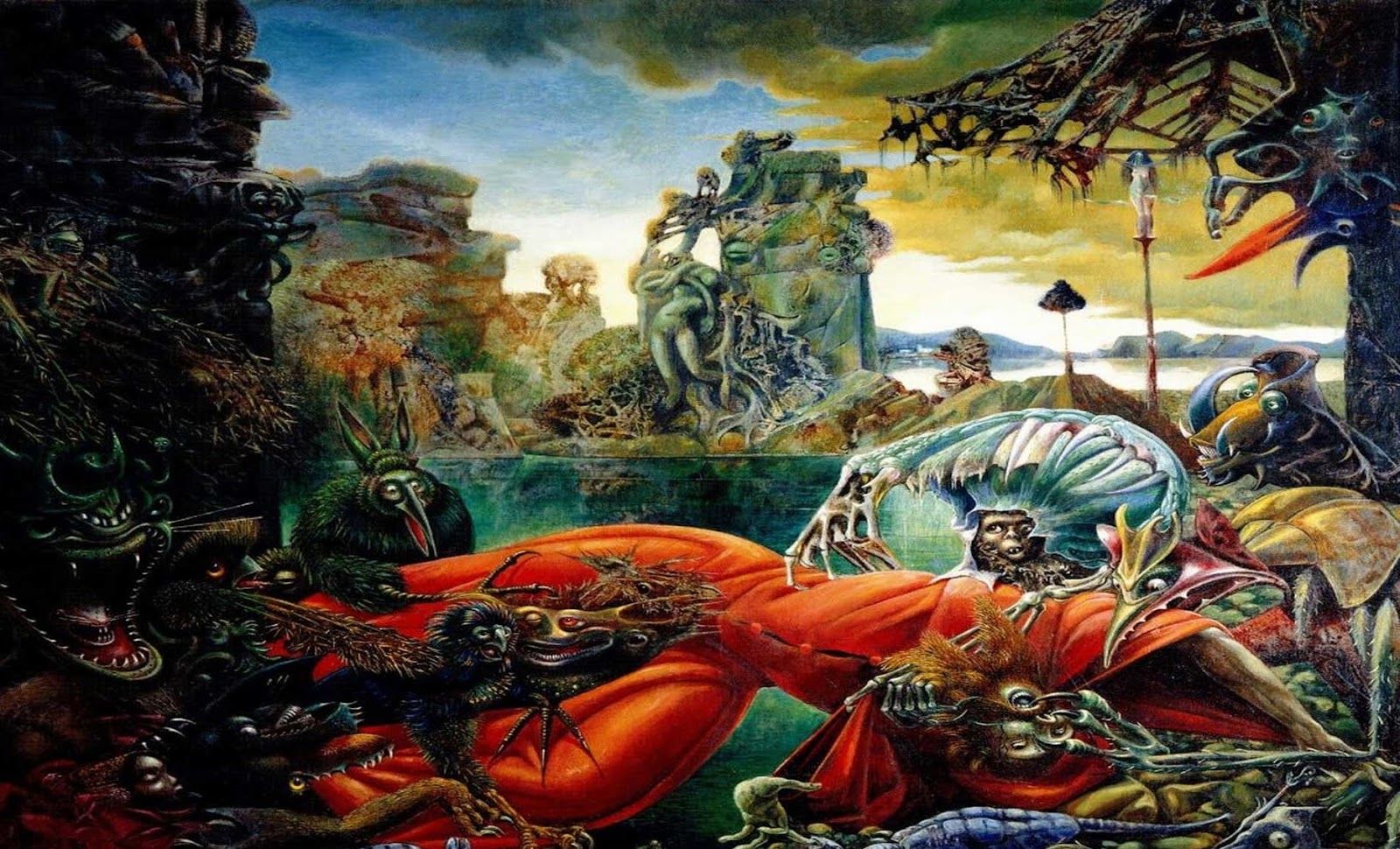
Max Ernst (1891 –1976) was a German painter, sculptor, graphic artist, and poet. A prolific artist, Ernst was a primary pioneer of the Dada movement and surrealism. He had no formal artistic training, but his experimental attitude toward the making of art resulted in his invention of frottage—a technique that uses pencil rubbings of objects as a source of images—and grattage, an analogous technique in which paint is scraped across canvas to reveal the imprints of the objects placed beneath. He is also noted for his novels consisting of collages.
"Ernst is most closely associated with Surrealism, an artistic and literary movement in Paris in the 1920s that prized the irrational and the unconscious over order and reason. A key contribution to this movement was his invention of frottage, a technique of placing paper over a textured material, such as wood grain or metal mesh, and rubbing it with a pencil or crayon to achieve various effects. The Surrealists prized this practice—which produced compositions like Forest and Sun—for both the serendipity of the resulting imagery and the passivity it encouraged, bypassing the constraints of the artist’s rational mind. Having little control over the resulting patterns, Ernst marveled that he “came to assist as spectator at the birth of all my works.”1 Eventually, he translated the method from paper to painting, using the word grattage to describe this technique of scraping wet paint off of the canvas to achieve similar patterned effects.
The fragmented logic of collage, which Ernst referred to as “the culture of systematic displacement,” persists in his paintings, whose subjects are disjointed even if their surfaces are smooth. In these foreboding dreamscapes, headless bodies and body-less hands appear incongruously amid lush forests or on deserted beaches. In the years leading up to World War II, and during his time as an émigré to the United States from 1941 to 1953, Ernst made work that once again reflected the menacing atmosphere of war."(www.moma.org)