Exposition Art Blog: abstract sculptor
Showing posts with label abstract sculptor. Show all posts

Isaac Witkin - New Generation of sculptors - Abstract Sculptures


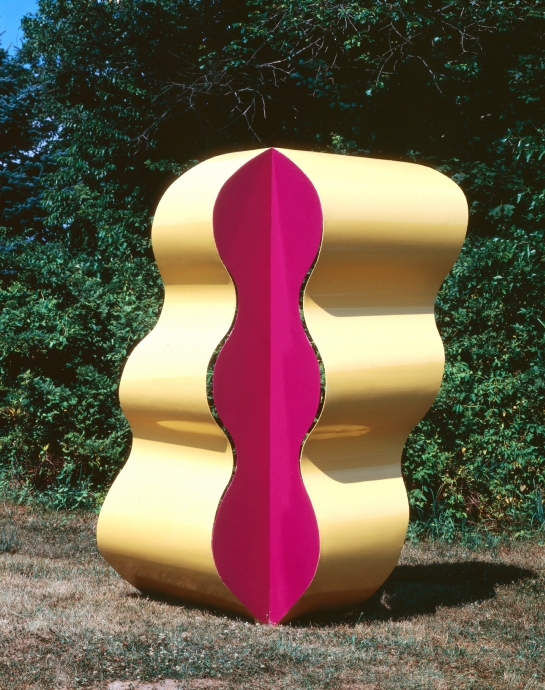
Isaac Witkin internationally renowned modern sculptor, was born in Johannesburg, South Africa on 10 May 1936, and he died 23 April 2006. Witkin entered Saint Martin's School of Art in London in 1957. Studying under Sir Anthony Caro and alongside other luminaries in training such as Phillip King, William G. Tucker, David Annesley and Michael Bolus, Witkin learned and helped create a new style of sculpture that led to their being called the New Generation of sculptors when their innovating abstract forms of modern sculpture reached and changed the art world. Witkin's work, abstract works of usually brightly colored fiberglass or wood, in particular was noted for its "witty, Pop-Art look".
"Isaac Witkin rejected the idea that the human figure is necessary to sculpture, and instead explored abstraction in his work. The sculpture consists of welded steel plates painted bright orange. Each plate has an irregular geometric shape, some straight and rigid and others elegantly curved. The sheets slice into one another, delicately balancing on precise contact points. Their sharp edges pierce the space around them, as if Witkin is not only carving the sculpture but also carving air. The overlapped and stacked forms allow for a constantly changing play of light and shadow, assuming different configurations based on the viewing angle. Witkin had a consistent interest in how the scale of a sculpture can be determined by its relationship to the human body. He once stated that “I aim to establish a freedom to move in multiaxial space in a way that draws the spectator in and around the sculpture to experience different aspects of an evolving dynamic.”




https://milenaolesinska.blogspot.com/p/blog-page_50.html

Giuseppe Spagnulo - Abstract Sculpture


Giuseppe Spagnulo (28 December 1936 – 15 June 2016) was an Italian sculptor.
Spagnulo was born in Grottaglie, Taranto. At young age he learned to work on the lathe in his father's ceramic workshop. Between 1952 and 1958 he studied at the Faenza Art Institute for Ceramics and then he moved to Milan, where he enrolled at the Brera Academy and worked as an assistant for Arnaldo Pomodoro and Lucio Fontana.In the late 1960s, Spagnulo started working on his first sculptures, including the corten steel installation "Black Panther" (1968-1969), which was exhibited at the 1972 Venice Biennale. In 1976 he was at the Venice Biennale again, this time with a solo presentation, and in 1977 he was invited to Documenta in Kassel.Spagnulo's sculptural style is characterized by the massive dimensions of his sculptures, often made of iron and whose subjects are generally abstract and tend to conceptualism. In the 1990s he started focusing on other materials, such as terracotta and steel.Wikipedia


Abstract Sculpture David Hayes

David Hayes (March 15, 1931 – April 9, 2013) was an American sculptor.
Hayes received a Bachelor of Arts degree from the University of Notre Dame in 1953, and a M.F.A. degree from Indiana University in 1955 where he studied with David Smith.Smith pioneered sculpture in metal and Hayes also made his sculpture using metal, formed in graceful curves, shapes abstracted from sketches of objects and ideas.He received a post-doctoral Fulbright Award and a Guggenheim Fellowship. He was a recipient of the Logan Medal of the Arts for Sculpture and an award from the National Institute of Arts and Letters. During his life, he had 300 exhibitions and his work is included in 100 institutional collections including those of the Museum of Modern Art and the Guggenheim Museum in New York City.In 2007, he was conferred an honorary Doctor of Humane Letters degree by Albertus Magnus College.Hayes resided in Coventry, Connecticut since 1958, where he had 57 acres of land to exhibit his works. He died of leukemia at his home there on April 9, 2013. He was 82.Wikipedia


Craig Kauffman

Craig Kauffman (March 31, 1932 – May 9, 2010) was an artist who has exhibited since 1951. Kauffman’s primarily abstract paintings and wall relief sculptures are included in over 20 museum collections, including the Museum of Modern Art, the Whitney Museum of American Art, the Tate Modern, the Louisiana Museum of Modern Art, the Art Institute of Chicago, the Los Angeles County Museum of Art, Seattle Art Museum, and the Museum of Contemporary Art, Los Angeles.
Kauffman first exhibited at the Felix Landau Gallery in Los Angeles, and was included in other Los Angeles group exhibits during the early 1950s. He was a member of the original group of artists at the Ferus Gallery (founded in 1957 by Edward Kienholz and Walter Hopps), and had a one-person show at that gallery in 1958. According to critic and historian Peter Plagens, the 1958 paintings were:
   …Abstract Expressionist but contain the first evidence of a Los Angeles sensibility: Tell Tale Heart (1958) is structured superficially along the lines of a second-generation New York painting, but it reveals the original stem-and-bulb shapes that Kauffman was later to translate into Plexiglas. The ‘clean’ Abstract Expressionist work of Craig Kauffman could be the point at which Los Angeles art decided to live on its own life-terms, instead of those handed down from Paris, New York, or even San Francisco.In several series of wall relief sculptures made between 1964 and 1970, Kauffman pioneered the use of acrylic plastic as a support for painting. Craig Kauffman’s wall relief sculptures are his most well known work. Throughout his career, Kauffman has explored the use of unorthodox materials. Art historian Susan C. Larsen notes: Kauffman’s work has maintained its radiant color and its emphasis on certain sensuous physical properties of his materials.
Through his integration of sprayed color and shape, Kauffman achieved the visual presence of his vacuum formed acrylic wall reliefs. Works from the late 1960s have been described by former Whitney museum curator Richard Armstrong as:
Glossy and symmetrical, the work’s visually wet surface engenders anatomical, sometimes overtly sexual, comparisons.Curators and historians now regard Kauffman’s works from the late 1960s in relation to the art movement known as Minimalism. Susan L. Jenkins wrote:…his works, as well as others associated with the L.A. Look, can nevertheless be thought of as possessing a relatively Minimalist sensibility. Like Judd’s ‘specific objects’, Kauffman’s vacuum-formed plastic works exist in a space between painting and sculpture.Wikipedia