Exposition Art Blog: Europen art
Showing posts with label Europen art. Show all posts

Paolo Salvati - Artworks


Paolo Salvati (1939 - 2014 ) was an Italian painter.
Paolo Salvati was born in Rome on February 22, 1939, in a house on Via Labicana. Expressionist painter, from 1967 exhibited a series of works in oil on canvas throughout cities in Sardinia such as Cagliari, Oristano, Bosa, Ghilarza, Paulilatino until 1969. Since 1970 he participated in exhibitions of plastic and figurative art in the church Trinità dei Monti and in Galleria Colonna renamed Galleria Alberto Sordi in Rome.
In the 1990 he won first prizes in different editions of paint-off: in December 1996 he received the prize Artitalia at the Exhibition of Contemporary Art in Galleria l’Agostiniana in Rome...Wikipedia


https://milenaolesinska.blogspot.com/p/blog-page_50.html

Pop Art - Kiki Kogelnik

Kiki Kogelnik (1935–1997) was an Austrian painter, sculptor and printmaker. Born in southern Austria, she studied at the Vienna Academy of Fine Arts and moved to New York City in 1961. Kogelnik is considered Austria’s most important pop-related artist, despite having been known to take issue with being considered part of the pop art movement.Kogelnik began her career at the Galerie Nächst St. Stephan in Vienna in 1961, showing abstract works. At the time she was influenced by Serge Poliakoff of the École de Paris, but later found her own unique genre while surrounded by the pop art movement in New York. At one point she was engaged to Austrian abstract expressionist artist Arnulf Rainer.Kogelnik was close to another abstract expressionist, the American artist Sam Francis, and spent time with him in 1961 in New York and Santa Monica, California. Kogelnik then moved to New York in 1962 where she joined a close-knit group of artists that included Roy Lichtenstein, Claes Oldenburg, Andy Warhol, Larry Rivers, Tom Wesselmann, Joan Mitchell, Robert Rauschenberg and Jasper Johns, among others. Pop was a way of life, and with Kogelnik extravagant hats and outfits Kogelnik became a captivating happening wherever she went.Her work during that time was strongly influenced by the pop art colors and materials of the time, producing numerous brightly colored euphoric space-themed paintings.
Unlike pop artists, she avoided the celebration of commerce or quotidian objects, although she was known to foreground plastics and the artificial over nature.During the early 1960s Kogelnik began to use life-size cutout paper stencils of her friends to produce her paintings. In 1965 these prototype cut-outs became vinyl hangings, presented on the same clothing racks that she saw pushed down the streets in the vicinity of her studio in New York’s garment district.In the 1970s Kogelnik’s focus shifted to what later became known as her Women works, specifically addressing the female role portrayed in commercial advertising. Broaching feminist issues indirectly with irony, humor and a cool pop aesthetic was unique to Kogelnik’s work during this time. In 1974 she also began to work occasionally with ceramics, employing sculptural form as an extension of painting.
In the 1980s, fragmented people, signs and symbols begin to fill Kogelnik’s work and in her Expansions series she used ceramic modules shown in conjunction with her paintings. She also produced and directed a short 16mm B&W film CBGB in 1978, featuring Jim Carroll and others.In later works, the human body is depicted in increasingly fragmented and manipulated form, until in the 1990s much of her work portrayed highly abstracted yet expressive faces. During this time Kogelnik created a series of glass sculptures, related drawings and prints, in which she sought to comment on decorative and commercial themes in art-making.Wikipedia


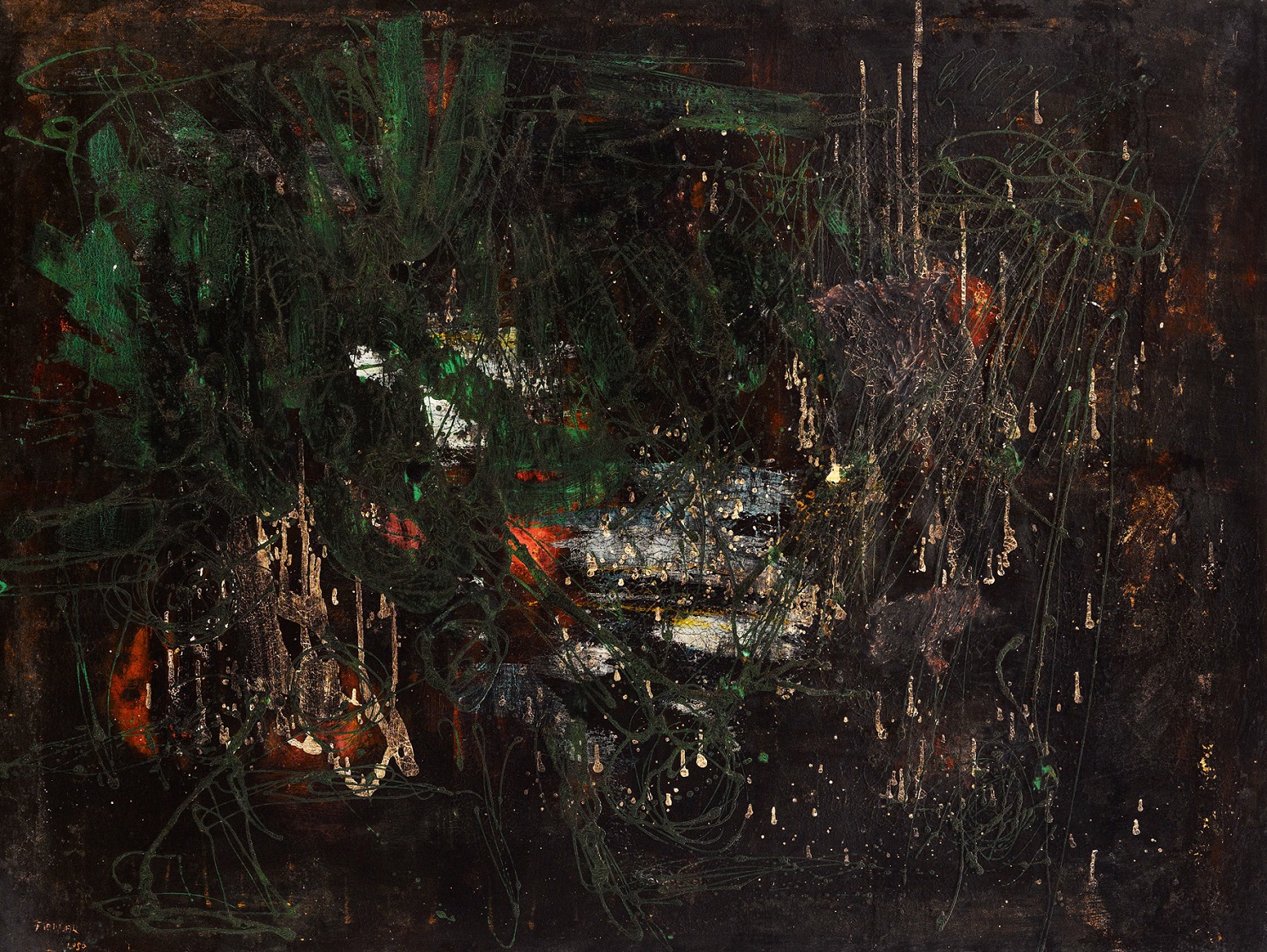
Abstract Expressionism Art Francois Fiedler

Francois Fiedler (Košice, 1921 - Saint-Germain-Laval, Seine-et-Marne, 2001) was a Hungarian-born naturalized French painter
One of the vitally important artists in the Aimé Maeght stable that included Marc Chagall, Giacometti and Joan Miró, was François Fiedler (1921-2001). Fiedler's life and art was chronicled in many books and journals, including Collection de la Fondation Maeght, and several Maeght publications entitled simply Fiedler.
After receiving a Masters in Fine Arts degree from the Academy of Budapest, François Fiedler moved to Paris with his first wife in 1946. His wife died six months later, leaving him alone in a country where he barely spoke the language and had no friends. To make money, he made official copies of famous paintings for museums, as well some small figurative paintings of his own.


 He met his second wife, Claire, and they lived in a little house in the forest south of Paris. One day while looking at a pot of house paint, crackled by the sun and making such beautiful designs, he decided to reproduce this process on canvas. After this he never made any more figurative paintings, finding so many forms of expression in this new technique.The great artist Miró saw one of these in a corner of a little gallery and was amazed by it. He decided to find the artist and so met Fiedler. They became close friends, and Miró presented François to the famous gallery and art dealer Aimé Maeght. Now he was connected with some of the greatest creators of the time, all managed by Aimé Maeght. He became close with Giacometti, Brach, Cesar, Ubac, Tal-Coat, Miró, Chagall, and so many other artists of this era.
During his long career, François was regularly featured in salon shows alongside his contemporaries mentioned above, and his works were a regular feature in the Maeght Foundation publication Derrière le miroir.


 As many young collectors did not have the money to buy an oil painting, he decided to find a way to convey the same feeling and meaning in etchings that he had achieved in oils. He started a series of etchings, some in very limited editions. It was original artwork for an affordable price, which is exactly what Fiedler intended.
Aimé Maeght had told Fiedler that he was "next in line" to be made famous, but sadly Aimé died before François could reach the level of notoriety that some of his fellow artist friends had achieved. After Aimé's passing, Fiedler was taken under the wing of well known Parisian (via Lausanne, Switzerland) art photographer Daniel Kramer. Kramer continued to support Fiedler with paint and canvases, while also wearing the hats of manager, photographer, publicist, and plumber.
When Fiedler died in 2001 he left behind a large and diverse body of work, including scores of oil paintings ranging from .5 meters across to well over 2 meters, monotype prints, and etchings.Wikipedia


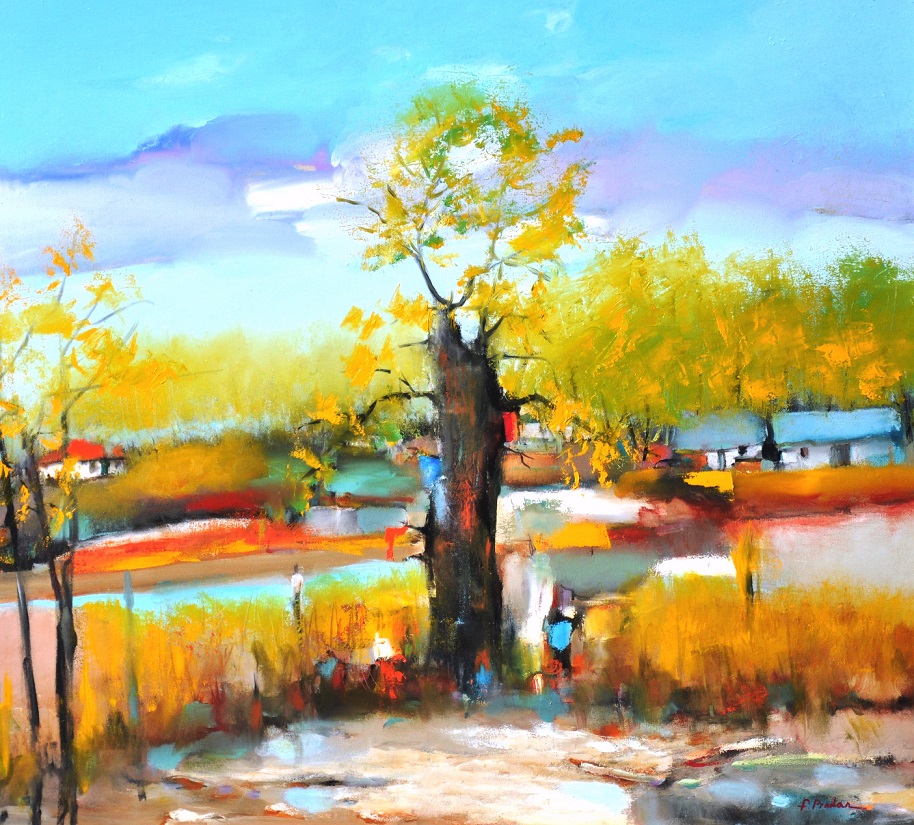
Florin Prodan

Painter – Florin Prodan
Personal details
Date of birth: November 4th 1962
Place of birth: Hlipiceni, Botosani, ROMANIA
Professional details
Graduated I.P. Iasi.
Studied free art.
Member of Plastic Artists Union – President of Botosani branch
Founding member of “Stefan Luchian” Foundation

***

 Feeling – Colour - Wit in Florin Prodan’s painting
 
From the engineering field he took information about perspective, the sense of proportion, volumetric units and he was taught the lesson about colour, as any plastic artist, from the succession of seasons, reason for which he called one of his exhibitions as “Seasons”.
The painter has around 30 personal exhibitions and many other group exhibitions in the country, in Bucharest, Iasi, Botosani, Suceava, Piatra Neamt, as well as many works in private collections in the countries like France, England, Germany, Canada, USA, Greece, Italy, China. Among seasons, he focuses more on spring, summer and autumn. Spring for the chlorophyll green which symbolises life in its more active shape and autumn for the polychromic air with symphonic sounds.
 The winter landscapes with snow clouds are the ones that show the silver white of snowflakes, the “milky” and cold atmosphere, how winter enters the “rest” state.
By his works, the painter leads us to the idea that he is the supporter of calm romance of nature. His paintings are dedicated, mainly to nature, it is a plain air painting and the artist is, as Iohannes Iten was saying, of Bauhaus School, an impressive optic. The impressions gathered from the most typical and hidden places of nature, there are not simple sensory experiences, chosen by chance, but they are attentively selected and instrumented from compositional point of view, according to an artistic intuition, connected with the engineer sense of free form – subject to poetic fantasy law.
Therefore, the main source of inspiration represents nature and people with their concerns – it is, we can say, a campestre painting.
His artist eye aimed in nature especially delusions made by the effect of water in relationship with the light (the sun rise, sunset, mornings with crystal clear dew drops and dense fog, the sunset with solar brightness, filtered by the clouds curtain and the effect of evaporation with the water morphology in the wind, especially after the rain). Our of this reason, the artist, by using light with generosity, can be considered, more, a meridian with Tiepolo asymptotic approaches.
The forms of nature elements aimed by the artist are so filled with light that sometimes we have the illusion that we enjoy the presence of diaphane shapes made of coloured light vapours, or photonic clouds.
His landscapes works, where we can always find aquatic shapes of laguna landscape (rivers, ponds, lakes) lead to the illusion of some images from the waters empire. The house seems more a decorative element of nature than a rural civilisation sign, even for an immemorial time.
The flowers paintings, especially in warm colours, combined with floral species in contrasting colours prove the colourist calling as well as the sensitivity and passion for flowers of the author, important knowledge for the symbolist language of flowers.  Flowers are spread in a series that start from the opulence of the sunflower to the delicacy and wild freshness of field flowers, from the intensive red of corn poppies to cornflowers which gradually diminish their colour in the floral mass.
His style is the one of a romantic artist, in impressionist expression with well tempered chromatic and logically developed compositions and the vivacity generated by nature in all its complexity leads us to the idea of renaissance hylozoism subtly transmitted to the visible romanticism of François René Chateaubriand.
Mihai PĂSTRĂGUŞ, arts critic


Ernst Wilhelm Nay

Ernst Wilhelm Nay (1902, Berlin – 1968, Cologne) was a German abstract painter influenced by L'Art Informel.Ernst Wilhelm Nay studied under Karl Hofer at the Berlin Art Academy from 1925 until 1928. His first sources of inspiration resulted from his preoccupation with Ernst Ludwig Kirchner and Henri Matisse as well as Caspar David Friedrich and Nicolas Poussin. Nay's still lifes, portraits and landscapes were widely acclaimed. In 1931 Nay received a nine-months' study bursary to the Villa Massimo in Rome, where he began to paint in the abstract Surrealist manner. On the recommendation of the Lübeck museum director, C.G. Heise, Nay was given a work grant financed by Edvard Munch, which enabled Nay to spend time in Norway and on the Lofoten Islands in 1937. The "Fischer- und Lofotenbilder" represented a first pinnacle of achievement. That same year, however, two of his works were shown in the notorious exhibition of "Degenerate art" and Nay was forbidden to exhibit any longer. He wasn't even allowed to paint nor buy ready made colours.


 Conscripted into the German armed forces in 1940, Nay went with the infantry to France, where a French sculptor placed his studio at Nay's disposal where Nay could paint in secret. In the "Hekatebildern" (1945–48), featuring motifs from myth, legend and poetry, Nay worked through his war and postwar experiences. The "Fugale Bilder" (1949–51) proclaim new beginnings in a fiery palette and entwined forms. In 1950 the Kestner Gesellschaft Hannover mounted a first retrospective of Nay's work. The following year the artist moved to Cologne, where, with the "Rhythmischen Bildern" he took the final step towards entirely non-representational painting. In them he began to use colour purely as figurative values.From 1955 Nay's painted "Scheibenbilder", in which round colour surfaces organize subtle modulations of space and colour. These are developed further in 1963/64 in what are known as the "Augenbilder". A first one-man-show in America at the Kleeman Galleries, New York, in 1955, participation in the 1956 Venice Biennale and the Kassel documenta (1955, 1959 and 1964) are milestones marking Nay's breakthrough on the international art scene.Ernst Wilhelm Nay was awarded important prizes and is represented by work in nearly all major exhibitions of German art in Germany and abroad. The first English-language monograph of Nay's work was published by Ridinghouse in 2012.Wikipedia