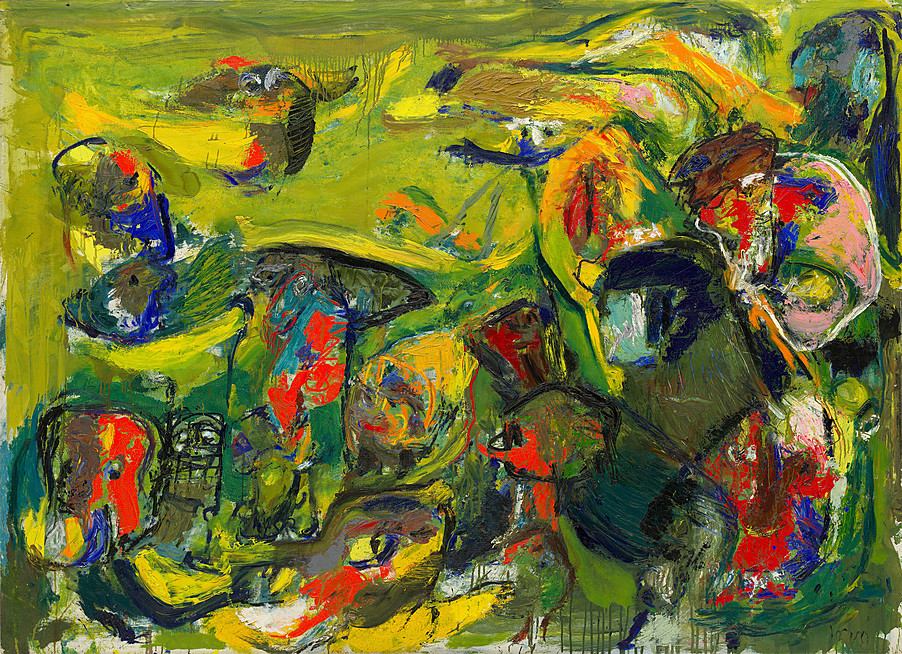
"Asger Jorn was a Danish artist and co-founder of the avant-garde CoBrA group in 1948. He is best known for his paintings, lithographs, and etchings, where he experimented with spontaneous line and semi-figurative representation—two fundamental aspects of the distinctive CoBrA visual language. In one of his best-known series called Défigurations, he overpainted inexpensive 19th century works that he collected at the flea markets, obscuring the classical images with his gestural style. Born on March 3, 1914 in Vejrum, Denmark, he studied at the Royal Danish Academy of Fine Arts in Copenhagen from 1937 to 1942, where he was influenced abstract art and critical thought. One of Jorn’s other major contributions came after he and his friend, the artist Guy Debord, founded the Situationist International in 1957. As a member of social avant-garde revolutionary movements, Jorn often combined writing with images as a means of popular communication. During this same time, he began working on his masterpiece painting, simply titled Stalingrad, which used layers of paint to depict the famous Russian battle. Jorn continued laboring on the painting until his death on May 1, 1973 in Aarhus, Denmark. The Silkeborg Museum of Art was renamed the Museum Jorn in 2010 in his honor."(artnet.com)
Painting is like silent poem, said Simonides, poet from ancient Greece.Paintings are icons, doors to the Platonian world above the heavens. Paintings on my blog are just those icons, which lead a viewer into the magic world of harmony and beauty. Artists who present their achievements on my blog have a very different cultural and national background, they represent variety of artistic traditions and schools
Showing posts with label Asger Jorn. Show all posts
COBRA
COBRA was a European avant-garde movement active from 1948 to 1951. The name was coined in 1948 by Christian Dotremont from the initials of the members' home cities: Copenhagen (Co), Brussels (Br), Amsterdam (A).
COBRA was formed by Karel Appel, Constant, Corneille, Christian Dotremont, Asger Jorn, and Joseph Noiret on 8 November 1948 in the Café Notre-Dame, Paris,[1] with the signing of a manifesto, "La Cause Était Entendue" ("The Case Was Settled"),drawn up by Dotremont. Formed with a unifying doctrine of complete freedom of colour and form, as well as antipathy towards Surrealism, the artists also shared an interest in Marxism as well as modernism.
Their working method was based on spontaneity and experiment, and they drew their inspiration in particular from children’s drawings, from primitive art forms and from the work of Paul Klee and Joan Miró.
Coming together as an amalgamation of the Dutch group Reflex, the Danish group Høst and the Belgian Revolutionary Surrealist Group, the group only lasted a few years but managed to achieve a number of objectives in that time: the periodical Cobra, a series of collaborations between various members called Peintures-Mot and two large-scale exhibitions. The first of these was held at the Stedelijk Museum in Amsterdam, November 1949, the other at the Palais des Beaux-Arts in Liège in 1951.
In November 1949 the group officially changed its name to Internationale des Artistes Expérimentaux with membership having spread across Europe and the USA, although this name has never stuck. The movement was officially disbanded in 1951, but many of its members remained close, with Dotremont in particular continuing collaborations with many of the leading members of the group. The primary focus of the group consisted of semi-abstract paintings with brilliant color, violent brushwork, and distorted human figures inspired by primitive and folk art and similar to American action painting. Cobra was a milestone in the development of Tachisme and European abstract expressionism.Wikipedia
COBRA was formed by Karel Appel, Constant, Corneille, Christian Dotremont, Asger Jorn, and Joseph Noiret on 8 November 1948 in the Café Notre-Dame, Paris,[1] with the signing of a manifesto, "La Cause Était Entendue" ("The Case Was Settled"),drawn up by Dotremont. Formed with a unifying doctrine of complete freedom of colour and form, as well as antipathy towards Surrealism, the artists also shared an interest in Marxism as well as modernism.
Their working method was based on spontaneity and experiment, and they drew their inspiration in particular from children’s drawings, from primitive art forms and from the work of Paul Klee and Joan Miró.
Coming together as an amalgamation of the Dutch group Reflex, the Danish group Høst and the Belgian Revolutionary Surrealist Group, the group only lasted a few years but managed to achieve a number of objectives in that time: the periodical Cobra, a series of collaborations between various members called Peintures-Mot and two large-scale exhibitions. The first of these was held at the Stedelijk Museum in Amsterdam, November 1949, the other at the Palais des Beaux-Arts in Liège in 1951.
In November 1949 the group officially changed its name to Internationale des Artistes Expérimentaux with membership having spread across Europe and the USA, although this name has never stuck. The movement was officially disbanded in 1951, but many of its members remained close, with Dotremont in particular continuing collaborations with many of the leading members of the group. The primary focus of the group consisted of semi-abstract paintings with brilliant color, violent brushwork, and distorted human figures inspired by primitive and folk art and similar to American action painting. Cobra was a milestone in the development of Tachisme and European abstract expressionism.Wikipedia
Subscribe to:
Posts (Atom)