Nasreddine Dinet (born as Alphonse-Étienne Dinet on 28 March 1861 – 24 December 1929, Paris) was a French orientalist painter.
Dinet was born the son of a prominent French judge. In 1865 his sister Jeanne, who would be his biographer, was born.
From 1871, he studied at the Lycée Henry IV, where the future president Alexandre Millerand was also among the students. Upon graduation in 1881 he enrolled in the École nationale supérieure des Beaux-Arts and entered the studio of Victor Galland. The following year he studied under William Bouguereau and Tony Robert-Fleury at the Académie Julian. He also exhibited for the first time at the Salon des artistes français.
Dinet made his first trip to Bou Saâda by the Ouled Naïl Range in southern Algeria in 1884, with a team of entomologists. The following year he made a second trip on a government scholarship, this time to Laghouat. At that time he painted his first two Algerian pictures: les Terrasses de Laghouat and l’Oued M’Sila après l’orage
Dinet was born the son of a prominent French judge. In 1865 his sister Jeanne, who would be his biographer, was born.
From 1871, he studied at the Lycée Henry IV, where the future president Alexandre Millerand was also among the students. Upon graduation in 1881 he enrolled in the École nationale supérieure des Beaux-Arts and entered the studio of Victor Galland. The following year he studied under William Bouguereau and Tony Robert-Fleury at the Académie Julian. He also exhibited for the first time at the Salon des artistes français.
Dinet made his first trip to Bou Saâda by the Ouled Naïl Range in southern Algeria in 1884, with a team of entomologists. The following year he made a second trip on a government scholarship, this time to Laghouat. At that time he painted his first two Algerian pictures: les Terrasses de Laghouat and l’Oued M’Sila après l’orage
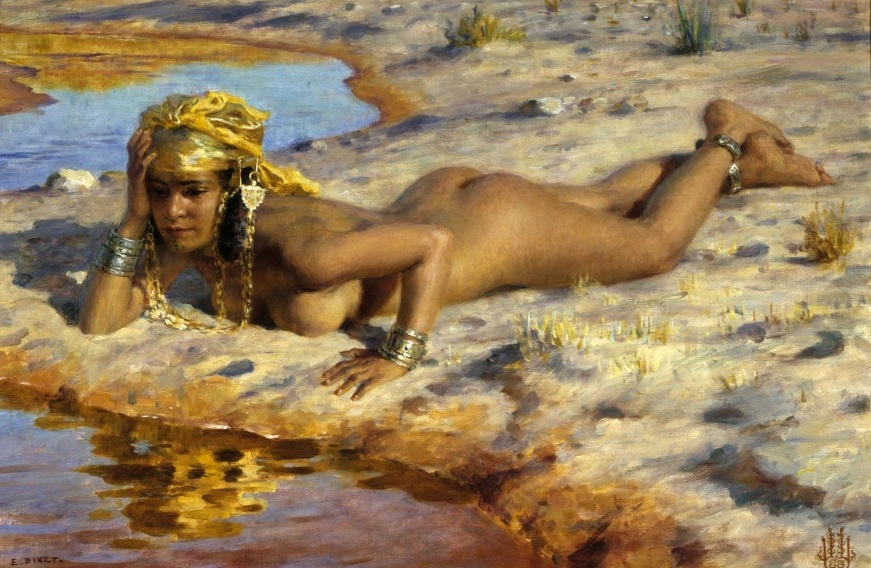


Compared to modernist painters such as Henri Matisse, who also visited northern Africa in the first decade of the 20th century, Dinet’s paintings are extremely conservative. They are highly mimetic, indeed ethnographic, in their treatment of their subject.
Dinet’s understanding of Arab culture and language set him apart from other orientalist artists. Surprisingly, he was able to find nude models in rural Algeria. Before 1900, most of his works could be characterized as "anecdotal genre scenes".[4] As he became more interested in Islam, he began to paint religious subjects more often.[4] He was active in translating Arabic literature into French, publishing a translation of an Arab epic poem by Antarah ibn Shaddad in 1898.Wikipedia
Dinet’s understanding of Arab culture and language set him apart from other orientalist artists. Surprisingly, he was able to find nude models in rural Algeria. Before 1900, most of his works could be characterized as "anecdotal genre scenes".[4] As he became more interested in Islam, he began to paint religious subjects more often.[4] He was active in translating Arabic literature into French, publishing a translation of an Arab epic poem by Antarah ibn Shaddad in 1898.Wikipedia