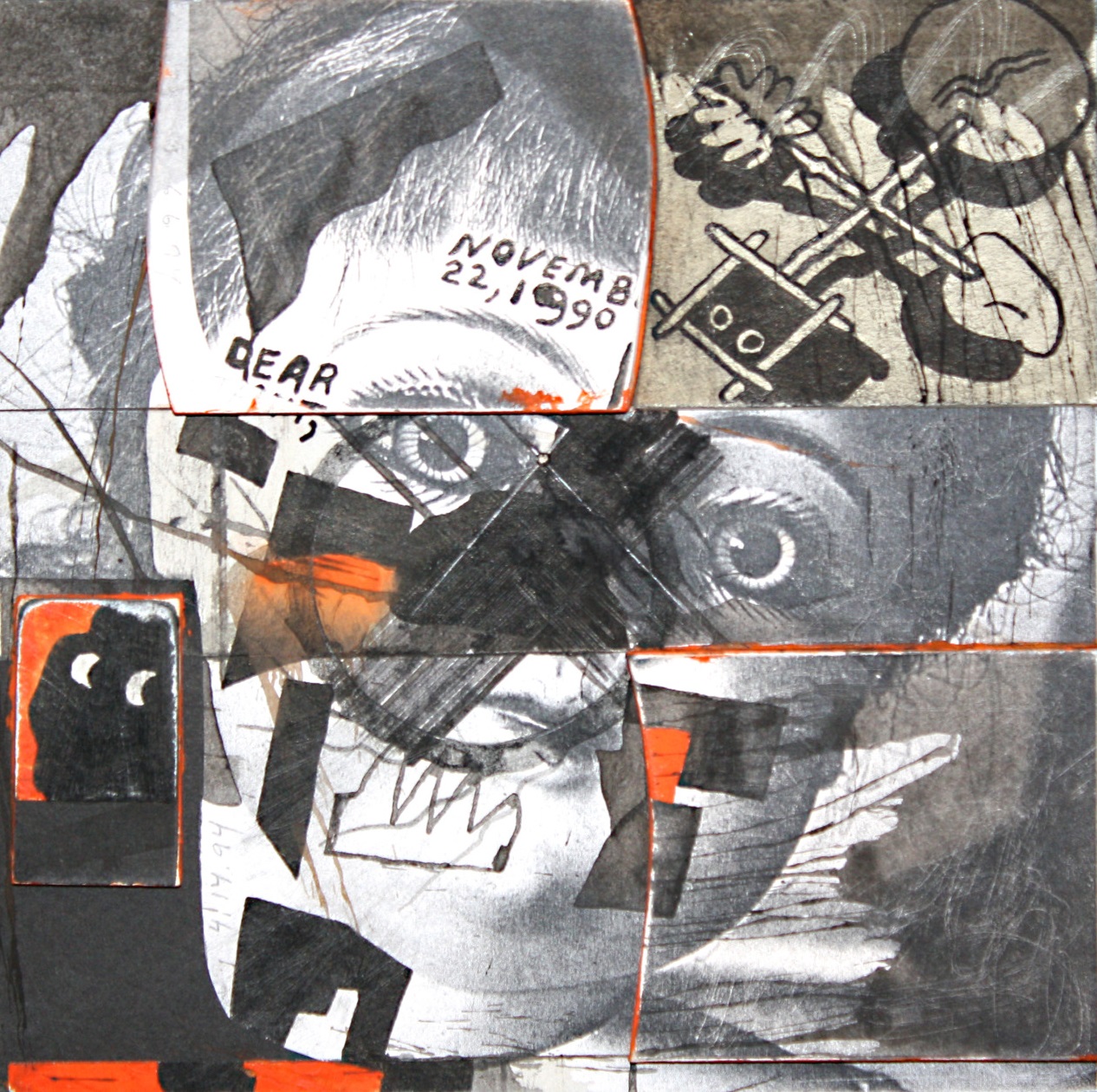
"Ray Johnson (1927-1995) was a seminal Pop Art figure in the 1950s, an early conceptualist, and a pioneer of mail art. His preferred medium was collage, that quintessentially twentieth-century art form that reflects the increased (as the century wore on) collision of disparate visual and verbal information that bombards modern man. Integrating texts and images drawn from a multiplicity of sources — from mass media to telephone conversations — Johnson’s innovativeness spread beyond the confines of the purely visual. He staged what Suzi Gablik described in Pop Art Redefined as perhaps the “first informal happening” and moved into mail art, artist books, graphic design, and sculpture, working in all modes simultaneously. Johnson not only operated in what Rauschenberg famously called "the gap between art and life," but he also erased the distinction between them. His entire being – a reflection of his obsessively creative mind – was actually one continuous "work of art." His works reflect his encyclopedic erudition, his promiscuous range of interests, and an uncanny proto-Google ability to discover connections between a myriad of images, facts and people.


Born in Detroit, Michigan on October 16, 1927, Johnson grew up in a working class neighborhood and attended an occupational high school where he enrolled in an advertising art program. He studied at the Detroit Art Institute and spent a summer in a drawing program at Ox-Bow School in Saugatuck, Michigan, an affiliate of the Art Institute of Chicago. Leaving Detroit in the summer of 1945, he matriculated at the progressive Black Mountain College, where he spent the next three years with the exception of the spring of 1946. He studied painting with former Bauhaus faculty Josef Albers and Lyonel Feininger, as well as Robert Motherwell. By the summer of 1948, Johnson had befriended summer visiting lecturers John Cage, Merce Cunningham, Willem de Kooning, Buckminster Fuller, and Richard Lippold and fellow student Ruth Asawa. He participated in “The Ruse of Medusa,” the culmination of Cage’s Satie Festival (characterized by scholar Martin Duberman as “a watershed event in the history of ‘mixed-media’”) with Cage, Cunningham, Fuller, the de Koonings, and Ruth Asawa, among others. In early 1949, Johnson moved to New York City and became an active participant in the downtown art scene. Alongside the American Abstract Artists group, Johnson painted geometric abstractions heavily influenced by the imagery of his former professor, Josef Albers. Johnson later destroyed most of this work, having turned to collage.By 1954, Johnson was making irregularly shaped "moticos,” his name for small-scale collages upon which he pasted images from popular culture such as Elvis Presley, James Dean, Shirley Temple, and department store models. Johnson’s 1950s moticos anticipated Warhol's 1960s Pop imagery. However, his attitude towards fame remained the antithesis of Warhol’s. He continually dodged it and was dubbed “the most famous unknown artist” by Grace Glueck in a 1965 New York Times article in which she discussed his deliberate elusiveness. Johnson carried boxes of moticos around New York, sharing them with strangers on sidewalks, in cafes, and even in Grand Central Station. He solicited and even occasionally recorded the public’s response to his intricate creations. After a number of performance-like installations of these works in 1954-55, Johnson claimed to have burned a plethora of them in Cy Twombly’s fireplace, a gesture that John Baldessari later replicated in his “Cremation.”

From the early 1960s onwards, Johnson would reuse his “moticos,” cutting them up to create tiny compositions that he glued onto small blocks of layered cardboard. He would then ink, paint, and sand these “tiles” or “tesserae,” using them in his extremely complex collages whose underlying structural emphasis on repetition and variations of semi-geometric forms relate to the eccentric minimalism of fellow artists Louise Bourgeois and Eva Hesse. These collages reveal his profound understanding of cubism and his intent to explore it in different forms. Johnson incorporated meaningful texts into his work beginning in the 1950s – letters or fragments of words, names of celebrities, literary figures, and art-world denizens, both historical and current. He pointed his viewers towards marvelous connections between them and a world of metamorphosing glyphs that became part of Johnsons’s ever-expanding lexicon of text and forms. An artistic alchemist, Johnson could turn the detritus of ordinary life into proverbial art “gold.” In his typically self-deprecating way, Johnson would say that he did not make Pop Art, he made “Chop Art”.
In 1958, Johnson was already recognized as part of the nascent Pop generation. In a review of a Jasper Johns’ exhibition, a critic for ARTnews stated: “Johns’ first one-man show (...) places him with such better-known colleagues as Rauschenberg, Twombly, Kaprow and Ray Johnson.” Around 1959, Johnson met Billy Linich (later known as Billy Name) at New York’s Serendipity, and in 1963 Johnson introduced him to Warhol. Billy Name became a key figure at Warhol’s Factory, responsible for covering the Factory walls with silver, which resulted from Johnson bringing Warhol to Name's similarly silver-covered apartment.Johnson was one of the first conceptualists, an heir to Marcel Duchamp whom he may have met in 1961. Johnson shared his enthusiasm for the elder Frenchman’s work with many of his contemporaries. In Marcel Duchamp: Étant donnés, Michael Taylor notes, “The public display of Johnson’s work helped to situate him as a crucial figure in the post-World War II dissemination of Duchamp’s art and ideas, alongside cultural luminaries such as John Cage, Merce Cunningham, and Jasper Johns.” Johnson was one of the key artists to incorporate exhortations to the observer to participate actively in the work of art itself. His interest in codes, poetics, and semiotic systems looked back to Duchamp, while anticipating the enlarging contemporary conceptual practices, and the development of appropriation in particular, during the early second half of the 20th century.


Throughout the early stage of his career and spanning its duration, Johnson sought out the random and the ephemeral, incorporating chance operations into his artistic practice with “mail art.” He gradually built up an informal, hybrid network of friends, acquaintances, and strangers with whom he exchanged ideas and artworks by means of the postal system. By 1958, he began to write, “Please send to...” on his mailings, thereby creating even more sub-networks among the hundreds of correspondents in his greater mail art organization. By 1962, when it was named the “New York Correspondance [sic] School,” his virtual “school” of correspondents had become a network for a web of communication by mail that eventually spread across the nation and around the globe. Johnson was an early instigator of performance art, actively participating in events by James Waring and Susan Kaufman, among others, and staging his own starting in 1957 that included "Funeral Music for Elvis Presley" and "Lecture on Modern Music.” Johnson's compositions were performed at The Living Theatre and during events such as the Fluxus “Yam Festival” of 1963. From 1961 on, Johnson periodically staged events he called "Nothings,” described to his friend William S. Wilson as “an attitude as opposed to a happening,” which would parallel the “Happenings” of Allan Kaprow and later Fluxus events. The first of these, "Nothing by Ray Johnson," was part of a weekly series of events in July 1961 at AG Gallery, a venue in New York operated by George Maciunas and Almus Salcius. Ed Plunkett later recalled entering an empty room: " . . . Visitors began to enter the premises. Most of them looked quite dismayed that nothing was going on . . . Well, finally Ray arrived . . . and he brought with him a large corrugated cardboard box of wooden spools. Soon after arriving Ray emptied this box of spools down the staircase … with these … one had to step cautiously to avoid slipping … I was delighted with this gesture.” Johnson’s second Nothing took place at Maidman Playhouse, New York, in 1962. Furthermore, the carefully orchestrated circumstances of his suicide on Friday the 13th, 1995 have prompted the suggestion that the process of his drowning was his “final performance.”


On April 1, 1968, the first of the meeting of the New York Correspondance School was held at the Society of Friends Meeting House on Rutherford Place in New York City. Johnson called two more meetings in the following weeks, including the Seating-Meeting at New York’s Finch College, about which John Gruen reported: “It was . . . attended by many artists and ‘members’ . . . all of whom sat around wondering when the meeting would start. It never did . . . people wrote things on bits of paper, on a blackboard, or simply talked. It was all strangely meaningless — and strangely meaningful.” Until his death, Johnson continued to mail out an extraordinary quantity of material, including elements of chopped-up collages; drawings with instructions (“please add to and return...”); found objects; snakeskins; plastic forks; and annotated newspaper clippings, to name only a few. To Johnson, “art” rejected physical limitations, the restraints of time, or a single identifiable goal. In this capacity, Johnson privileged inclusivity, deeming anyone and everyone with whom he interacted suitable for creative exchange.
Richard Feigen was an early champion of his work, holding one-man exhibitions in New York and Chicago from 1966-72, including I Shot an Arrow into the Air It Fell to Earth in the Ear of an Artist Living in Flushing, New York Tit Show (1970) and Dollar Bills (1970). From 1968-1974, Johnson produced an ambitious body of work, received critical attention on the pages of Artforum, and was featured in several major exhibitions. In 1970, The Whitney Museum of American Art organized Ray Johnson: New York Correspondance School, which served as a major form of cultural validation for Johnson’s practice. Additionally, Johnson had several solo shows at Willard Gallery (New York) as well as Famous People’s Mother’s Potato Mashers (1973) at Galleria Schwarz (Milan) and Ray Johnson’s History of the Betty Parsons Gallery (1973) at the Betty Parsons Gallery (New York), and participated in the group exhibition Post Card Show (1971-72) at the Angela Flowers Gallery (London).


On June 3, 1968, the day Valerie Solanas shot Andy Warhol, Johnson was mugged at knifepoint in lower Manhattan. Two days later, the world was shocked by the assassination of Bobby Kennedy at the hands of Sirhan Sirhan in Los Angeles. These traumatic events prompted Johnson's abrupt departure to Glen Cove, Long Island, to house he described as a "small white farmhouse with a Joseph Cornell attic." He then relocated to nearby Locust Valley, where he lived in ever-greater reclusiveness. As his contemporaries became famous, Johnson gradually but purposefully closed off his private life and dwelling, but still maintained connections via his mail art, the telephone, and various activities in the Locust Valley community. Johnson, referring to himself as a “mysterious and secret organization,” eventually achieved legendary status as a “pure,” completely un-commercial artist. His underground reputation bubbled beneath the surface into the 1980s, despite his physical absence from the scene. Johnson’s presence continued to be felt by those who admired him including Jasper Johns, James Rosenquist, Roy Lichtenstein, Andy Warhol, Christo and Jeanne-Claude, Chuck Close, Robert Rauschenberg, and a close circle of friends, admirers, and collectors. Only a handful of people were ever allowed into his house and around 1978, he ceased to exhibit or sell his work commercially. In contrast to his physical seclusion, Johnson's pre-digital network of correspondents increased exponentially. Johnson feverishly developed richer and more complex collages, which Whitney Museum curator, Donna de Salvo, described as “extending the compositional network beyond the parameters of an individual work and into the wider world."
On April 5, 1973, Johnson declared the “death” of the “New York Correspondance School” in an unpublished letter to the Obituary Department of The New York Times but continued to practice mail art under this and other rubrics.
In 1976, Johnson began his Silhouette project, which involved creating over 200 profiles of friends’, artists’ or famous peoples’ faces, which he would often use as the basis for collages. Subjects included “a who’s who of the New York arts and letters scene”: Chuck Close, Andy Warhol, Paloma Picasso, James Rosenquist, Richard Feigen, Frances Beatty, William S. Burroughs, Nam June Paik, David Hockney, Peter Hujar, and Roy Lichtenstein, among others.
On January 13, 1995, Johnson was seen dressed in black diving off a bridge in Sag Harbor, Long Island and backstroking out to sea. Many aspects of his death involved the number "13": the date, his age, 67 (6+7=13), as well as the room number of a motel he had checked into earlier that day, 247 (2+4+7=13). There was much speculation amongst critics, scholars, admirers, and law-enforcement officials about a “last performance” aspect of Johnson’s drowning. After his death, hundreds of collages were found carefully arranged in his Long Island home. A retrospective at the Whitney Museum of American Art (1999), which traveled to the Wexner Center for the Arts as well as solo and group shows in the US and abroad, including Paris, London, Oslo, Budapest, and Barcelona, began the process of re-introducing Johnson’s work to a broader audience. Johnson is considered one of the major artistic innovators of the second-half of the 20th century within the critical community but his work remains underexposed and underappreciated by the general public."
(Adler Beatty represents the Ray Johnson Estate exclusively. /rayjohnsonestate.com )