Exposition Art Blog: Canadian Abstract Art
Showing posts with label Canadian Abstract Art. Show all posts

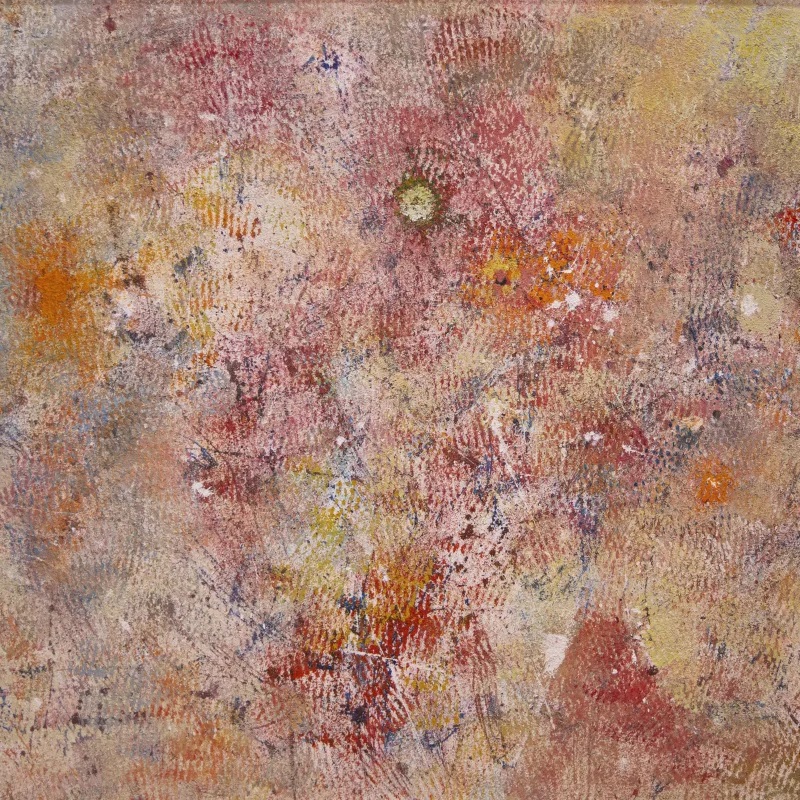
Michael Forster - Abstract Artwork


 Michael Forster (1907–2002) was an Anglo-Canadian abstract artist. Born in Kolkata, India, Forster spent most of his childhood in Meerut. He studied first at Lancing College in Sussex and then later at the Central School of Arts and Crafts (now Central St. Martins – University of the Arts), as well as the Académie Colarossi in Paris. In 1927–1928, he moved to Toronto, Ontario, Canada in hopes of avoiding The Great Depression.
"Creatively, Forster explored the changing visual face of the universe long before astronauts began their travels. For most of his career, he took inspiration from the glowing patterns and chromatic depths of space. He composed infinitely varied and rich abstract compositions from the flux and fusion of the galaxies. In this, Michael Forster is virtually unique among painters. Forster possessed a passion for colour that gained recognition from the eminent German art-historian, Paul Westheim: “Colour is the medium of his expression, he has reduced all that is visible, all that is imaginable to colour, a strange and fantastic world of visionary colour. By means of colour, he knows how to give form to a whole range of emotions and feelings.” Forster’s concern for the material of paint itself led him to create brilliant surface textures that are uniquely personal. He worked the varied luminous passages across his canvas from corner to corner, leading the eye through subtle and constant changes. These rich variations remain regardless of the dimensions of his work. His smaller compositions on paper are compelling in their lustrous presence.
In 1960, Forster was honoured with a solo-exhibition of eighty works by Mexico’s Mueso Nacional de Arte Moderno. He has also been the subject of major retrospectives in Luxembourg and Canada. Forster’s paintings have been exhibited in leading museums of the world, including the National Gallery, Washington, Musee d’art Moderne, Paris, the Stedelijk Museum, Amsterdam, the British Museum, and Sao Paulo Museum, Brazil. Loch Gallery is pleased to reintroduce this great artist to the Canadian public."(lochgallery.com)



David Bolduc - Canadian Abstract Art


 "David Bolduc (1945-2010) was born in Toronto and attended the Ontario College of Art for one year and then studied at the Montreal Museum of Fine Arts School (1964-65).  In 1966 he returned to Toronto where he worked in the ROM’s conservation department.  A Canada Council grant in 1968 allowed him to leave work and travel in Europe and Asia for eight months.  Throughout his lifetime, he continued to travel extensively, often drawing inspiration from the exotic locations.Beginning in 1967 Bolduc started showing with Carmen Lamanna Gallery and made work featuring shaped canvases painted in simple geometric colour designs.  By the 1970s, however, he switched his focus to abstract canvases and quickly developed his signature style of drawing directly from the tube painted on top of a colourful stained background.  The bold central image or motif was always set against a textured ground.
Considered part of the third generation of Toronto abstract painters which included artists such as Alex Cameron and Paul Sloggett, Bolduc remains one of Canada’s leading lyrical abstract painters.
His work is in the public collections of the Canada Council Art Bank, Beaverbrook Art Gallery, Art Gallery of Hamilton, Art Gallery of Ontario and the National Gallery of Canada."(gibsongallery.com)


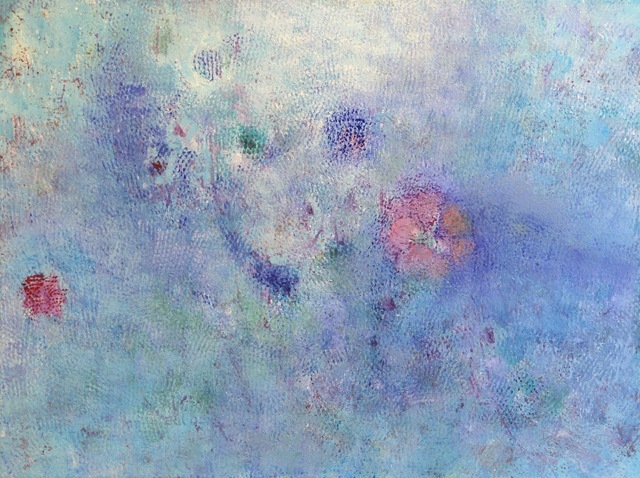
Alicia Dawn Popoff - Abstract Artworks


 Alicia Dawn Popoff (1950 – 2015) was a Canadian abstract painter who worked primarily in acrylic and sometimes mixed media. She also worked in sculpture, sometimes collaborating with her husband and fellow artist and sculptor Leslie Potter. Popoff's work has been exhibited across Canada in numerous exhibitions and commercial galleries and can be seen in public and corporate collections
 She received her BFA in 1979 and her MFA in 1984, both from the
Popoff's work is influenced by the prairie landscape and the works of surrealist artists Paul Klee and Joan Miró, among others. She has likened her work to a meditation of the world around her "…from the tiniest particle unseen, to the impressive and infinite sky. My work is constructed from sounds such as the birds and the wind, tastes and smells like the crisp winter air". Her interest in gardens and poetry can be seen in her compositions with their multiple layers and textures and their playful and expressive character. Popoff's work is an exploration of the interconnectedness of everything, from inner worlds to physical worlds and the continuity of life. Wikipedia


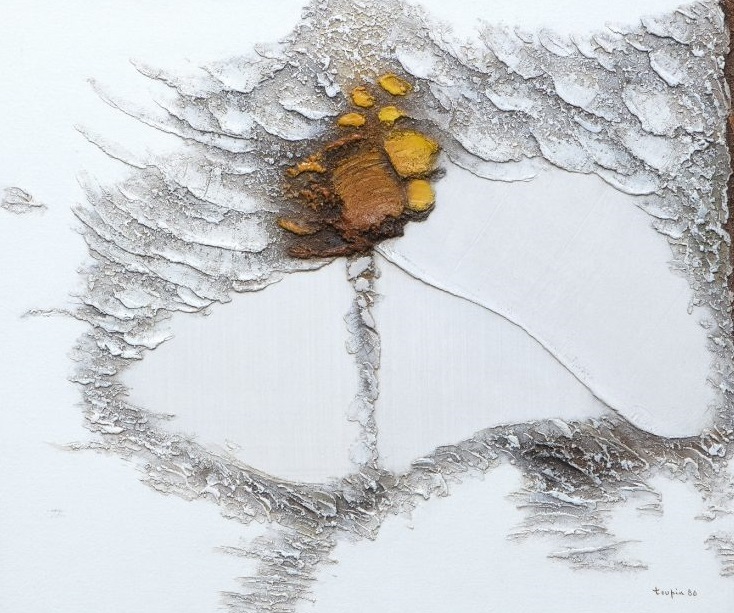
Fernand Toupin - Abstract Art


 Fernand Toupin (1930-2009)
"Known for his participation in the group Les Plasticiens, Fernand Toupin starts his artistic formation by taking drawing classes at Collège Mont-Saint-Louis in Montréal. He then studied at l’École des Beaux-Arts de Montréal. From 1949 to 1953, he works in Stanley Cosgrove’s workshop.
Toupin’s artistic career really begins in 1954. In 1955, he signs with Louis Belzile, Jean-Paul Jérôme and Jauran (Rodolphe de Repentigny) the Plasticiens’ Manifesto, written by Rodolphe de Repentigny. Opposed to the spontaneous and expressive art of the Automatists, Les Plasticiens endorse an art particularly inspired by Mondrian and will participate at a new painting movement’s emergence in Québec : the geometrical abstraction. Within this new movement, the image is considered like a bidimensional object that refuses any depth effect on the canvas. Fernand Toupin’s “shaped canvas” or “object-canvas” as the art critics named them, remain an important contribution from the artist to the movement.
In 1959, Toupin’s art engages in a new direction. Always interested by abstraction, the artist explores texture with a more abundant material on the canvas, where the pigments are mixed with marble dust. Toupin expresses his surrounding environment: Québec’s landscapes. “I like to feel the simmering of things as they are made. The uprising of the waves. The freshness of the snow. The ubiquity of the minerals.” In 1992, Fernand Toupin creates  a series of small canvas, which will materialize this idea. The Écorces sous la neige (bark under the snow), are miniature artworks made of marble dust in which the artist has inserted small pieces of bark and other natural materials onto the canvas. These elements thus become small treasures carefully buried under the snow. Then, in 1993, he goes back to geometrical abstraction."(galeriebernard.ca)