Exposition Art Blog: New York School
Showing posts with label New York School. Show all posts

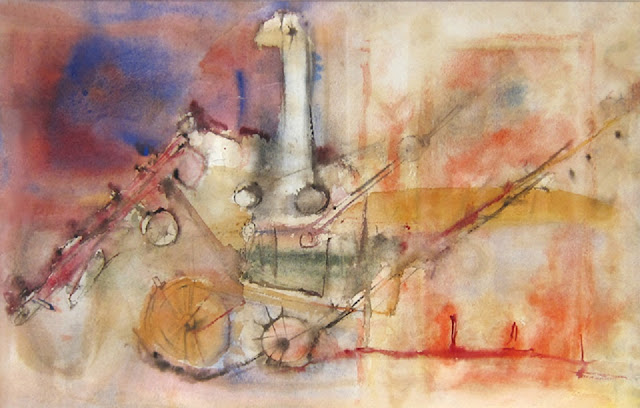
Hedda Sterne - Surrealism & Abstract Expressionism


 Hedda Sterne (born Hedwig Lindenberg) was an artist best remembered as the only woman in a group of Abstract Expressionists known as "The Irascibles" which consisted of Jackson Pollock, Willem de Kooning, Barnett Newman, Mark Rothko, and others. Sterne was, in fact, the only woman photographed with the group by Nina Leen for Life magazine in 1950. In her artistic endavors she created a body of work known for exhibiting a stubborn independence from styles and trends, including Surrealism and Abstract Expressionism, with which she is often associated.Sterne has been almost completely overlooked in art historical narratives of the post-war American art scene. At the time of her death, possibly the last surviving artist of the first-generation of the New York School, Hedda Sterne viewed her widely varied works more as in flux than as definitive statements. In 1944 she married Saul Steinberg the Romanian-born American cartoonist and illustrator, best known for his work for The New Yorker.During the late 1940s she became a member of The Irascible Eighteen, a group of abstract painters who protested the Metropolitan Museum of Art's policy towards American painting of the 1940s and who posed for a famous picture in 1950; members of the group besides Sterne included: Willem de Kooning, Adolph Gottlieb, Ad Reinhardt, Richard Pousette-Dart, William Baziotes, Jimmy Ernst, Jackson Pollock, James Brooks, Clyfford Still, Robert Motherwell, Bradley Walker Tomlin, Theodoros Stamos, Barnett Newman, and Mark Rothko.(www.wikiart.org)


Seymour Boardman - New York School - American Abstract Expressionism


Seymour Boardman (1921–2005) was a New York abstract expressionist. Since his first solo exhibition in Paris in 1951, Boardman developed a personal vision and style of his own, following his own path of abstraction. As a painter he sought to reduce the image to its bare essence.
Seymour Boardman was an artist who expressed his direct experience and willingness to take risks in the pursuit of ambitious painting. Initially working in the freely brushed manner of Abstract Expressionism, Boardman gradually eliminated the arbitrary aspects of his work until only straight lines and two or three areas of flat, sometimes somber, tones remained. He could hardly have achieved more with less.In a career that was steady and determined, Seymour Boardman created paintings that are unique, while avoiding fashion and trends. Wikipedia 


Taro Yamamoto - Abstract Expressionism

"Taro Yamamoto’s prolific career began at a young age. By the age of ten, he was already painting landscapes and still lifes in oil, and had won numerous prizes in exhibitions at school.Yamamoto was born in Hollywood, California in 1919, but was taken to live and study in Japan when he was six. His parents wanted him to receive a traditional Japanese education as he was descended from a long line of Shinto priests. Yamamoto remained there until he was 19 years old, then returned to the United States and studied cubism at Los Angeles City College.From 1941-1946, Yamamoto served in the U.S. Army. He then went back to painting, studying at Santa Monica City College where he made an award winning painting that was later presented to the Methodist Church in West L.A.Like many of his significant peers from that time, Yamamoto studied at the Art Students’ League in New York, working under Yasuo Kuniyoshi, Morris Kantor, Vaclav Vytlacil and Byron Browne. He subsequently received a scholarship from the Hans Hofmann School of Fine Arts, and began studying there in 1952. That same year, Yamamoto received the John Sloan Memorial Fellowship. The following year he won the Edward G. McDowell Traveling Fellowship and spent a year painting and studying in Europe. Yamamoto also spent periods of time at the McDowell Colony in Peterborough, New Hampshire in 1954, 1956 and 1957.He lived out his days in Provincetown, Massachusetts, with his wife and his son."(vallarinofineart.com)


Action Painting Franz Kline

Franz Kline (May 23, 1910 – May 13, 1962) was an American painter. He is associated with the Abstract Expressionist movement of the 1940s and 1950s. Kline, along with other action painters like Jackson Pollock, Willem de Kooning, Robert Motherwell and Lee Krasner, as well as local poets, dancers, and musicians came to be known as the informal group, the New York School. Although he explored the same innovations to painting as the other artists in this group, Kline's work is distinct in itself and has been revered since the 1950s
"Franz Kline's life story reads like a movie plot: Young artist starts out with high hopes, spends years struggling without success, eventually finds a style, becomes an "overnight sensation" and dies too soon.Kline was best known for his role as an "action painter" of abstract expressionism, a movement that was popular in New York during the 1940s and 1950s and introduced the world to artists including Jackson Pollock and Willem de Kooning.Kline was born on May 23, 1910 Wilkes-Barre, Pennsylvania. As the cartoonist for his high school newspaper, Kline was a good enough student to leave coal-mining country and attend Boston University. With budding artistic ambition, he went  to study at the Art Students League, and then Heatherly Art School in London. In 1938, he returned to the U.S. with his British wife and settled in New York City.It seemed New York really didn't care much that Kline had talent back in England and was ready to take on the world. He struggled for years as a figurative artist, doing portraits for two loyal patrons that won him a modest reputation. He also painted city scenes and landscapes, and occasionally resorted to painting barroom murals to pay the rent money.In the mid 1940s, he met de Kooning and Pollock, and began to explore his own growing interest in trying new styles of painting.Kline had been noodling around with black and white for years, creating small brush drawings and projecting them onto the wall of his studio. Now he got rather serious about creating the projected images using just his arm, brush and mental imagery. The pictures that began to emerge were given a solo exhibition in New York in 1950.As a result of the show, Franz became an established name in the art world and his large, black and white compositions—likened to grids, or Oriental calligraphy—achieved notoriety.With his reputation as a leading abstract expressionist secured, Kline concentrated on turning out his new passion. His new work had short, seemingly meaningless names, such as Painting (sometimes followed by a number), New York, Rust or the old stand-by Untitled.He spent his last years trying to introduce color back into the mix, but was cut down in his prime by heart failure. Kline died on May 13, 1962 in New York City. He couldn't explain what his paintings meant, but Kline left the art world with the understanding that explanation of his art was not its intended purpose. His paintings were supposed to make one feel, not comprehend."(Shelley Esaak  thoughtco.com )