Exposition Art Blog: collage art
Showing posts with label collage art. Show all posts

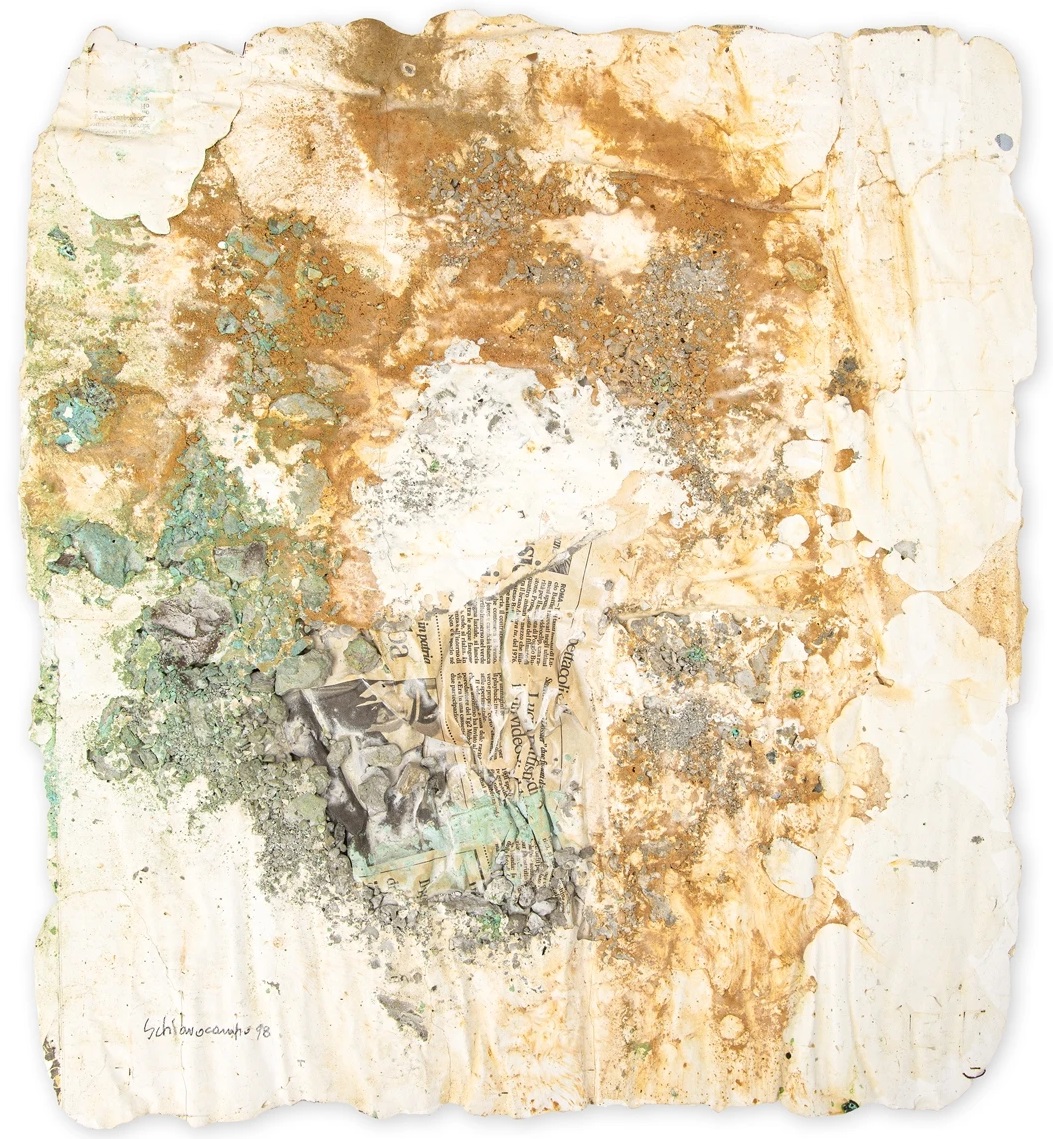
Paolo Schiavocampo


 Paolo Schiavocampo (1924 – 2022) was an Italian painter and sculptor.He received most of his success from his collaborations with Fiumara d'arte in Messina.
Schiavocampo was a student of Giacomo Manzù and studied architecture in Rome and Milan, and subsequently art history in Venice. In 1964, he stayed in New York City to work alongside Salvatore Scarpitta. His works have been acquired by various museums and collections, particularly at the Visconti Castle and the University of California, Los Angeles.


Bruno Canova "The Art of War"


 Bruno Canova was born in Bologna in 1925, was drafted in 1943 to military service in the Navy and shortly after he was arrested for attempting to organize a partisan group in La Spezia and interned in a labor camp in the Sudetenland German Brüx .After the liberation, he studied graphic design in the Boarding Schools of the “Convitti della Rinascita”, in Rome and Milan. Among his teachers: Luigi Veronesi, Max Huber, Albe Steiner, Lucio Lombardo Radice, Gabriele Mucchi. After his debut in 1949 in Prague, in an exhibition of Italian graphics and after having been, for some years, the political cartoonist of “L’Unità”, he devoted himself only to his work as an artist in Rome, the city where he would spend all his life and where he frequented, among others, Mario Mafai, Alberto Ziveri, Renato Guttuso, Renzo Vespignani, Salvatore Scarpitta, Ugo Attardi, Pier Paolo Pasolini. In 1965 he won the Premio Suzzara and participated in the Quadrennial of Rome, where his work was noticed by Carlo Ludovico Ragghianti, who wrote him a letter of great appreciation. In this period he develops a research on the city and its suburbs, and composes spreadsheets and drawings in black and white with a few chromatic elements in an assembly close to the experiences of historical avant-gardes. Draftsman and engraver of great quality, in the early eighties his path opens onto color and to a painting where the memory of the Roman School merges his analytical vision with the suggestions of the Northern Renaissance in a search which lasted until the last day. Marked as he was by his dramatic war experiences, from 1966 Bruno Canova worked continuously in the exhibition "The Art of War" that was exposed in public spaces in many Italian cities, with works where drawing and painting merge documents, newspapers and vintage posters, on the wake of the Dadaist collage and the outcomes are often close to certain conceptual experiences. Among his many exhibitions, we must remember his solo shows at the Villa Pignatelli in Naples (1975), at the Palazzo dei Diamanti in Ferrara (1976), at the National Central Library of Rome (1993) and in the Museum of Roman Laboratory of the University "La Sapienza" (1998 ), at the Quadrennial in Rome in 1965 and 1986, and the participation in the Italian Pavilion, section Lazio, 54th Venice Biennale at the Palazzo Venezia in Rome. He died in Lacco Ameno ( Ischia ) July 31, 2012.(.wikiart.org)


Igael Tumarkin


Igael Tumarkin ( 1933 – 2021) was an Israeli painter and sculptor
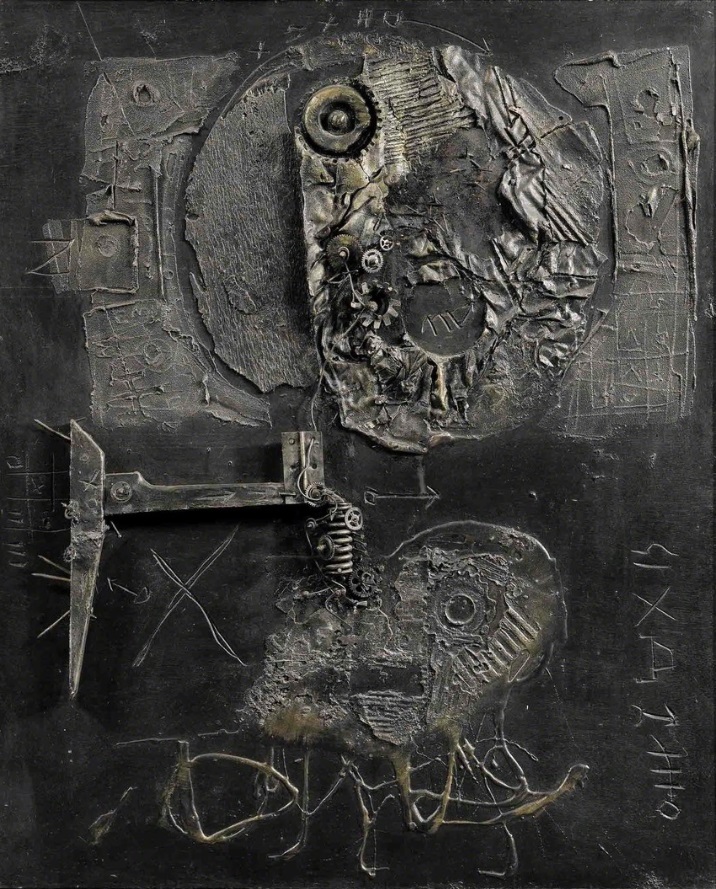
"Renowned Israeli artist Igael Tumarkin is internationally recognized for his public sculptures, paintings, and prints, as well as his divisive political views. A winner of the Israel Prize, Tumarkin was widely known for his anti-war politics, disdain for religion, and protest against West Bank settlements. His most famous sculpture, Monument to the Holocaust and Revival (1975), located in Tel Aviv’s Rabin Square, has been an integral site of political speech, including by performance artist Ariel Bronz. Born in Germany, Tumarkin immigrated to Israel as a child. As a young artist, he studied under sculptor Rudolf Lehmann and worked at Bertolt Brecht’s Berliner Ensemble. His prints and paintings combine aspects of Abstract Expressionism, Dada, and Pop art. Tumarkin represented Israel at the Venice, São Paulo, and Tokyo biennials. The Tel Aviv Museum of Art staged a major retrospective in 1992."(.artsy.net)Tumarkin was also an art theoretician and stage designer. In the 1950s, Tumarkin worked in East Berlin, Amsterdam, and Paris. Upon his return to Israel in 1961, he became a driving force behind the break from the charismatic monopoly of lyric abstraction there. Tumarkin created assemblages of found objects, generally with violent expressionist undertones and decidedly unlyrical color. His determination to "be different" influenced his younger Israeli colleagues. The furor generated around Tumarkin's works, such as the old pair of trousers stuck to one of his pictures, intensified the mystique surrounding him. 


Claudio Costa - Italian Avant Garde Art


 Claudio Costa (1942 – 1995, in Genova) was a Contemporary Artists from the 1970s avant-garde. Costa's artistic production is divided in several different periods. He explored Arte povera, Conceptual Art, paleontologist and anthropological art, alchemic art. As an artist associated with the Arte Povera movement, Costa's first exhibition took place at the La Bertesca Gallery in Genova directed by Francesco Masnata. He produced a series of "tele acide" (acid canvases) (1970–1971), where he deployed a new pictorial language made of symbolical and magic elements by mixing them with materials and glue-earth-bone-blood-acids. Costa explained the acid canvases in his writings: "I used three acids and a sulfate; nitric acid, which corroded the support almost immediately, iron chloride which gave a brownish colour, and copper sulphate, which reminded me of the wonderful color of vine leaves when they are sprayed and which I needed to obtain a light blue base". In 1971, Costa investigated the confines between science and art as a paleontologist and anthropologist. He returned to the remote prehistoric past in search of the roots of mankind, especially in pieces like "Museo dell'Uomo" (Museum of Man), where he attempted a summary and condensation of his anthropological studies. "Alchemic Art" was also his main focus when he exhibited at the Venice Biennale in 1986In 1988, he started working in Psychiatric Hospital in Genoa as an art-therapist. Costa had a large workshop inside the hospital. In this period he founded the "Institute for Unconscious Matter and Forms", where he exhibited works of patients as well as professional artists. Wikipedia