Exposition Art Blog: German painter
Showing posts with label German painter. Show all posts

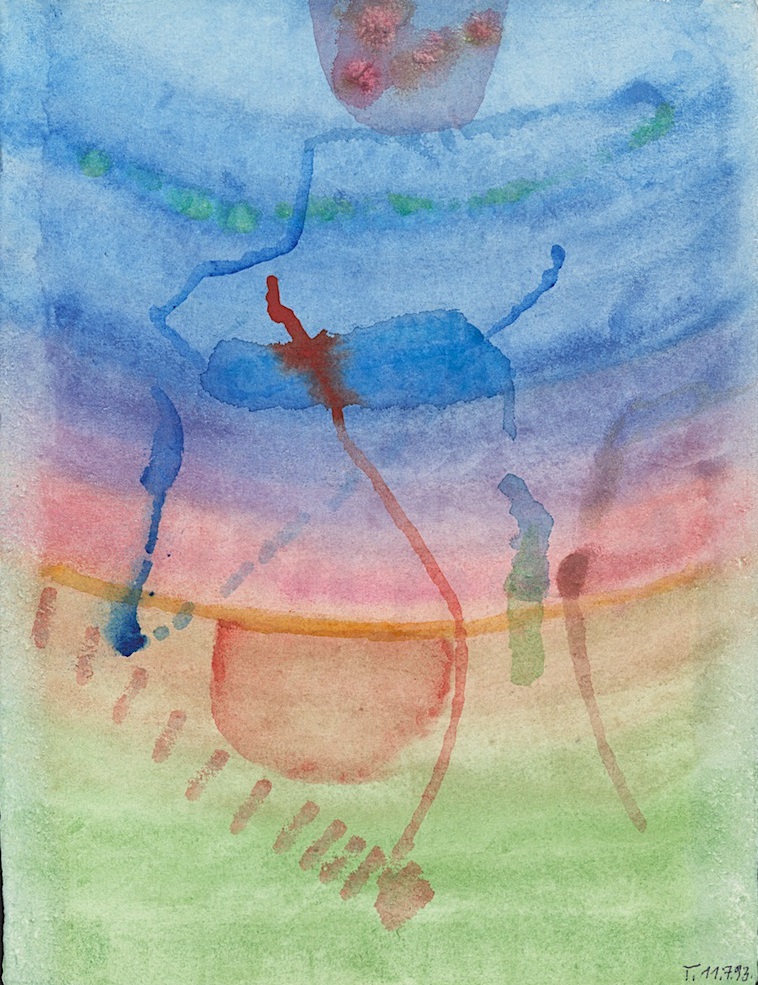
Heinz Trökes


Heinz Trökes (1913 –1997) was a German painter, printmaker and art teacher "I believe in the creative in the world and in people, that art will endure and that it is worth living in our century, despite everything. Don’t become timid, don’t let yourself be upset by big talk, doubt, smile, let yourself be surprised, even by yourself, experience our world with keen senses.The terrestrial zoo is large and has room for many species; the higher of them are our good fortune and our comfort. I would like to call them poets, who see our world in a new way, in colours, words, shades and equations, as we have not yet known it, who reveal unparalleled wealth."(troekes.com)


Sigmar Polke - Pop Art


"Multi-media artist, Sigmar Polke, had the capacity to be at once irreverent, playful, and acerbic. From painting to photography and film to installations and prints, Polke's work, which often incorporated non-traditional materials and techniques, was above all a critique of art itself. Sometimes veiled and sometimes confrontational, the messages conveyed in his work raise serious questions about aesthetic, political, and social conventions. For Polke, the production of art was consistently a dialogue between himself and the viewer, which presented virtually limitless interpretive possibilities. Along with a group of fellow artists that included Gerhard Richter, he introduced the term, Capitalist Realism, which refers loosely to commodity-based art. Further, and specifically in the case of Polke's work, Capitalist Realism constitutes not only a critique of Pop art and the commodification of art and capitalism overall but also of the idealistic and overtly nationalistic Soviet Social Realism that Polke was particularly exposed (and opposed) to.The cynically witty Polke helped launch the Capitalist Realism style as a response to American and British Pop art. Rather than simply commenting on mass production and conspicuous consumption Polke went a step further. With works such as Chocolate Painting, he eliminated signifiers like labels with brand names in order to poke fun at notions of individuality and uniqueness. Indeed, despite the biting commentary of Pop art and its critique of capitalist consumer homogeneity, works like Andy Warhol's Campbell's Soup cans, with their labels and their sameness, still sold for large sums. The objects in Polke's Pop works are stripped of such identifiers, which emphasizes how banal they actually are.At the fore of Polke's experiments was the impulse to challenge virtually every convention of art, often in surprising and ingenious ways. His iconoclastic tendencies extended not merely to content but to the materials of the works themselves, which were often adamantly non-traditional. From uranium and meteorite dust, brightly printed fabric and soot, to bubble wrap and potatoes, Polke's artistic odyssey took him and his work to the potential limits of creation."(theartstory.org)


Ernst Wilhelm Nay - Art Informel

Ernst Wilhelm Nay was a German painter known for his association with the Art Informel movement and post-World War II artists such as Karel Appel, Jean Dubuffet, and Alberto Burri. Despite working exclusively in abstraction, Nay’s distinctive Expressionistic use of color and textile-like patterning show the influence of representational painters like Ernst Ludwig Kirchner and the Henri Matisse. Born on June 1, 1911 in Berlin, Germany, he went on to study under Karl Hofer at the Berlin Art Academy. Nay was on track for a successful career in Germany, until the Nazi regime labeled his work as Degenerate, thereby making it illegal for him to show or even produce artworks. After being conscripted into the Nazi army, the artist served in France where he was able to secretly paint in a friend’s sculpture studio. It was not until a decade after the war with his participation in the 1956 Venice Biennale that Nay made a breakthrough into the international art scene. Today, his works are in the collections of the Kunstmuseum Basel, the Tate Modern in London, the Solomon R. Guggenheim Museum in New York, and the Nationalgalerie in Berlin, among others. he died on April 8, 1968 in Cologne, Germany.(artnet )


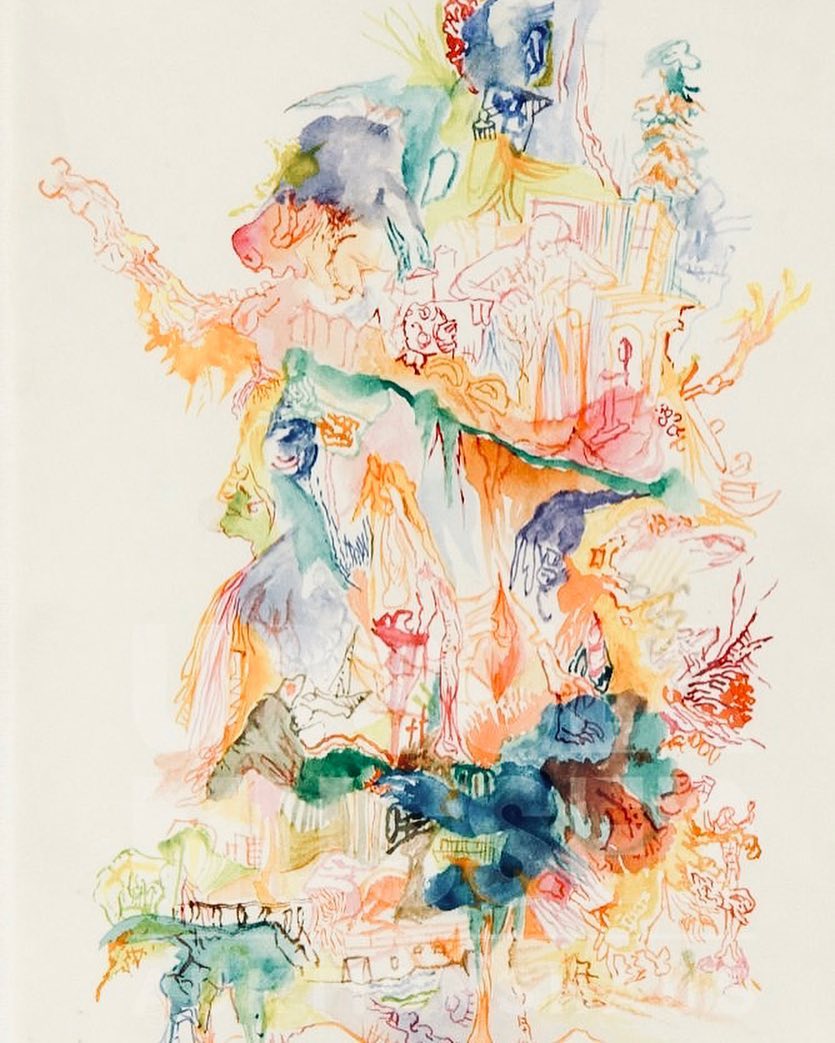
Bernard Schultze - German Abstract Painting

Bernard Schultze was born on 31 May 1915 in Schneidemühl (West Prussia). After his Abitur he studied at the art academies in Berlin and Düsseldorf from 1934 to 1939.His entire work produced before 1945 was destroyed during an air-raid on Berlin in 1945. Schultze moved to Frankfurt two years later where he began making his first informel paintings in 1951.An exhibition of the artist group "Quadriga" in 1952, of which he was a co-founder, in the "zimmer galerie franck" in Frankfurt included works by the artist. The group's aim was to move away from figurative and formalistic abstraction towards the international avant-garde movements Action Painting and Tachisme.In 1955 Schultze married the painter Ursula Bluhm and he made his first relief paintings with different materials stuck onto the canvas. The so-called "tabuskris" (tabulae scriptae), works combining painting and drawing made from 1957, were followed by the "Migofs" in 1961. This name, invented by Schultze, refers to constructions and creatures, which, in his eyes, exist among the creatures of nature.He travelled regularly to Paris and New York during this period, before moving from Frankfurt to Cologne in 1968. He travelled to Russia, the USA and Asia. He was elected a member of the "Akademie der Künste" in Berlin in 1972. Schultze achieved an important late woke, on which he worked intensively until his death on 14 April 2005.His work has been awarded a number of prizes: he was honoured with the title of a "Titularprofessor" of the state of North-Rhine Westphalia in 1981; he was awarded the "Großer Hessischer Kulturpreis" in 1984, the Lovis Corinth Prize in 1986 and the Stefan-Lochner-Medal of the City of Cologne in 1990.Important exhibitions have been dedicated to the artist's work since the 1980s, for example the extensive retrospective exhibition in Düsseldorf, Berlin, Frankfurt and Saarbrücken in 1980-81 and the retrospective exhibition of his graphic work in the Albertina in Vienna and other museums in Germany in 1984. A large selection of his works toured to Cologne, Bologna and Budapest between 1994 and 1996.Berhard Schulze belonged to the last great names and precursors of German postwar-abstraction.(www.bernard-schultze.com)