Exposition Art Blog: American art
Showing posts with label American art. Show all posts

Jess Collins: The Mysterious Alchemist of American Art

 Jess (Jess Collins) – American Artist

Jess Collins (August 6, 1923 – January 2, 2004), known simply as Jess, was a distinctive American visual artist celebrated for his unique paintings, collages, and drawings. Born Burgess Franklin Collins in Long Beach, California, he later rejected his family name and became known professionally as Jess.

Jess grew up surrounded by literature and classical music. As a child, he read L. Frank Baum’s Oz books, Edgar Allan Poe, and Marcel Proust, while listening to Beethoven, Mahler, Sibelius, and Brahms. He also created scrapbooks with his great-aunt — an experience he later identified as the origin of his lifelong collage practice.

His artistic work is deeply influenced by themes of alchemy, mythology, the occult, chemistry, and male beauty. Jess developed a highly personal and symbolic visual language that stood apart from mainstream art movements of his time.

Notable Works and Series

One of his most important series is Translations (1959–1976), consisting of heavily textured, impasto paintings created in a meticulous paint-by-number style. These works reinterpret found images into lush, dreamlike compositions. Six paintings from this series were exhibited at the Wadsworth Atheneum in 1975.

Jess also created elaborate murals in the late 1950s for the Berkeley home of renowned film critic Pauline Kael. These fantastical, Romantic-style murals still adorn the walls today.

In addition to painting, Jess was a master of collage. He famously repurposed vintage book illustrations and comic strips — most notably transforming the Dick Tracy strip into his own subversive series called Tricky Cad.

His final major work, the large-scale drawing Narkissos (over 6 x 5 feet), is considered a masterpiece and is part of the permanent collection of the San Francisco Museum of Modern Art (SFMOMA).

Artistic Legacy

Jess’s art is appreciated for its poetic sensibility, intricate detail, and deep engagement with myth and mysticism. Though he worked largely outside the spotlight of major art trends, his work continues to influence contemporary artists interested in collage, symbolism, and alternative narratives.

Today, Jess is recognized as one of the most original and enigmatic figures in post-war American art.


Ralph Rosenborg - Abstract Landscape Painting


"Although Ralph Rosenborg has painted abstract work throughout his life, nature has served as his perennial motif.He won a scholarship while still in high school to Saturday art classes at the American Museum of Natural History in New York City. After classes ended, he later continued to study privately with his teacher there, Henriette Reiss, who provided not only exacting technical training, but broad-based instruction in music, literature, and art history. More significantly, Reiss had worked with Kandinsky earlier in her career and introduced her young protégé to the vast arena of vanguard European ideas. After four years, Rosenborg was ready to exhibit. He showed frequently during the 1930s—initially in group exhibitions at ACA Galleries and later in Mayor La Guardia’s 1934 Mile of Art at Radio City. His first solo exhibition, at the Eighth Street Theater in 1935, was followed by shows at various galleries almost annually throughout the 1940s.
A highly personal artist, inclined toward interpreting nature rather than the geometric form pursued by many of his fellow members of the American Abstract Artists, Rosenborg wrote in 1955,
“Painting will always remain a super-real world to me, devoid of all modern forms of blasphemy. It is a world in which the immensity of creation moves me to a personal form of prayer and contemplation. It is also a world in which its laws demand a personal integrity of purpose, a simple humbleness, and a sufficient set of experiences as the basic requirement for admission to it.”
During the 1930s and 1940s, Rosenborg moved freely between expressionist watercolors evocative of the rhythms and colors of nature (such as the Untitled watercolor of about 1938) and more consciously structured oils, such as The Far-away City, in which deep-toned, dream-world landscapes take on the color and architecture of expressive stained glass. He paid little heed to modernist theories of surface and structure that fascinated many of his contemporaries. Later during the 1950s, Rosenborg’s paintings increasingly reflected the energies, as well as the appearances, of the natural world. Tumultuous seascapes, serene landscapes, and brightly colored floral still lifes, were all executed with an attention to richly textured, heavily painted surfaces."(americanart.si.edu)


Cadillac Ranch - Chip Lord, Hudson Marquez and Doug Michels


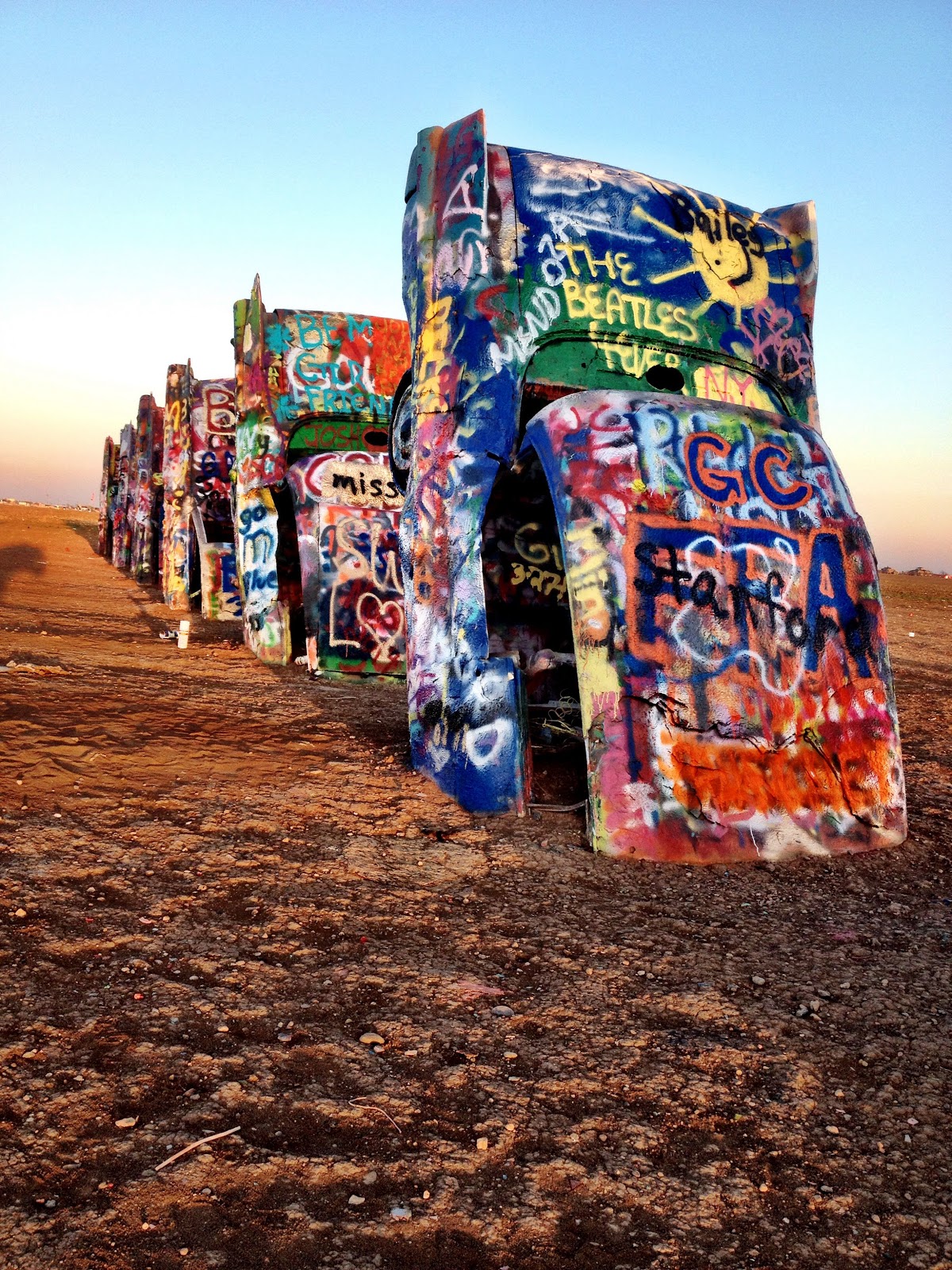
Cadillac Ranch is a public art installation and sculpture in Amarillo, Texas, USA. It was created in 1974 by Chip Lord, Hudson Marquez and Doug Michels, who were a part of the art group Ant Farm. It consists of what were (when originally installed during 1974) either older running used or junk Cadillac automobiles, representing a number of evolutions of the car line (most notably the birth and death of the defining feature of mid twentieth century Cadillacs: the tailfins) from 1949 to 1963, half-buried nose-first in the ground, at an angle purportedly corresponding to that of the Great Pyramid of Giza in Egypt. According to Marquez, “Chip and I were living in the mountains north of San Francisco, and there was a book meant for kids left in a bar near where we lived. It was called ‘The Look of Cars,’ and there was something on the rise and fall of the tail fin. I didn’t have a lot to do, so I just sorta drew it up. I’ve always loved the Cadillacs.”The group claims to have been given a list of eccentric millionaires in 1972 in San Francisco, identifying Stanley Marsh 3 of Amarillo amongst those who might be able to fund one of their projects and submitted it to him. Marsh's response began "It's going to take me awhile to get used to the idea of the Cadillac Ranch. I'll answer you by April Fool's Day. It's such an irrelevant and silly proposition that I want to give it all my time and attention so I can make a casual judgement of it.Cadillac Ranch was originally located in a wheat field, but in 1997, the installation was quietly moved by a local contractor to a location two miles (three kilometers) to the west, to a cow pasture along Interstate 40, in order to place it farther from the limits of the growing city.Both sites belonged to the local millionaire Stanley Marsh 3, the patron of the project. Marsh was well known in the city for his longtime patronage of artistic endeavors including the Cadillac Ranch; Floating Mesa; Amarillo Ramp, a work by land artist Robert Smithson; and a series of fake traffic signs throughout the city known collectively as the Dynamite Museum. As of 2013, Stanley Marsh 3 did not own the Cadillac Ranch; ownership appears to have been transferred to a family trust some time before his June 2014 death.Cadillac Ranch is visible from the highway, and though located on private land, visiting it (by driving along a frontage road and entering the pasture by walking through an unlocked gate) is tacitly encouraged. In addition, writing graffiti on or otherwise spray-painting the vehicles is now encouraged, and the vehicles, which have long since lost their original colors, are wildly decorated. The cars are periodically repainted various colors (once white for the filming of a television commercial, another time pink in honor of Stanley's wife Wendy's birthday, and again all 10 cars were painted flat black to mark the passing of Ant Farm artist Doug Michels, or simply to provide a fresh canvas for future visitors). In 2012 they were painted rainbow colors to commemorate gay pride day. The cars were briefly "restored" to their original colors by the motel chain Hampton Inn in a public relations-sponsored series of Route 66 landmark restoration projects. The new paint jobs and even the plaque commemorating the project lasted less than 24 hours without fresh graffiti.Wikipedia


https://milenaolesinska.blogspot.com/p/blog-page_50.html

Philadelphia Wireman


The Philadelphia Wireman is the working name given to an unknown outsider artist responsible for approximately 1,200 small-scale wire-frame sculptures that were found by a passerby, abandoned on a street outside a transient home in Philadelphia, Pennsylvania in 1982.The artist is assumed to have access to tools required to bend some of the heavy-gauge wire in the sculptures; it is hypothesised that the sculptures were abandoned after their creator's death. Nothing is known about the artist's motives. Many of the pieces resemble African art, and this plus the demographics of the neighborhood where the art collection was found cause some reviewers to speculate that the artist was African-American.Wikipedia


https://milenaolesinska.blogspot.com/p/blog-page_50.html