Carol Haerer was born and raised in Kansas and received her B.A. from the Univeristy of Nebraska. She won a Fulbright Scholarship and a Woolley Fellowship allowing her to study, work, and exhibit in Paris in the 1950s. She returned to the U.S. to study at U.C. Berkeley, shortly thereafter co-founding the Berkeley Gallery. She moved to New York in the late 1950s, becoming a prominent New York abstractionist. Carol Haerer exhibited at the San Francsico Museum of Modern Art, the Whitney Museum, the Sheldon Memorial Art Gallery, Dartmouth College, and numerous New York galleries. Haerer's work is in the collections of the Guggenheim Museum, the Whitney Museum, the Sheldon, the University of Kansas, and many others.(grinderfineart.com)
Painting is like silent poem, said Simonides, poet from ancient Greece.Paintings are icons, doors to the Platonian world above the heavens. Paintings on my blog are just those icons, which lead a viewer into the magic world of harmony and beauty. Artists who present their achievements on my blog have a very different cultural and national background, they represent variety of artistic traditions and schools
Showing posts with label lyrical abstraction artist. Show all posts
Lyrical Abstraction Hans Hartung
Hans Hartung (21 September 1904 – 7 December 1989) was a German-French painter, known for his gestural abstract style. He was also a decorated World War II veteran of the French Foreign Legion.artung was born in Leipzig, Germany into an artistic family. He developed an early appreciation of Rembrandt, German painters such as Lovis Corinth, and the Expressionists Oskar Kokoschka and Emil Nolde. In 1924 he enrolled in Leipzig University, where he studied philosophy and art history. He subsequently studied at the Fine Arts academy of Dresden, where he copied the paintings of the masters. The modern French and Spanish works he saw in 1926 at the Internationale Kunstausstellung in Dresden were a revelation to him,and he decided that he would leave his native country to prevent succumbing to provincialism. Consequently, after a bicycle trip through Italy, he moved to Paris.
In Paris, Hartung had little contact with other artists, and copied the works of old and modern masters. He visited the south of France, where the landscape inspired him to a close study of the works of Cézanne, and he developed a great interest in principles of harmony and proportion such as the golden section. In 1928 he visited Munich where he studied painting technique with Max Doerner. In 1929 he married the artist Anna-Eva Bergman and established himself in the French towns of Leucate, and then in the Spanish Balearic Islands, eventually settling in Minorca. He exhibited for the first time in 1931 in Dresden.
The death of his father in 1932 severed Hartung's last bonds with Germany. He was rejected from Nazi Germany on account of being a 'degenerate', because his painting style was associated with Cubism – an art movement incompatible with Nazi Germany's ideals. In 1935 when he attempted to sell paintings while visiting Berlin, the police tried to arrest him. He was able to flee the country with the help of his friend Christian Zervos.
After he returned to Paris as a refugee, Hartung and his wife divorced, and he became depressive. His paintings were becoming more abstract and did not sell well. His friends tried to help him with his financial difficulties, and the sculptor Julio González offered him the use of his studio. In 1939 Hartung married González’s daughter Roberta.
In December 1939, he became a member of the French Foreign Legion. He was closely followed by the Gestapo and arrested for seven months by the French police. After they learned he was a painter, he was put in a red cell in an attempt to disturb his vision. After being released he rejoined the Legion to fight in North Africa, losing a leg in a battle near Belfort. He earned French citizenship in 1945, and was awarded the Croix de Guerre.
In 1947 in Paris he had his first solo exhibition. By the late 1950s he had achieved recognition for his gestural paintings, which were nearly monochromatic and characterized by configurations of long rhythmical brushstrokes or scratches. In 1960 he was awarded the International Grand Prix for painting at the Venice Biennale.
Hartung's freewheeling abstract paintings set influential precedents for many younger American painters of the sixties, making him an important forerunner of American Lyrical Abstraction of the 1960s and 1970s. He was featured in the 1963 film documentary "School of Paris: (5 Artists at Work)" by American filmmaker Warren Forma.In the 1970s, Hartung and Anna-Eva Bergman remarried. He died on 7 December 1989, in Antibes, France.Wikipedia
Arshile Gorky
"Arshile Gorky, original name Vosdanik Adoian (born April 15, 1904, Khorkom, Van, Turkish Armenia [now in Turkey]—died July 21, 1948, Sherman, Connecticut, U.S.) American painter, important as the direct link between the European Surrealist painters and the painters of the American Abstract Expressionist movement.
Gorky’s early life was disrupted when his father abandoned Turkey, his wife, and his family in order to avoid service in the Turkish army. The rest of the family soon fled to Armenia to escape Turkish persecution and were subsequently dispersed. In 1920 Gorky emigrated to the United States, where he rejoined his sister in Watertown, Mass., and assumed the pseudonym by which he became known. The name Arshile is derived from Achilles, the brooding Achaean hero of the Iliad. The name Gorky (Russian for “the bitter one”) is derived from that of the writer Maksim Gorky.
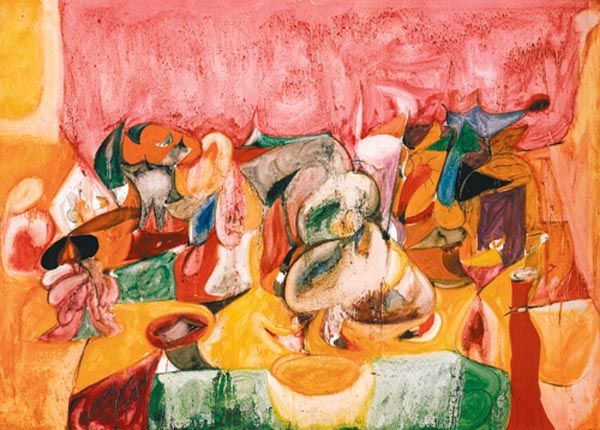
After studying painting at the Rhode Island School of Design, Gorky enthusiastically entered into the Bohemian life of Greenwich Village in New York City, occasionally passing himself off as a successful Russian portraitist who had studied in Paris and experimented with Automatism. From 1926 to 1931 he taught at the Grand Central School of Art. Early in his career, he hit on the idea of becoming a great painter by subjecting himself to long apprenticeships, painting in the style of such artists as Paul Cézanne, Joan Miró, and Pablo Picasso. His aim was never merely to imitate the work of others, however, but to assimilate fully their aesthetic vision and then move beyond it.
Gorky remained stylistically unable to move beyond the work of his mentors until about 1939, when he met the Chilean Surrealist painter Roberto Matta. The Surrealists’ idea that art is the expression of the artist’s unconscious enabled Gorky to discover his personal idiom, which he pursued the last eight years of his life. In such works as The Liver Is the Cock’s Comb (1944) and How My Mother’s Embroidered Apron Unfolds in My Life (1944), biomorphic forms that suggest plants or human viscera float over an indeterminate background of melting colours. The erotic significance of the loosely painted forms and elegant, fine black lines is often made explicit in such titles as The Diary of a Seducer (1945) and The Betrothal II (1947). The years that saw Gorky finally emerge as one of the most important painters in the United States were marked by personal tragedy, however. In early 1946 he lost many of his paintings in a studio fire, and soon after he underwent an operation for cancer. In June 1948 his neck was broken in an automobile accident, and he lost the use of his painting hand. His wife left him the following month, and shortly thereafter he hanged himself."(Encyclopædia Britannica)
Gorky's contributions to American and world art are difficult to overestimate. His work as lyrical abstraction was a "new language. He "lit the way for two generations of American artists".The painterly spontaneity of mature works like The Liver is the Cock's Comb (1944), One Year the Milkweed (1944), and The Betrothal II (1947) immediately prefigured Abstract expressionism, and leaders in the New York School have acknowledged Gorky's considerable influence.
But his oeuvre is a phenomenal achievement in its own right, synthesizing Surrealism and the sensuous color and painterliness of the School of Paris with his own highly personal formal vocabulary. His paintings and drawings hang in every major American museum including the National Gallery of Art, the Museum of Modern Art, the Art Institute of Chicago, the Metropolitan and the Whitney Museum of American Art in New York (which maintains the Gorky Archive), and in many worldwide, including the Tate in London.Wikipedia
Subscribe to:
Posts (Atom)


