Exposition Art Blog: modern art
Showing posts with label modern art. Show all posts

Ernst Fuchs Austrian Master of Surrealism and Mysticism

 Ernst Fuchs (1930–2015)  was one of the most influential Austrian painters, graphic artists, and sculptors of the 20th century, widely regarded as a leading figure and co-founder of the Vienna School of Fantastic Realism (Wiener Schule des Phantastischen Realismus).
A true visionary, Fuchs developed a highly distinctive artistic language characterized by meticulous detail, luminous color, and profound symbolic depth. His works seamlessly blend elements of surrealism, symbolism, mysticism, and religious iconography, creating dreamlike yet technically masterful compositions.Artistic Style and Vision
Fuchs’s paintings are renowned for their rich, jewel-like surfaces and intricate detailing. He often employed the Mischtechnik — a complex, old-master glazing technique combining oil and tempera — which allowed him to achieve extraordinary luminosity and depth. His compositions frequently feature floating figures, mythological beings, erotic symbolism, alchemical references, and biblical themes reinterpreted through a fantastical lens. Themes of transformation, spirituality, sexuality, and the subconscious permeate his oeuvre. Fuchs drew inspiration from artists such as Gustav Klimt, Albrecht Dürer, Hieronymus Bosch, and the Symbolists, while also incorporating influences from Eastern philosophy, Jewish mysticism (Kabbalah), and Christian iconography.
Beyond painting, Fuchs was a prolific graphic artist, creating numerous etchings, lithographs, and mezzotints. He also designed furniture, jewelry, and stage sets, demonstrating his versatility as a total artist in the spirit of the Renaissance.
Legacy Ernst Fuchs played a crucial role in reviving traditional painting techniques in the post-war era while simultaneously pushing the boundaries of figurative art. His work stands as a bridge between classical mastery and visionary imagination. Today, his paintings are held in prestigious private collections and museums worldwide, and he remains a major source of inspiration for contemporary artists working in the fantastic, surreal, and symbolic traditions.
Often called the “prince of visionary art,” Fuchs created a unique universe where the sacred meets the sensual, and reality merges with myth — leaving behind a body of work that continues to fascinate and enchant viewers across generations.


Alen Divis


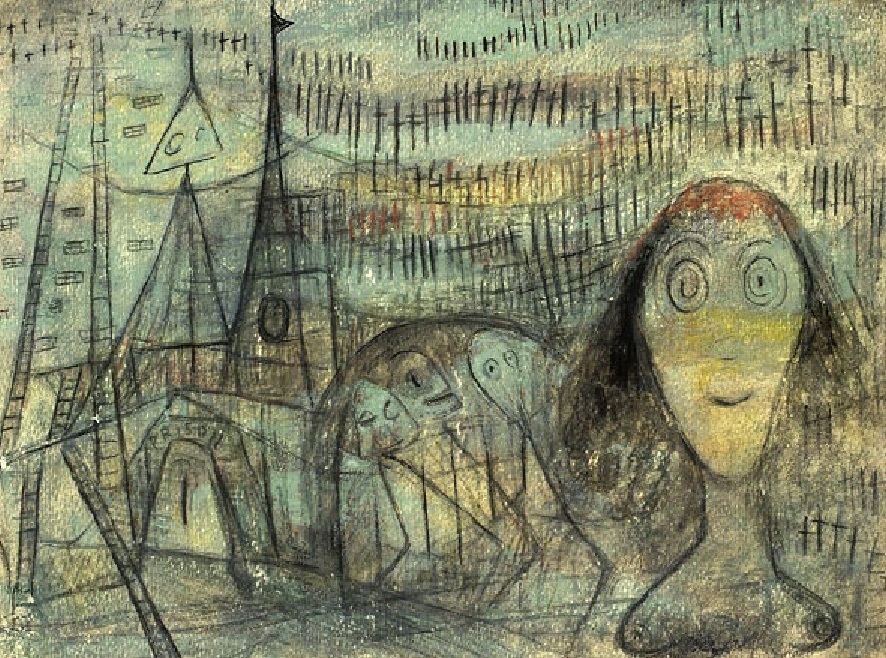
 Alen Divis ( 1900 – 1956) was a Czech painter known for his melancholic art. Having spent much of his life abroad, often working in solitude, he remained rather unknown during his life but has had a postmortem revival in the art world.
In 1947, after the end of the Second War and the liberation of Czechoslovakia, Diviš returned to his native country, more than two decades after he had first left for Paris. Upon his return, he achieved a brief period of success. His written memoirs of Santé were published in a weekly paper, and in February 1948, his recent work was exhibited in Prague. The same month, however, brought the Communist coup d'état which would marginalize artists of his type out of work. He spent the rest of the decade producing illustrations for Karel Jaromír Erben's mid-19th century collection of ballads
"He became a sort of mythological figure in Czech modern art. He was known as an artist that was forgotten and then sort of miraculously rediscovered. He was someone who was very secretive, whose art was very dark. He was more a figure coming from a romantic literature than from life..."


Paul Guiragossian


 Paul Guiragossian (1926 –1993) was an Armenian Lebanese painter.
"Art is greater than me, greater than any artist. I will remain an apprentice until the end. Art is our oxygen, it keeps us conscious, and without it we are insignificant. It's the crossroad of all disciplines, of all sciences. Like a sun it illuminates the past, the present and the future. It preserves our humanity, it is so much more important that man is hardly a rough draft. Our problem is that we don't live up to our humanity'. (Paul Guiragossian). A trajectory of Paul Guiragossian's oeuvre conveys an evolution of an abstract practice that originated in figurative portraiture. He is of Armenian origin, born in Jerusalem and lived in Lebanon. Undoubtedly his background has highly influenced a body of work that not only responds and is limited to the region's historical context but one that engages with the postmodern occupation with notions of identity, and 'the other'. In Madonna and Child (lot 13) dated circa early 1960s, Guiragossian draws from a palette of warm hues of red often associated with religious iconography. The main figure appears to be flat against the surface whilst tablets of religious narratives frame Mary. We begin to witness the emergence of thick brushstrokes- a style that defines Guiragossian's later works. Additionally, the context in which this work was executed is significant in gaining insight to Guiragossian's earlier practice. The Middle East was in upheaval, the Arabs were defeated in the 1956 war with Israel, and the Armenian community was vulnerable to constant persecution. Guiragossian was granted a scholarship and travelled to Florence and Paris to pursue his studies in painting. He was abandoned by his mother from an early age, thus possibly explaining the ubiquity of the female figure in his works. It may be suggested that this work reveals the artist's personal struggle and marks a shift from a more traditional style towards the later abstract work that is manifested in vibrant and luminous colours. Nevertheless, it certifies and reasserts Guiragossian's mastering of figurative technique and his proficiency as an artist. In lot 14 dated circa 1968-1972, Guiragossian employed thick brushstrokes in a muted brown palette to depict a laborer who appears to be kneeling on the ground with his head resting on his arms. The figure's posture suggests melancholy, fatigue and hardship. By observing and painting the everyday life, he sought to express the human condition in its most difficult and most wonderful state. He called himself "the artist of the people", always acknowledging himself as one of them, therefore accepting that this was also his own condition. Guiragossian creates a certain intimacy and understanding between himself and his character in lot 14. This painting further resonates traditional drawings of the labour workers executed by European painters in the 19th century. Guiragossian arrives at his later works of elongated abstract vertical slim figures in the late 1970s. Vertical figures are manifested through the use of thick brushstrokes. The artist often used multiple layers of paint to create a thick opaque texture on the surface offering multiple depths throughout. Additionally in this period, his palette expanded to vibrant and luminious colours intrinsic to a Mediterranean landscape of sea, mountain and sun. 'The colors of the sun and the rainbow', he said, 'belonged to us in the Orient, it's from here where the sun rises and it's from here where it all begins'. However, the 1970s had witnessed the cusp of a Lebanese Civil War, raging throughout the 1980s, yet the brightness of his colours were also a symbol of giving hope to his people in the Middle East during these decades of war. Guiragossian's abstract figures resonate with Jackson Pollock splurges of expressionist dismay or even recalls Barnet Newman's vertical zips conveyed in Adam and Eve. In Guiragossian's work there is nonetheless an undertone of positivity, a deliberate upward movement that is drenched in a vibrancy that is both static and in motion, possibly also evoking Alberto Giacometti's existentialist bronze sculptures that effect a perspective of distance. The elongated figures in Nocturne  stand with their heads slightly bowed, possibly suggesting a sense of mourning or resignation."(christies.com)


Renato Guttuso

 
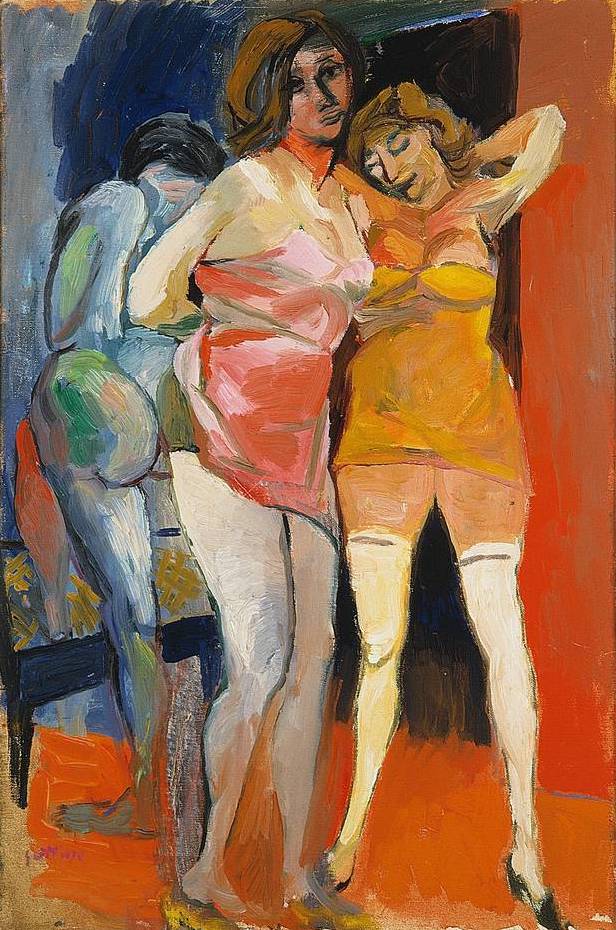
Renato Guttuso (1911-1987) was an Italian artist known for his association with the Socialist Realism movement popular in the Soviet Union. A fervent opponent of Fascism and a devoted communist, Guttuso’s works carried a strong political message, as seen in his troubling Execution by Firing Squad in the Countryside (1938), a painting depicting the violent assassination of the Spanish poet Federico Garcia Lorca by fascist militia. His expressive brushstrokes and rich use of warm reds and browns, can be seen in his painting La Vuicciria (1974), a scene of a bustling market in Palermo. Born on December 26, 1912 in Bagheria, Sicily, he gave up studying law at Palermo University to pursue a career as an artist. Having shown an aptitude for drawing at a young age, his early style reflected the influence of Giorgio de Chirico. The artist went on to exhibit two of his paintings in 1931 at the showcase, Prima Quadriennale d’Arte Nazionale de Roma. Guttuso died January 18, 1987 in Rome at the age of 75.