Exposition Art Blog: Pop art
Showing posts with label Pop art. Show all posts

Charles Thomas Close


 Charles Thomas Close (1940 – 2021) was an American painter, visual artist, and photographer who made massive-scale photorealist and abstract portraits of himself and others. Close also created photo portraits using a very large format camera. Chuck Close is known for his innovative conceptual portraiture, depicting his subjects, which are transposed from photographs, into visual data organized by gridded compositions.Throughout his childhood and adolescence, Close used art as a means of navigating a learning disability. He continued to develop his artistic skills through private art lessons, drawing and painting from live models. As a student at the University of Washington (BA, 1962), and then at Yale (BFA 1963; MFA 1964), he began to emulate the styles of Arshile Gorky and Willem de Kooning, considering himself a third-wave Abstract Expressionist and as he explored this vocabulary he pivoted from biomorphism to figuration.
After studying at the Akademie der Bildenden Künste in Vienna (1964) on a Fulbright grant, Close returned to the United States in 1965. He taught painting at the University of Massachusetts, Amherst, where he received his first solo exhibition in 1967. Seeking to break from the gestural style that had characterised his student work, Close shifted toward Pop-inflected figuration before embracing the tools of commercial art and illustration. Basing his paintings on photographic imagery, Close reduced his palette to black and white.


Michael "Mike" Kelley


 Michael "Mike" Kelley (1954 - 2012) was an American artist. His work involved found objects, textile banners, drawings, assemblage, collage, performance and video. He often worked collaboratively and had produced projects with artists Paul McCarthy, Tony Oursler and John Miller. Writing in The New York Times, in 2012, Holland Cotter described the artist as "one of the most influential American artists of the past quarter century and a pungent commentator on American class, popular culture and youthful rebellion
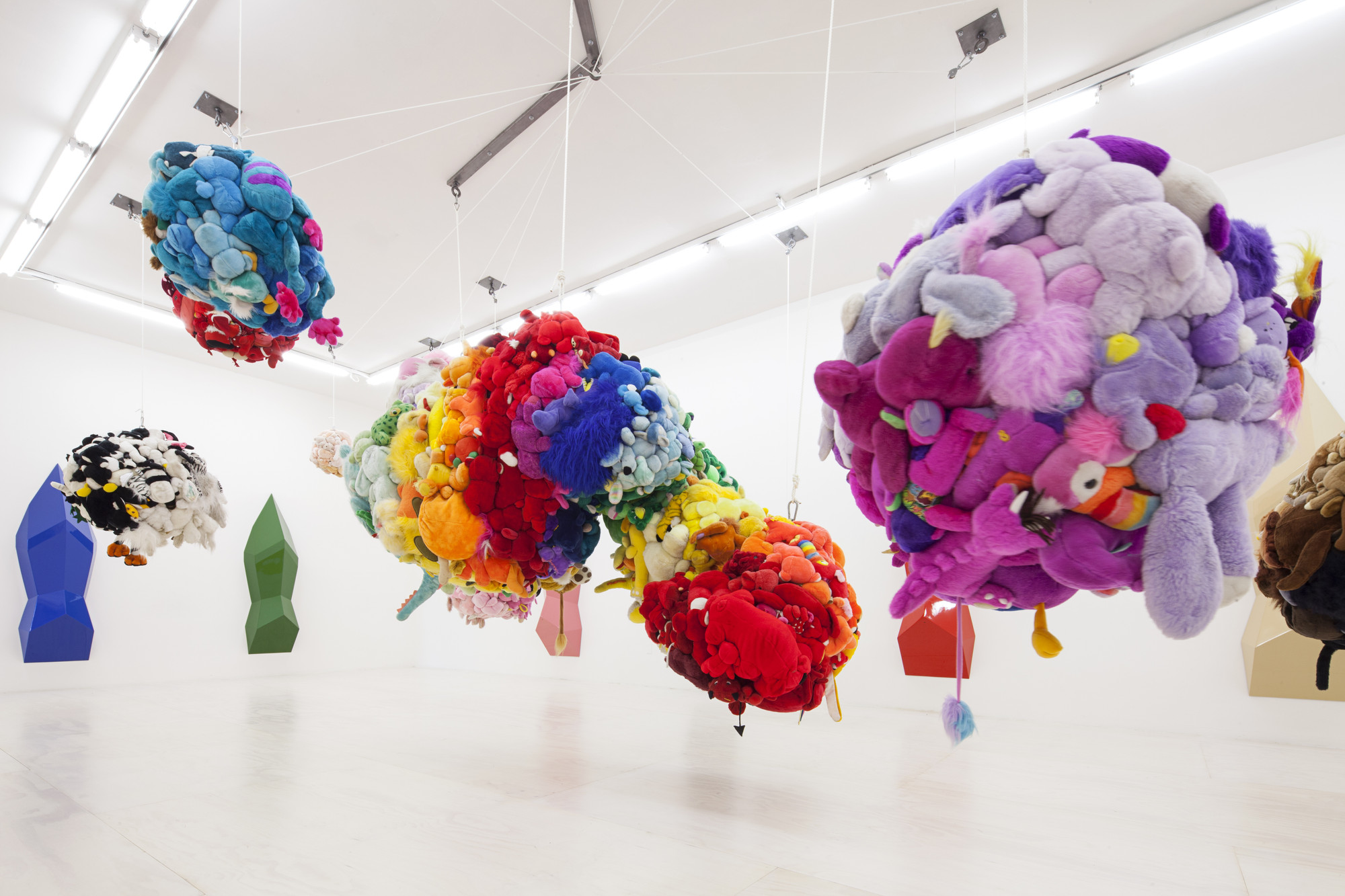
Kelley gained recognition in the 1980s for his work with children's soft toys and other found materials. With these materials, he examined popular culture, memories and fragmented narratives.
Children's toys also function in Kelley's work as a satirical metaphor. Deodorized Central Mass with Satellites (1991–99) consists of suspended balls created from discarded, brightly coloured toys. By transforming children's toys into serious sculpture, Kelley visualised a darker side to the American dream's endorsement of excessive consumption and reckless luxury collecting, and intermingled the 'low' and the 'high' of American culture. He also deodorised his suspended sculptures, mocking America's selective amnesia of unpleasant realities.


Sigmar Polke - Pop Art


"Multi-media artist, Sigmar Polke, had the capacity to be at once irreverent, playful, and acerbic. From painting to photography and film to installations and prints, Polke's work, which often incorporated non-traditional materials and techniques, was above all a critique of art itself. Sometimes veiled and sometimes confrontational, the messages conveyed in his work raise serious questions about aesthetic, political, and social conventions. For Polke, the production of art was consistently a dialogue between himself and the viewer, which presented virtually limitless interpretive possibilities. Along with a group of fellow artists that included Gerhard Richter, he introduced the term, Capitalist Realism, which refers loosely to commodity-based art. Further, and specifically in the case of Polke's work, Capitalist Realism constitutes not only a critique of Pop art and the commodification of art and capitalism overall but also of the idealistic and overtly nationalistic Soviet Social Realism that Polke was particularly exposed (and opposed) to.The cynically witty Polke helped launch the Capitalist Realism style as a response to American and British Pop art. Rather than simply commenting on mass production and conspicuous consumption Polke went a step further. With works such as Chocolate Painting, he eliminated signifiers like labels with brand names in order to poke fun at notions of individuality and uniqueness. Indeed, despite the biting commentary of Pop art and its critique of capitalist consumer homogeneity, works like Andy Warhol's Campbell's Soup cans, with their labels and their sameness, still sold for large sums. The objects in Polke's Pop works are stripped of such identifiers, which emphasizes how banal they actually are.At the fore of Polke's experiments was the impulse to challenge virtually every convention of art, often in surprising and ingenious ways. His iconoclastic tendencies extended not merely to content but to the materials of the works themselves, which were often adamantly non-traditional. From uranium and meteorite dust, brightly printed fabric and soot, to bubble wrap and potatoes, Polke's artistic odyssey took him and his work to the potential limits of creation."(theartstory.org)


James Rizz - American Pop Art

James Rizzi (October 5, 1950 – December 26, 2011) was an American pop artist who was born and raised in Brooklyn, New York.James Rizzi is a US American Pop Artist, graduated from University of Florida in Gainesville, Florida. He came up with the idea of 3D multiples now mostly associated with his name when, having taken classes in painting, printmaking and sculpturing, he had to hand in grade work for all three subjects, but only had time for doing one. So he created an etching, printed it twice, handcolored it, and mounted parts of the one print on top of the other, using wire as a means of adding depth. Having received good grades from all three teachers, he stuck with the idea and developed it further.He lived with Baybi Day an actress from 1971- 1979. Later, he married Gaby Hamill, a fashion designer, they shortly after divorced. James Rizzi never had any children of his own, but has two nieces Jennifer Fishman and Laura Rizzi and one nephew Brian Rizzi who is also his godson. Finally a goddaughter Georgia Rae Pai Foster, daughter of Emrie Brooke Foster.
Rizzi was most famous for his 3D artwork, "especially the large, elaborate prints and teeming anthropomorphic cityscapes. His merry maximalism and delight in delirious detail and elaborate minutiae created a true art brand, a trademark style as recognizable as any in the world."Late in life, he returned to painting. His "latest paintings combine his Picasso meets Hanna-Barbera drawing style with an increasingly chromatic palette and a complex graphic structure that simultaneously evokes cubism and the most sophisticated Amerindian friezesWikipedia