Exposition Art Blog: European avant-garde art
Showing posts with label European avant-garde art. Show all posts

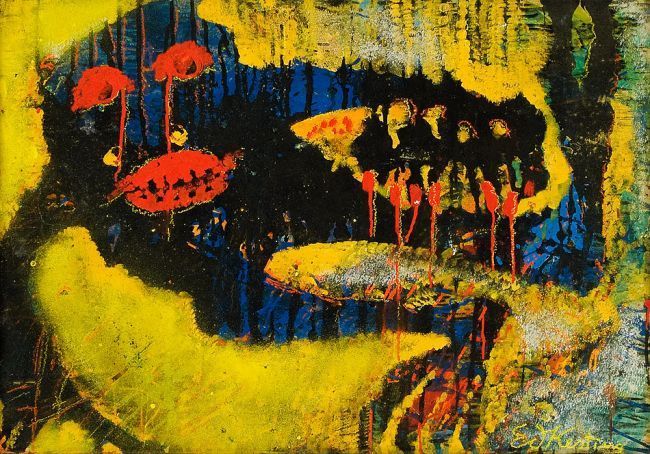
Edmund Kesting - European Avant-Garde Art


 Edmund Kesting ( 1892 –1970 ) was a German photographer, painter and art professor.
He studied until 1916 at the Dresden Academy of Fine Arts before participating as a soldier in the First World War, upon returning his painting teachers were Richard Müller and Otto Gussmann and in 1919 he began to teach as a professor at the private school Der Weg. In 1923 he had his first exposition in the gallery Der Sturm in which he showed photograms. When Der Weg opened a new academy in Berlin in 1927, he moved to the capital.He formed relations with other vanguardists in Berlin and practiced various experimental techniques such as solarization, multiple images and photograms, for which reason twelve of his works were considered degenerate art by the Nazi regime and were prohibited. He participated in the controversy between socialist realism and formalism that took place in the German Democratic Republic, therefore his work was not realist and could not be shown in the country between 1949 and 1959. In 1955 he began to experiment with chemical painting, making photographs without the use of a camera and only with the use of chemical products such as the developer and the fixer and photographic paper, for which he made exposures to light using masks and templates. Between 1956 and 1967 he was a professor at the Academy of Cinema and Television of Potsdam.His artistic work was not recognized by the authorities of the German Democratic Republic until 1980, ten years after his death.Wikipedia


Jorgen Nash - Avant-Garde Art

Jorgen Nash (March 16, 1920 – May 17, 2004) was a Danish artist, writer and central proponent of Situationism.
"Member of Danish resistance during WW II, arrested twice. Fled to Sweden, where he lived his last forty years in the forest at a place called Drakabygget, outside Örkelljunga, 50 km northeast of Helsingborg in the south of Sweden.
Well-known multi-artist, infamous for his happenings and the amount of artists from all over who lived at Drakabygget from time to time.Married to Liz Zwick. Father of Cecilia Zwick-Nash and five more children from three different marriages.
Brother of Asger Jorn. Changed his name early on in order to set him free from his more famous brother.His major claim to fame was when he, along with other members of Bauhaus Situationniste and as a part of an anti consumerism manifestation, decapitated the world famous The Little Mermaid at Langelinie in Copenhagen harbour on 24 April 1964, something he openly confessed only few years before his death. The head was never found again, and a new one had to be made. The statue has since been decapitated and vandalised repeatedly, as well as being painted and dressed in burqas. On 24 April 1964, Nash with other members of Bauhaus Situationniste decapitated the statue of The Little Mermaid in Copenhagen harbour. This manifestation was part of the movements campaign against consumerist society."(imdb.com)


Ib Braase - experimental art

Ib Valentin Braase (7 August 1923 – 18 March 2009) was a Danish sculptor.From 1968, he lived and worked in Marcoussis near Paris.Born in Stege on the island of Møn, Braase was the son of the stonemason Christian Braase who introduced him to the art of stonework. As a 14-year-old, he crafted his first busts of family members. He studied at the Royal Danish Academy of Fine Arts from 1949 to 1954 under Einar Utzon-Frank and Aksel Jørgensen, becoming the assistant of Astrid Noack with whom he created small stone figures.After initially working with stone, in the 1950s he turned to bronze, embarking on a new, experimental phase which soon led him to abandon the traditional approach of the Academy. One of his acclaimed works from this period is Barneværelset (1969) which juxtaposes iron profiles and belongs to his bronze creations in an open structure. In 1968, he moved to Marcoussis near Paris where he developed an independent approach with unconventional materials such as bronze, iron, wood, zinc and paint in works resembling unfinished furniture or makeshift scaffolding.Braase exhibited widely from 1949, first as a member of the Den Polychrome association, then in Den Frie Udstilling and Grønningen. His work has also been presented in numerous solo exhibitions in Denmark and France.Wikipedia


Cobra Group - avant-garde painting Mogens Balle

Mogens Erik Schack Bale (April 1, 1921 in Copenhagen - 20 November 1988 in Asmindrup) was Danish painter.
Mogens Balle was the youngest of the Danish artists in the COBRA, a European avant-garde movement active from 1948 to 1951.