Exposition Art Blog: painter and sculptor
Showing posts with label painter and sculptor. Show all posts

Bolesław Biegas

Bolesław Biegas (1877–1954) was a Polish surrealist artist (painter and sculptor), best known for his "vampire-as-femme fatale" style of painting. Biegas was born in Koziczyn, Poland, and studied art under Konstanty Laszczka at the Jan Matejko Academy of Fine Arts in Krakow.
Biegas created a small museum for his art in Paris, France, called the Musée Boleslas Biegas. It is located within the Polish Library in Paris in the 4th arrondissement of Paris at 6, Quai d'Orléans.
The museum was established by Biegas in 1950, and contains his own paintings and sculpture, as well as those of other Polish artists active from the end of the nineteenth century to the beginning of the twentieth century, including Olga Boznańska and Tadeusz Makowski. The museum occupies one room in the Polish Library in Paris, which also houses the Musée Adam Mickiewicz and the Salon Frédéric Chopin. Guided visits are available Thursday afternoons and Saturday mornings by prior appointment; an admission fee is charged.Wikipedia


Shota Voskanyan

Shota Voskanyan ( born June 26, 1960 in Yerevan), is an Armenian artist.
1982–1987 Shota Voskanyan studied at the Moscow University of Arts. Since 1995 Shota Voskanyan is a Member of the Union of Artists of Armenia
His works are exhibited in National Gallery of Armenia, Artsakh museums, in Arame Art Gallery, Yerevan.
He has exhibited his works in Russia, Stokholm, Jerusalem, Germany, France, and New York
.Wikipedia

"The  Land  of  Peace  and Silence
How can one explain the particular interest of Shota Voskanyan (and some of his contemporaries) towards some theatrical and circus performance, reincarnation, certain episode or a fairytale illustration? Perhaps it is a dramatizing of our routine life. Perhaps it is a reality deviation or a poetic metaphor concentrating the life. All those really matter for the artist himself and his art. Most likely he makes up that world, and does not mark it out from the seen. Shota is a chamber artist depicting undercover, intimate feelings. In his works he lifts the veil of his own emotions. The world of his depictions is based on common truths arising from a vital formula of his zest for life: life is good regardless of misery, pain and solitude… The artist is sensible to the inner world of a human being full of sympathy and compassion. Notwithstanding, Shota believes that love and kindness rule the world.We observe that love in the nude figures of young women as well. Here is the admiration for female body shape like a precious vessel, an amazing tune…unique and charming. Here is archness, bliss and flirtation… The images of women are his vision of frank passion in all its variety. Here is no parting and consequently no misery now and then highlighted in his “theatrical” works."
Ruben Angaladyan


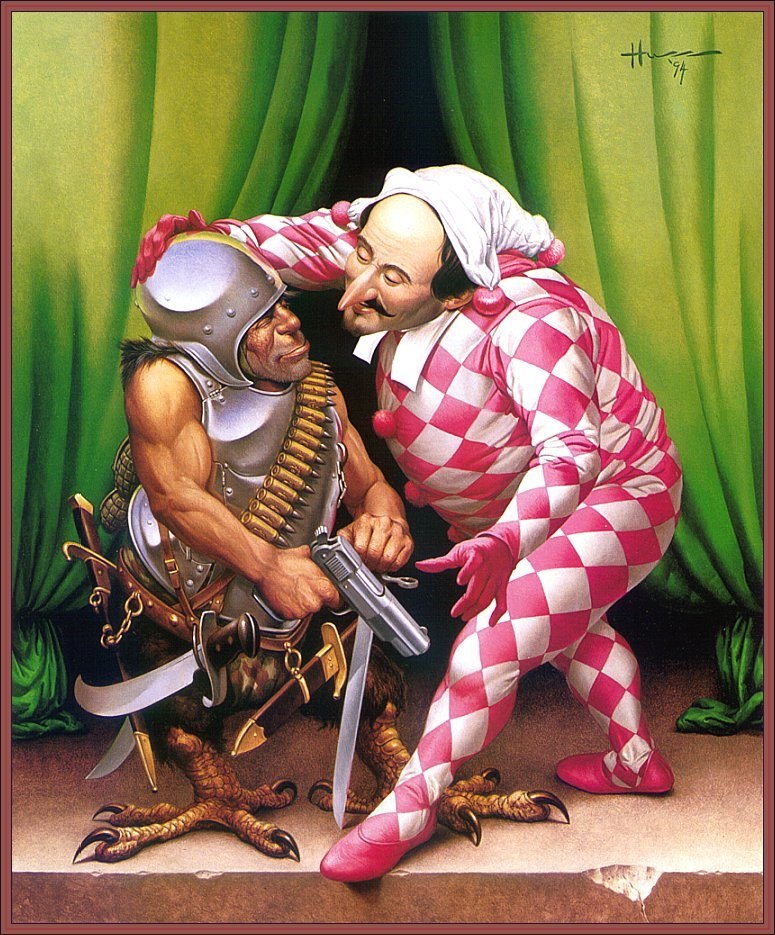
Fantastic art Judson Huss

Judson Huss (8 May 1942 – 25 July 2008), born Clifford Judson Huss, was an American-born painter and sculptor of fantastic art.
Born in Durham, North Carolina, he later moved with his family to Los Angeles, California where he began to study art. He was also a rock musician, playing guitar and bass with many bands, including Smith. He relocated to Paris in the mid 1970s, where he began to paint full-time. He was represented by the Morpheus Gallery, and through that gallery published River of Mirrors (1996), a retrospective book of his art.Wikipedia


Stefan Knapp

Stefan Knapp (1921 – October 12, 1996) was a Polish-born painter and sculptor, who worked in Great Britain. He developed and patented a technique of painting with enamel paint on steel, facilitating decorating public architectural structures.
Knapp was born in Biłgoraj. His father's name was Antoni and his mother was Julia, née Wnuk.
In 1935 he began studies at the Lwów Polytechnic. After the outbreak of World War II the Soviet Union occupied Lwów, murdered Knapp's father and sent Stefan to a gulag in Siberia. There, among other things, he worked building schools for Russian children who had been orphaned because their parents had been imprisoned or murdered for political reasons.While in the Gulag, because artistic endeavors were limited, he made chess sets out of bread and playing cards out of trash for his fellow prisoners


 He was released in 1942 after the Sikorski-Mayski Agreement was signed between Poland and Soviet Union. He joined the Anders Army and volunteered for the air force, hence he was shipped to Great Britain. Knapp began his training as a pilot on 29 June 1942 in Hucknall.He served as an officer and Spitfire pilot in the Royal Air Force. While in the RAF Knapp pursued his art by painting or sketching portraits of his fellow pilots in 318 Squadron.After the end of the war he remained in London and took advantage of a veteran's stipend to further his studies at the Royal Academy and at the Slade School of Fine Art..His experience in the Gulag and as an RAF pilot caused him to suffer from recurring nightmares and insomnia for many years. Consequently, he used his art as a form of therapy. In the late 1940s this resulted in a series of works titled Gulag. The works were noted for many experimental techniques.
Knapp was known for producing murals of unprecedented size with materials which were meant to last for thousands of years. He first received wide attention and acclaim during his exhibition in London in 1954. There he presented a unique and innovative style and technique, which involved melting glass into pieces of light steel, using specially made furnaces. Prior to finding fame he worked as a ski instructor in the Swiss Alps to make ends meet


 In the late 1950s Knapp moved away from traditional painting to experiments with enamel and sculpture. In the 1960s he painted several murals at Heathrow Airport, which were later reinstalled in the 1990s. In the early 1950s he painted a mural in the foyer of Hallfield Primary School, Westminster which was designed by the architect Denys Lasdun. He also painted a mural for the Warsaw metro entitled The Battle of Britain. Between 1954 and 1968 he held at least one exhibition each year, including ones in the Netherlands, Austria, and Peru. In 1972, he proposed an astronomy-themed work for the Mikołaj Kopernik University of Toruń which was accepted. Knapp also designed many decorations for synagoguess, many of which he based on his memories of synagogues, kirkuts and Jewish prayer houses in his childhood town of Biłgoraj.In the 1970s Knapp, together with his wife, moved to the British countryside, where he built a large furnace for his work. Knapp is also the author of the largest mural in the world, sized at 200⨯50 feet (about 60⨯15 metres), painted on the Alexander's department store building in Paramus, New Jersey.The building has since been demolished and the mural is currently in storage.


 For his military service he was awarded the Virtuti Militari cross. Knapp was the only Pole ever to receive the Churchill Fellowship, which he used to study and expand his knowledge of murals in Guatemala, India, Iran, Japan and Mexico. His other awards included the Knight's Cross of Polonia Restituta and the Cross of Valor. He was one of the best known Polish artists working in Great Britain. He wrote an autobiography "Kwadratowe Słońce" (The Square Sun) about his life in the Siberian gulag.
He died in 1996 at his studio in London, still working on his art. Thousands of people attended his funeral in London.Wikipedia


Painting in Space Yervand Kochar

Ervand "Kochar" Kocharyan (June 15, 1899, Tiflis, Russian Empire - January 22, 1979, Yerevan, Soviet Armenia) was a prominent sculptor and artist of the twentieth century, founder of Painting in Space.
Ervand Kochar was born in Tiflis on June 15, 1899. He graduated in 1918 from Nersisian School, and, between 1915-1918, also studied at the Arts School of the Caucasus Association for Promotion of Fine Arts (known as O. Schmerling School) in Tbilisi.From 1918 to 1919 he studied at the State Free Art Studio of Moscow. He returned to Tbilisi, where he was granted a certificate of professor of Fine Arts and Technical Studies by the People's Commissariat of the Georgian SSR.
In 1921 - 1922 Kochar was elected to the exhibition commission of the Union of Armenian Artists and became a member of the "HAYARTUN" (House of Armenian Art).


 In April 1922 he left from Batum and traveled abroad - to Constantinople, then to Venice, Rome, Florence and Paris. Kochar's works were first exhibited in Tbilisi in 1921 and the following year in Allied-controlled Constantinople (Istanbul) and in Venice.
By 1923 Kochar had settled down in Paris, where his art was well received and earned an enduring recognition. In 1928 there were reported cases of vandalism towards two sculpture-paintings by Kochar in the exhibition at the Salon des Indépendants. Those works were the first heralds of "Painting in Space".


 Between 1941 and 1943 Kochar was imprisoned on politically motivated charges, but was eventually freed due to the intervention of his friends from Nersissian School, Karo Halabian and Anastas Mikoyan. Yervand Kochar continued working in Yerevan, earning recognition as an Honored Artist of Armenia in 1956, People's Artist of Armenia in 1965, State Prize recipient in 1967, Soviet Order of Red Banner in 1971 and People's Artist of the Soviet Union in 1976. His most recognized works include the statues of David of Sassoun (1959) which has become the symbol of Yerevan, the capital of Armenia; of Vardan Mamikonian (1975); of Komitas (1969) in Echmiadzin. One of his masterpieces in painting is "Disasters of War". In 1963 The National Museum of Modern Art Centre Georges Pompidou in Paris acquired one of Kochar's works of "Painting in the Space" (1934). He died in 1979 in Yerevan. A museum dedicated to his art opened near Yerevan's Cascade in 1984. In 1999 UNESCO marked Kochar's centennial as one of the "outstanding dates" in world art. In 2010 Armenia's Union of Artists opened an exhibit dedicated to Yervand Kochar's artistic legacy marking 110 years since the artist's birth.Wikipedia