Exposition Art Blog: collag painting
Showing posts with label collag painting. Show all posts

Felipe Jesus Consalvos

"Felipe Jesus Consalvos (1891 – c. 1960) was a Cuban-American cigar roller and artist, known for his posthumously-discovered body of art work based on the vernacular tradition of cigar band collage.
A large body of Consalvos' art work was discovered in 1983 at a Philadelphia garage sale. The body of work consists of over 800 collages on paper, found photographs, musical instruments, furniture, and other objects. Consalvos' playful and often subversively political work—on which he is thought to have collaborated with his son, Jose Felipe Consalvos -- appropriated cigar bands and cigar-box paper, along with magazine images, family photographs, postage stamps, and cut-up money. Following extensive conservation work, Consalvos' work was first exhibited in a solo show in 2004 at Fleisher/Ollman Gallery in Philadelphia. Subsequently, his work has appeared in a number of public exhibitions and collections, including the Philadelphia Museum of Art, the American Folk Art Museum, and the Art Institute of Chicago."(Greaves 2008). Consalvos has been described by art critic Roberta Smith as a "self-starting modernist" who is "nearly on a par with folk-art greats like Henry Darger, Martin Ramirez and James Castle." According to Smith, Consalvos' work "belongs to the collage continuum from Hannah Höch to Barbara Kruger."


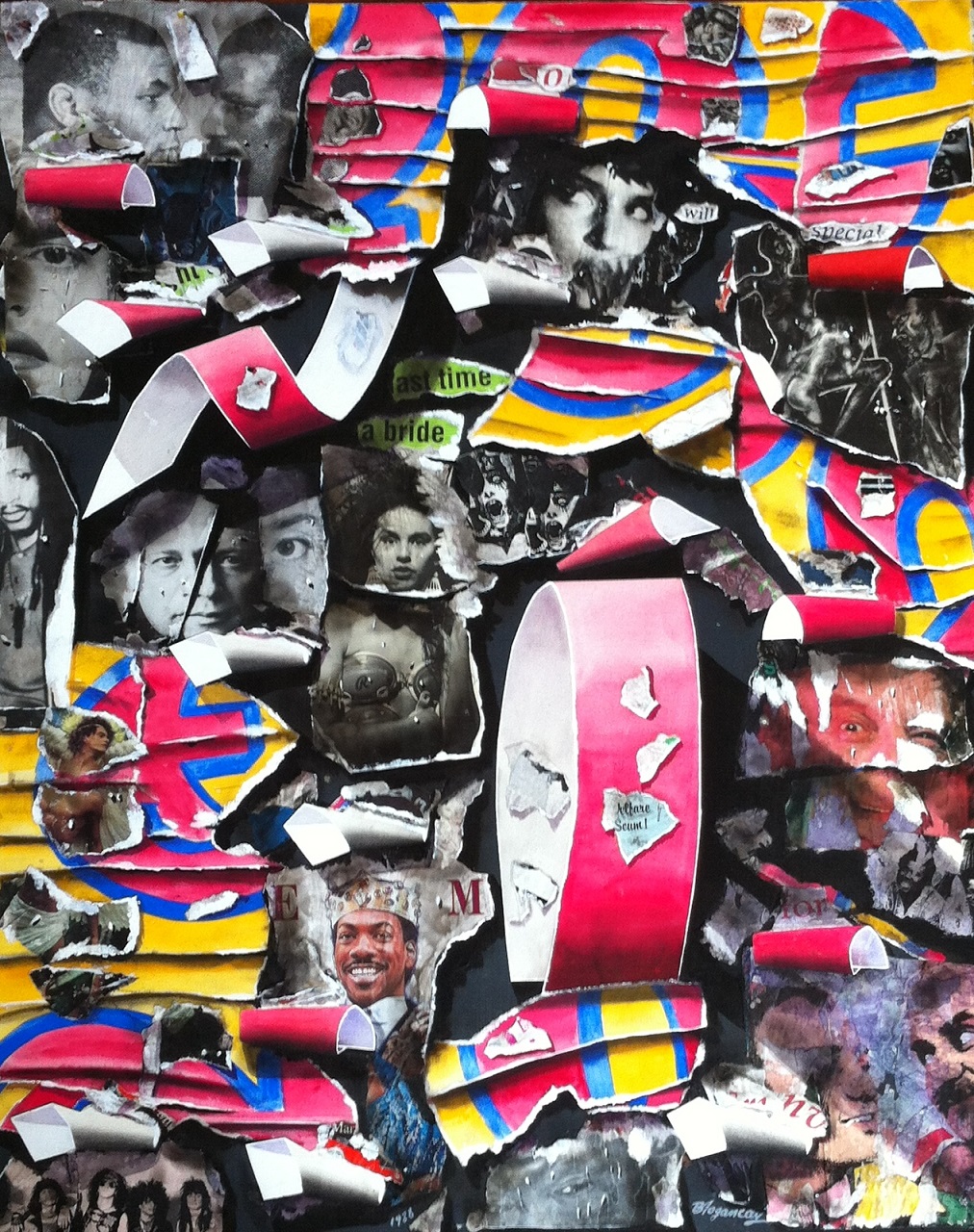
Burhan Dogancay - Painting and collage

Burhan Dogancay (11 September 1929 – 16 January 2013) was a Turkish-American artist. Dogancay is best known for tracking walls in various cities across the world for half a century, integrating them in his artistic work.
With posters and objects gathered from walls forming the main ingredient for his work, it is only logical that Dogancay's preferred medium has been predominantly 'collage' and to some extent 'fumage'. Dogancay re-creates the look of urban billboards, graffiti-covered wall surfaces, as well as broken or neglected entrances such as windows and doors in different series. The only masters with whom he compares himself are those from the last heroic period of art that he experienced and in which he was an active participant, notably Robert Rauschenberg and Jasper Johns. Dogancay, however, has always preferred to reproduce fragments of wall surface in their mutual relations just as he found them, and with minimal adjustment of color or position, rather than up-end them or combine them casually in the Rauschenberg manner.In large measure his practice has been one of simulation in the spirit of record-keeping, carried out with the collector's rather than the scavenger's eye. In many cases, his paintings evoke the decay and destruction of the city, the alienated feeling that urban life is in ruins and out of control, and that we cannot put the pieces together again. Pictorial fragments are often detached from their original context and rearranged in new, sometimes inscrutable combinations. So the diversifications of his complex and uniformly experimental painterly oeuvre will always range from photographic realism to abstraction, from pop art to material image/montage/collage. In the 1970s and 1980s he gained fame with his interpretation of urban walls in his signature ribbons series, which in contrast to his collaged billboard works such as the Cones Series, Doors Series or Alexander's Walls consist of clean paper strips and their calligraphically-shaped shadows. These brightly intense curvilinear forms seem to burst forth from flat, solid-colored backgrounds. The graceful ribbonlike shapes take on a three-dimensional quality, especially as suggested by the implied shadows.  This series later gave rise to alucobond–aluminum composite shadow sculptures and Aubusson Tapestries.Wikipedia


Clinton Hill - Abstract Art

Clinton Hill (1922–2003) was an American abstract artist who created abstract color compositions on canvas, constructions made from wood and canvas, wood and plastic relief sculptures, collage, woodblock prints and unique assemblages of handmade paper.Born in Payette, Idaho, and raised on a working ranch, Clinton Hill served in the navy during World War II as commander of a minesweeper in the Pacific. Upon his return from service, Hill attended the University of Oregon from which he graduated in 1947. He then moved to New York City, where Hill attended the Brooklyn Museum Art School from 1949 to 1951."The work of Clinton Hill is characterized by a lyrical abstraction which is derived from the painterly tradition of the New York School" In 1951 he left for Paris where he furthered his art studies on the GI Bill at the Academie de la Grande Chaumiere and then on to Florence, Italy where Hill studied painting at the Instituto d'Art Statale."Clinton's Hill's first important works were made in the period after 1950s." Upon returning to NY, Hill prepared for his first solo exhibition at the Zabriskie Gallery. His friend Mark Rothko suggested the name of the show "Ladders and Windows;" and from that exhibit in 1955 forward, Hill had numerous one man shows in both the US and Europe. Over a 55-year period Clinton Hill has been included in close to 100 exhibitions."Hill would expand his interest in physically assertive surfaces and outline into outright sculptural relief" In 1958 Hill traveled to India on a Fulbright scholarship."Since the late eighties he produced pieces with a linear element running through the handmade paper, and sculptural forms utilizing wood, charcoal and oil, sometimes attached to canvas and sometimes freestanding pieces, using similar color balances" For over 20 years he was Professor of Painting at Queens College of the City University of New York.Wikipedia


Michael Mallalieu - collage

   "This is a collage I've done on A2 paper for college a few years ago  in a lesson using cut outs of photographs I've taken of bus stops and pictures from a newspaper and then applied 1 or 2 colours of acrylic paint using  nothing just a folded up piece of paper."Michael Mallalieu


Writer and Collage artist Claude Pélieu

Claude Pélieu (December 20, 1934 – December 24, 2002) was a French postmodernist poet and graphical artist. He lived in France until 1963, when he moved to the United States, where he spent the rest on his life. Pélieu wrote in French, German and English.Pélieu was born to Pierre and Marguerite Pélieu on December 20, 1934 in a clinic in Pontoise, Val d'Oise, north of Paris. They lived in the village of Beauchamp, near Pontoise.
After graduation in 1952, Claude Pélieu entered the School of the Beaux-Arts in Paris. In 1952 he participated in a group show in Paris at the Galerie du Haut-Pavé in the Center Saint-Jacques on the rue Danton. Through priest Gilles Vallée, Claude met the future architect Henri Caubel who would later arrange retrospective shows of Claude Pélieu’s collages between 1999 and 2001. From 1952 to 1953, Pélieu worked as a library aide at La Maison des amis des livres, a bookstore founded by Adrienne Monnier, a friend of Sylvia Beach, a second cousin of Mary Beach (Claude Pélieu’s second wife).


Claude Pélieu’s first texts were published in 1955 in Le Libertaire (or Lib), a political journal close to the Lettrist movement. At that time he was politically active in the libertarian movement. This was the beginning of Claude Pélieu’s interest in the poetry of Jacques Prévert but also in collage. He continued to draw assiduously (the sale of drawings provided a meager living). In 1956, he participated in a group show at the bookstore/gallery The Sun in the Head organized by the mother of Jean-Jacques Lévêque, Marguerite Fos.
On July 14, 1959 Claude met Lula at a ball at the Vieux colombier Street. Lula and Claude had a passionate relationship often accompanied by misery. They married on May 11, 1960.


Pélieu met Mary Beach in 1962, and one year later Claude and Lula separated. The poet had an addiction to heroin. In November 1963, Pélieu left for San Francisco with Mary Beach.
In the United States, Claude Pélieu lived in San Francisco, New York and Hawaii. Automatic Pilot was published at the end of 1964, translated from French into English by Mary. She also translated, with the assistance of Claude, several books by William Burroughs, Bob Kaufman and Allen Ginsberg.
Years from 1969 to 1979 were particularly prolific for Pélieu, who had a dozen or so books published through 1979, mostly by Bourgois, Soleil Noir, and 10/18.
Between 1979 and 2002, Claude Pélieu devoted himself to collage while continuing to write and publish irregularly. At the end of the 1990s, several exhibits of his collages took place in France. He also had several new books published right up to his death December 24, 2002 in Norwich, New York.Wikipedia


Mary Beach and Claude Pelieu

Mary Beach and Claude Pelieu