Exposition Art Blog: avant-garde painting
Showing posts with label avant-garde painting. Show all posts

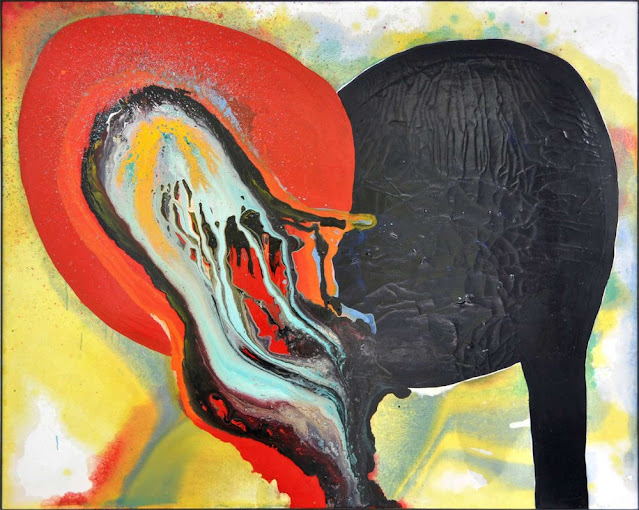
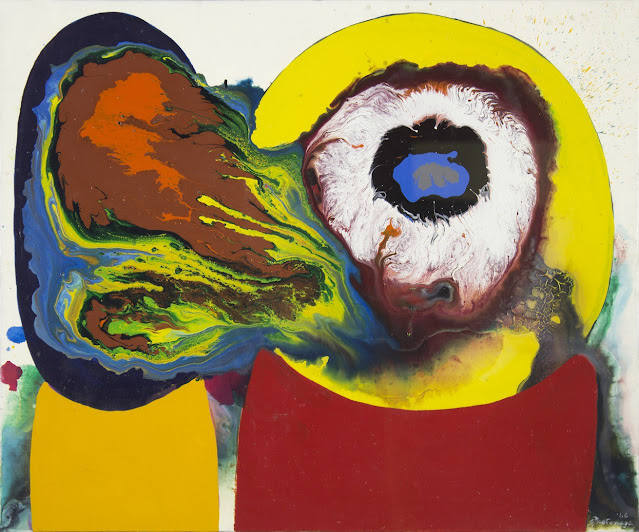
Sadamasa Motonaga - Gutai Group


 Sadamasa Motonaga (Japanese, 1922–2011) was a Japanese abstract painter and a founding member of the avant-garde Gutai group. He was born on November 26, 1922 in Mie Prefecture, Japan and initially sought to be a cartoonist before turning his attention to painting, studying under the tutelage of Jiro Yoshihara. A pronounced sense of humor remained in his work throughout his lengthy career, creating paintings which are characterized by simple lines and a gentle palette of muted primary colors. Motonaga gradually expanded his practice to include printmaking, stage design, and children’s books, all while continuing his ongoing elliptical investigation into abstract painting. His awards include the Légion d’Honneur from the French government and the Japanese Purple Ribbon Award; he was the first abstract artist to receive the latter. He died on October 3, 2011 in Kobe, Japan, and his work has been the subject of many retrospectives, including at Hyogo Prefectural Museum of Art in Kobe in 1998, Hiroshima City Museum of Contemporary Art in 2003, and the Mie Prefectural Museum of Art in 2009. The first Western retrospective of his work was held at the Dallas Museum of Art in 2014.(artnet.com)


Jorgen Nash - Avant-Garde Art

Jorgen Nash (March 16, 1920 – May 17, 2004) was a Danish artist, writer and central proponent of Situationism.
"Member of Danish resistance during WW II, arrested twice. Fled to Sweden, where he lived his last forty years in the forest at a place called Drakabygget, outside Örkelljunga, 50 km northeast of Helsingborg in the south of Sweden.
Well-known multi-artist, infamous for his happenings and the amount of artists from all over who lived at Drakabygget from time to time.Married to Liz Zwick. Father of Cecilia Zwick-Nash and five more children from three different marriages.
Brother of Asger Jorn. Changed his name early on in order to set him free from his more famous brother.His major claim to fame was when he, along with other members of Bauhaus Situationniste and as a part of an anti consumerism manifestation, decapitated the world famous The Little Mermaid at Langelinie in Copenhagen harbour on 24 April 1964, something he openly confessed only few years before his death. The head was never found again, and a new one had to be made. The statue has since been decapitated and vandalised repeatedly, as well as being painted and dressed in burqas. On 24 April 1964, Nash with other members of Bauhaus Situationniste decapitated the statue of The Little Mermaid in Copenhagen harbour. This manifestation was part of the movements campaign against consumerist society."(imdb.com)


Iaroslav Serpan - Czech abstract painter

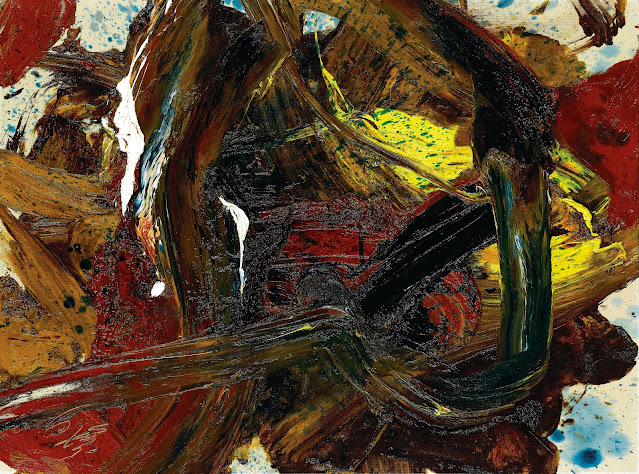
Iaroslav Serpan was born in Prague in 1922. He was a member of the of the Surrealist group with whom he exhibited at the show Le Surréalisme at the Maeght Gallery in Paris. He left the group in 1951, developing his own pictorial style attached to the Art Informel and Lyrical Abstraction. Later, he experimented with collage, sculpture and wall ceramic. Serpan died in 1976. 


Ken Kiff - Figurative Avant Garde Art

Ken Kiff  (29 May 1935 – 15 February 2001) an internationally known figurative artist, was born in Dagenham and trained at Hornsey School of Art 1955-61. He came to prominence in the 1980s thanks to the championship of art critic Norbert Lynton, and a cultural climate intent on re-assessing figurative art following the Royal Academy’s ‘New Spirit in Painting’ exhibition in 1981. He started exhibiting at Nicola Jacob’s gallery, moved to Fischer Fine Art in 1987 and finally to the Marlborough Gallery in 1990, by which time he had begun exhibiting internationally and had work in major public collections. He was elected to the Royal Academy in 1991 and became Associate Artist at the National Gallery 1991-93. His 30-year teaching career at Chelsea School of Art and the Royal College influenced a generation of students.
Despite his success, Kiff’s position was never a comfortable one. His commitment to the pictorial values of modernism, his deep respect for artists such as Klee, Miro or Chagall, and his ideas about painting were often at odds with prevailing assumptions. In contemporary debates around abstraction versus figuration he tended to push past the battle-lines: ‘colour thinking’ as opposed to ‘image thinking’, pictorial form versus representational meaning, in order to get at something beneath their seeming differences. Images themselves arose out of the stuff of painting and an intimate relationship with a technique. His deep personal knowledge of poetry and music informed his sense of a painting’s structure. He saw colour in terms of images and images in terms of colour, which constituted, as he saw it, “the natural complexity of painting”.Colour and colour relationships interacted in his paintings with a range of images evoking the blissfully radiant and lyrical to the comic and disturbingly grotesque. ‘Fantasy’ as he saw it ‘was a way of thinking about reality’. The matter-of-fact imagery of streets, houses, trees, animals and people was configured with dreamlike encounters and happenings in a way that invited the viewer into an internal world constantly using the external world as its subject-matter.By the late 1980s his range of media had expanded to include woodcuts, monotypes, lithography and etching. He enjoyed how new ways of working with materials, the grain of the wood, for example, or the wax in the encaustics, could extend his visual thinking and force him to make decisions more quickly. He took great pleasure in collaborating with master printmaking technicians such as Dorothea Wight and Mark Balakjian in Britain, Erik Hollgersson in Sweden, and Garner Tullis in the US. Wikipedia