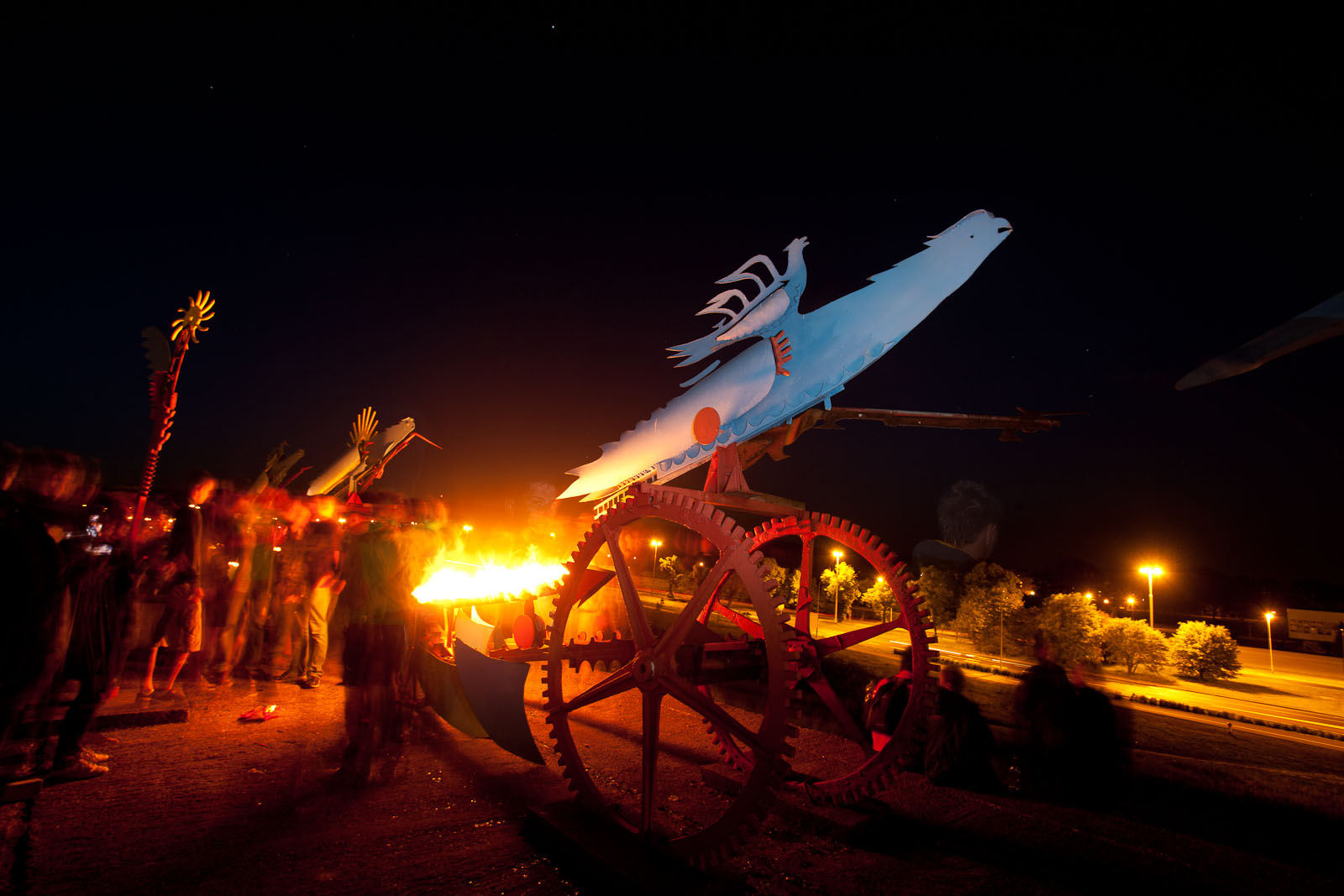
Władysław Hasior ( May 14, 1928 – July 14, 1999) was one of the leading Polish contemporary sculptors connected with the Podhale region. He was also a painter and theatre set designe.Władysław Hasior was born in Nowy Sącz on May 14, 1928. From 1947-1952, he studied under Professor Antoni Kenar at the State Secondary School of Visual Art Techniques. In 1952 he started his studies in sculpture at the Academy of Fine Arts in Warsaw. He graduated from the Academy in 1958. From 1959-60, he stayed in Paris as a holder of a scholarship of the French Ministry Culture and studied under Ossip Zadkine. His first individual exhibition was in 1961 at the Jewish Theater in Warsaw. Since then his works have been displayed at over seventy individual exhibitions in Poland and Europe. In 1968 Hasior had returned to his first school and became a teacher there until 1968.
Hasior’s art meant to provoke and shock the beholder. He continuously experimented with forms, techniques and materials by creating spatial compositions, assemblages and collages. He also authored many unconventional monuments and plein air sculptures, both in Poland and abroad. Since 1984 artist focused on the continuous arrangement of the authors Gallery.Władysław Hasior died on July 14, 1999 in Kraków. He is buried at the Zakopane Cemetery of the Meritorious at Pęksowy Brzyzek.Wikipedia
"Władysław Hasior was one of the most prolific contemporary Polish artists. He was an extraordinary personality, and a very colourful and magnetic individual. In the West, he was hailed as "the most talented student of Rauschenberg and Warhol". In Poland, his work is considered as a precursor to pop art and assemblage, despite the artist's obstinate insistence that he had "never suffered from modernity". Hasior regarded artistic activity as an intellectual and creative provocation, and he perceived modernity as rooted in a culture whose language was universal.
He entered the art world in a manner that immediately drew the attention of the general public, and soon after became a "cult" artist for the 60s and 70s generations. His work shocked and delighted, aroused extreme emotions and judgement, and his controversial attitude compelled audiences to ask questions about the nature of art, and the artistic license of choosing the language of expression. As one of the few such artists of the time, he gained a level of popularity typically enjoyed by celebrities of film and stage.He was a sculptor, although many of his works are difficult to be categorized precisely in terms just sculpture. He became famous as a total artist, working on the borders between many artistic genres: painting, sculpture, architecture, arts and crafts. In 1958, he abandoned classical sculpture in favour of "something" which his contemporaries could not yet fully define. In his art practice, he employed a collage technique to create assemblages, namely, semantically rich three-dimensional compositions incorporating various found objects and finished works.Hasior used degraded elements of technological civilization as art materials. He built structures out of everyday objects or fragments thereof, thus restoring their significance. In this fashion, he engaged in a continuous dialogue with Polish reality and mythology, a dialogue leavened with poetry, but also with mockery and irony. The relevance of Hasior’s artistic attitude lies in his authenticity, and in his acute powers of observation which encompassed sociology and culture, combining tradition and modernity, high and low culture."( Culture.pl )
Hasior’s art meant to provoke and shock the beholder. He continuously experimented with forms, techniques and materials by creating spatial compositions, assemblages and collages. He also authored many unconventional monuments and plein air sculptures, both in Poland and abroad. Since 1984 artist focused on the continuous arrangement of the authors Gallery.Władysław Hasior died on July 14, 1999 in Kraków. He is buried at the Zakopane Cemetery of the Meritorious at Pęksowy Brzyzek.Wikipedia
"Władysław Hasior was one of the most prolific contemporary Polish artists. He was an extraordinary personality, and a very colourful and magnetic individual. In the West, he was hailed as "the most talented student of Rauschenberg and Warhol". In Poland, his work is considered as a precursor to pop art and assemblage, despite the artist's obstinate insistence that he had "never suffered from modernity". Hasior regarded artistic activity as an intellectual and creative provocation, and he perceived modernity as rooted in a culture whose language was universal.
He entered the art world in a manner that immediately drew the attention of the general public, and soon after became a "cult" artist for the 60s and 70s generations. His work shocked and delighted, aroused extreme emotions and judgement, and his controversial attitude compelled audiences to ask questions about the nature of art, and the artistic license of choosing the language of expression. As one of the few such artists of the time, he gained a level of popularity typically enjoyed by celebrities of film and stage.He was a sculptor, although many of his works are difficult to be categorized precisely in terms just sculpture. He became famous as a total artist, working on the borders between many artistic genres: painting, sculpture, architecture, arts and crafts. In 1958, he abandoned classical sculpture in favour of "something" which his contemporaries could not yet fully define. In his art practice, he employed a collage technique to create assemblages, namely, semantically rich three-dimensional compositions incorporating various found objects and finished works.Hasior used degraded elements of technological civilization as art materials. He built structures out of everyday objects or fragments thereof, thus restoring their significance. In this fashion, he engaged in a continuous dialogue with Polish reality and mythology, a dialogue leavened with poetry, but also with mockery and irony. The relevance of Hasior’s artistic attitude lies in his authenticity, and in his acute powers of observation which encompassed sociology and culture, combining tradition and modernity, high and low culture."( Culture.pl )