Exposition Art Blog: modern painting
Showing posts with label modern painting. Show all posts

Lee Mullican

Lee Mullican (December 2, 1919 in Chickasha, Oklahoma – July 8, 1998 in Santa Monica, California) was a painter and art teacher, and an influential member of the Dynaton Movement. He moved to San Francisco in 1947, and was part of a 1951 exhibition called "Dynaton" held at the San Francisco Museum of Art.Mullican was a member of the UCLA art faculty from 1962 to 1990.He married Luchita Hurtado; their son Matt Mullican is a New York City based artist; their son John Mullican is a Los Angeles based writer and director. He is represented by Marc Selwyn Fine Art in Los Angeles, California.
An exhibition of Mullican's ceramics, photography and computer drawings were exhibited in a re-purposed commercial space in Beverly Hills as part of a series of installations hosted by the non-profit, Equitable Vitrines from October 3 through November 21, 2015.Wikipedia


 "While occasionally diverting himself with other mediums, the greater body of Mullicans work consists mostly of drawing and, usually aided by the palette knife, painting. Most of these meticulously-constructed canvases can be found in the Los Angeles area, the center of his exhibiting and teaching career.
A wide range of Mullicans life experiences -- cultural, philosophical, and artistic -- have influenced his painting style. More than his college training, which yielded little beyond some technical development, it was Mullicans term in the army that proved most artistically formative. Drafted into the war as a topographer, his training and eventual service in Hawaii and Japan demanded innumerable recordings of aerial photographs. This process, ingraining shapes and patterns from birds-eye perspectives into his drawing habits, cultivated his preexisting appreciation for naturalistic forms and abstract patterns. Additionally, access to museums and libraries of the East Coast and Hawaii during this time presented him the opportunity to ponder contemporary trends and thought in the art world, an art world effectively hidden from the Midwest. Specifically, his knowledge of (through the magazine Dyn) and ensuing friendship with Wolfgang Paalen exposed Mullican to non-western antiquity as well as to Paalens transcendent philosophies born out of the European Surrealist movement.
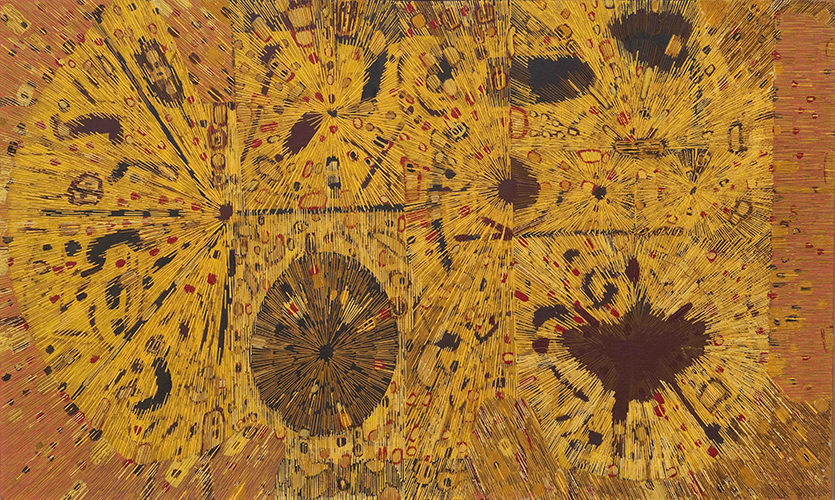


 Absorbing these war-time developments while infusing them into his work afterward in San Francisco, Mullican began crafting his tapestry-like paintings in a style characterized by apparent contradictions. His paintings are at once naturalistic yet rigidly linear. Though relevant in their cosmopolitan exhibition environment, his paintings exude with the mysticism of ancient American cultures. Chaotically germinating but grounded in focal points, Mullicans work is suggestive both of scientific phenomena (DNA strands, cells, etc.) and spiritual states of being. In an interview with Paul Karlstom he discussed his approach to painting in relation to these conflicts: I was one minute grasping outer space, and the next minute, I was grasping whats below the desert floor.
Rarely is this element of paradox more evident than in examples of his Guardian canvases, completed between 1978-1980. Abstract patterns weave together vertically and horizontally, conjuring images of mysterious figures in a manner reminiscent of Pre-Colombian textiles. This historical influence --which Mullican admits to be a factor -- would seemingly locate the work within a particular time frame. However, the vague nature of the beings in the paintings, their lack of specific titles or features (along with Mullicans insistence that they bare no chronological significance), seems at odds with the former conclusion; it speaks of universality.


 At one point early in his career, a friend asked him to describe the mental process that occurs while painting in the studio. Never having considered this question, Mullican realized that each finished work represented a record of an unconscious process. I am standing on this particular metaphysical, almost unexplainable plane in my studio, the canvas is there before me, and its in this attitude that makes the painting appear.He relies upon his subjectively-rooted unconscious to achieve objective universal truths, again indicating the element of paradox as it applies to his studio mindset. That the ultimate end of any of his paintings relies upon contradictory visual elements is perhaps attributable to this equally contradictory approach."(sullivangoss.com/Mullican_Lee)


Australian art Norman Lindsay

Norman Alfred William Lindsay (22 February 1879 – 21 November 1969) was an Australian artist, etcher, sculptor, writer, editorial cartoonist, scale modeler, and an accomplished amateur boxer.He was born in Creswick, Victoria.
Lindsay was the son of Anglo-Irish surgeon Robert Charles William Alexander Lindsay (1843–1915) and Jane Elizabeth Lindsay (1848–1932), daughter of Rev. Thomas Williams, Wesleyen missionary. from Creswick. The fifth of ten children, he was the brother of Percy Lindsay (1870–1952), Lionel Lindsay (1874–1961), Ruby Lindsay (1885–1919), and Daryl Lindsay (1889–1976).Lindsay married Catherine (Kate) Agatha Parkinson, in Melbourne on 23 May 1900. Their son Jack was born in Melbourne on 20 October 1900, followed by Raymond in 1903 and Philip in 1906. They divorced in 1918. He later married Rose Soady who was also his business manager, a most recognizable model, and the printer for most of his etchings. They had a daughter, Jane Lindsay, born in 1920. Philip died in 1958 and Raymond in 1960. In the Lindsay tradition, Jack became a prolific publisher, writer, translator and activist. Philip also became a writer of historical novels, and worked for the film industry.
Lindsay is buried in Springwood Cemetery in Springwood, close to Faulconbridge where he lived.


 Lindsay is widely regarded as one of Australia's greatest artists, producing a vast body of work in different media, including pen drawing, etching, watercolour, oil and sculptures in concrete and bronze.
A large body of his work is housed in his former home at Faulconbridge, New South Wales, now the Norman Lindsay Gallery and Museum, and many works reside in private and corporate collections. His art continues to climb in value today. In 2002, a record price was attained for his oil painting Spring's Innocence, which sold to the National Gallery of Victoria for A$333,900.His frank and sumptuous nudes were highly controversial. In 1940, Soady took sixteen crates of paintings, drawings and etchings to the U.S. to protect them from the war. Unfortunately, they were discovered when the train they were on caught fire and were impounded and subsequently burned as pornography by American officials. Soady's older brother Lionel remembers Lindsay's reaction: "Don't worry, I'll do more


 Lindsay's creative output was vast, his energy enormous. Several eyewitness accounts tell of his working practices in the 1920s. He would wake early and produce a watercolour before breakfast, then by mid-morning he would be in his etching studio where he would work until late afternoon. He would work on a concrete sculpture in the garden during the afternoon and in the evening write a new chapter for whatever novel he was working on at the time.
As a break, he would work on a model ship some days. He was highly inventive, melting down the lead casings of oil paint tubes to use for the figures on his model ships, made a large easel using a door, carved and decorated furniture, designed and built chairs, created garden planters, Roman columns and built his own additions to the Faulconbridge property.
In 1938, Lindsay published Age of Consent, which described the experience of a middle-aged painter on a trip to a rural area, who meets an adolescent girl who serves as his model, and then lover. The book, published in Britain, was banned in Australia until 1962.Wikipedia


Vangel Naumovski

Vangel Naumovski was born in 1924 in the Macedonian city of Ohrid (then part of Yugoslavia). He was interested in art at a young age, but this led nowhere as he left school after third grade and worked a series of odd jobs -- gardener, farmer, butcher. After a stint in the army, he enrolled in art school in Skopje in 1946, lasting a year. He then worked in a woodcarving shop in Ohrid for thirteen years. During this time he was painting, initially in a folk myth style which led to him being considered a Naive artist. In the early 60s his painting morphed into a gooey sort of surrealism. He first exhibited in Yugoslavia in the 50s, and later had one-man shows in Rome, London, Paris, and Toronto. At some point he started a gallery in his home in Ohrid (it is unknown whether it is still open). He died in 2006. (www.wikiart.org)


Symbolism David Boyd

David Fielding Gough Boyd  (23 August 1924 – 10 November 2011) was an Australian artist, and a member of the Boyd artistic dynasty.
The Boyd artistic dynasty began with the marriage of Emma Minnie à Beckett (known as Minnie) and Arthur Merric Boyd in 1886. Both were already established as painters at the time of their marriage. Their second-born son Merric Boyd married Doris Gough and had five artistic children, Lucy de Guzman Boyd, Arthur Boyd, Guy Boyd, David Boyd, and Mary Elizabeth Boyd.
Boyd entered the Melba Memorial Conservatorium of Music in Melbourne at seventeen, but was conscripted to the army after one year. Upon his return, he studied art at the National Gallery School on an ex-serviceman's grant.
In 1946, he worked with his brother Guy at the Martin Boyd Pottery in Sydney. He also established a pottery studio in London in the early 1950s and continued working mainly in pottery through to the mid-1960s. In 1956, Boyd and his wife became widely known as leading Australian potters. They introduced new glazing techniques and potter's wheel use in shaping sculptural figures
.


Boyd's painting career began in 1957 with a series of symbolic paintings on Australian explorers that aroused much controversy at the time, focusing as they did on the tragic history of the Aboriginal Tasmanians. In 1958 he exhibited a series of paintings based on the histological episodes in the explorations of Burke and wills and Bass and Flinders.[3] He joined the Antipodeans Group in the 1950s. Boyd discovered a technique in 1966 that he named Sfumato, after da Vinci's usage of the word to describe graduations of smoky tones in painting. Boyd's method achieved this effect through a new technique involving candle flame.


 Boyd and his family moved to Rome in 1961, and later moved to London. They also spent several years creating art in Spain and the south of France before returning permanently to Australia in 1975.
David Boyd was artist-in-residence at the School of Law, Macquarie University, Sydney from 1993–1996.In a September 2004 art review, Alex McDonald of State of the Arts magazine stated that David Boyd's work was 'ahead of his time in addressing the mistreatment of Indigenous people in Australia, but commented that an 'explanation for his frosty reception from Australian critics and dealers may have something to do with his choice of subject matter'. McDonald explained that the controversy may have stemmed from the fact that the 'legal system, race relations and religion' are 'not exactly popular issues' and were not 'up for debate in the late 1950s'.Wikipedia


John Altoon

John Altoon was an influential avant-garde American artist of his time who dominated the art scene of 1950s and ‘60s Los Angeles. Most of his works came under abstract expressionism, the first true artistic movement that emerged out of America. He rose to prominence as a part of a group of artists referred to as the ‘Ferus Group’ because of their association with the Ferus Gallery. This group included artists like Edward Keinholtz, Robert Irwin, Ed Ruscha, Ed Moses and Larry Bell among others. A highly popular figure in all his circles, this boisterous painter was a very passionate individual whose personality left a far greater legacy than his artistic works. By the end of his thirties, he was diagnosed with schizophrenia and he was only 43 when he passed away following a massive heart attack. This marked the tragic end to the life of a lively, boozing, skirt-chasing man harried by bouts of depression and episodes of mania that was often destructive and violent.


John Altoon was born to immigrant American parents in Los Angeles, California.Not much information is available on his parents, early education and early life. However, certain records suggest that Altoon had a fairly creative childhood. From 1947-1950, in a period of 4 years, Altoon underwent formal training in art in three different institutes: Otis Art Institute, Art Center College of Design and Chouinard Art Institute. Beginning as an abstract expressionist, he turned to figurative works by the 60’s. These works were characterized by skillful draftsmanship and sexual imagery. His art was also shaped by his visit to Europe where he stayed in Spain for some time. He also served in the US Navy during WW II.


Altoon’s work was primordially influenced by “Abstract expressionism”, although he is best celebrated for his figurative works. His work has been described as a mish-mash of “vaguely figurative, botanical and biological forms.” A man of “outsized personality and reckless intensity” the influence of John Altoon loomed large over the L.A. art scene during the 1950 and ‘60s. Rebellious, romantic, ambitious and slightly mad, Altoon’s painting oozed with mischievous humor and intellectual rigor (.thefamouspeople.com)


Tarsila

Tarsila do Amaral, (September 1, 1886 – January 17, 1973), known simply as Tarsila, is considered to be one of the leading Latin American modernist artists, described as "the Brazilian painter who best achieved Brazilian aspirations for nationalistic expression in a modern style." She was a member of the "Grupo dos Cinco" (Group of Five), which was a group of five Brazilian artists who are considered the biggest influence in the modern art movement in Brazil. The other members of the "Grupo dos Cinco" are Anita Malfatti, Menotti Del Picchia, Mário de Andrade, and Oswald de Andrade. Tarsila was also instrumental in the formation of the Antropofagia Movement (1928-1929); she was in fact the one who inspired Oswald de Andrade's famous "Cannibal Manifesto"


While in Paris, she was exposed to surrealism and after returning to Brazil, Tarsila began a new period of painting where she departed from urban landscapes and scenery, and began incorporating surrealist style into her nationalistic art. This shift also coincided with a larger artistic movement in São Paulo and other parts of Brazil which focused on celebrating Brazil as the country of the big snake. Building on the ideas of the earlier Pau-Brasil movement, artists strove to appropriate European styles and influences in order to develop modes and techniques that were uniquely theirs and Brazilian.


Tarsila's first painting during this period was Abaporu (1928), which had been given as an untitled painting to Andrade for his birthday. The subject is a large stylized human figure with enormous feet sitting on the ground next to a cactus with a lemon-slice sun in the background. Andrade selected the eventual title, Abaporu, which is an Indian term for "man eats", in collaboration with the poet Raul Bopp.This was related to the then current ideas regarding the melding of European style and influences. Soon after, Andrade wrote his Anthropophagite Manifesto, which literally called Brazilians to devour European styles, ridding themselves of all direct influences, and to create their own style and culture. Instead of being devoured by Europe, they would devour Europe themselves. Andrade used Abaporu for the cover of the manifesto as a representation of his ideals. The following year the manifesto's influence continued, Tarsila painted Antropofagia (1929), which featured the Abaporu figure together with the negroid figure from Le Negra from 1923, as well as the Brazilian banana leaf, cactus, and again the lemon-slice sun.


In 1931, Tarsila traveled to the Soviet Union. While there, she had exhibitions of her works in Moscow at the Museum of Occidental Art, and she traveled to various other cities and museums. The poverty and plight of the Russian people had a great effect on her. Upon her return to Brazil in 1932, she became involved in the São Paulo Constitutional Revolt against the current dictatorship of Brazil, led by Getúlio Vargas. Along with others who were seen as leftist, she was imprisoned for a month because her travels made her appear to be a communist sympathizer.


The remainder of her career she focused on social themes. Representative of this period is the painting Segundo Class (1931), which has impoverished Russian men, women and children as the subject matter. She also began writing a weekly arts and culture column for the Diario de São Paulo, which continued until 1952.
In 1938, Tarsila finally settled permanently in São Paulo where she spent the remainder of her career painting Brazilian people and landscapes. In 1950, she had an exhibition at Museum of Modern Art, São Paulo where a reviewer called her "the most Brazilian of painters here, who represents the sun, birds, and youthful spirits of our developing country, as simple as the elements of our land and nature…. She died in São Paulo. Tarsila's life is a mark of the warm Brazilian character and an expression of it tropical exuberance. Wikipedia


Avant Garde Art Philippe Vandenberg

Philippe Vandenberg (Ghent, 1952 - Brussels, June 29, 2009) was a Belgian painter.
Philippe Vandenberg was born in 1952 in Ghent, where the contact with the works of Hieronymus Bosch and Gustave Van de Woestijne at the Museum of Fine Arts will arouse fascination for painting. In 1970 he began his studies of Arts and Philosophy and Art History at the University of Ghent he stops in 1972 to fully focus on his studies of painting. In 1976 he graduated in the direction of painting at the Royal Academy of Fine Arts in Ghent and two years later he leaves for the first time to New York where he met the space in the work of Pollock, Rothko and Kline and was struck by 'The battle of the rebel Angels' Ensor.


 A first visit to the Museo del Prado in 1980 developed his passion for Diego Velázquez, El Greco and Francisco Goya. Philippe Vandenberg remains fascinated by literature and met with Hugo Claus in 1985 resulting in the literary edition Proverbs, where the link is reinstated with the literature. Vandenberg then start his first sign books in which the drawing function allows the book. In 1994, he lives through Job and the Apocalypse, Augustine, Sophocles, Heiner Müller, San Juan de la Cruz and Emil Cioran. A year later he wrote the suite texts The state of things and the lamentations of the ship, which is published in dialogue with lithographs and book and he paints The Seventh Seal, composed a work of tiny, skimpy painted panels where besides oil also watercolor, gouache and blood may be used. Just as in the drawings begin to form the work ensembles.


 Between 1996 and 1999 he repeatedly Marseille, birthplace of Antonin Artaud and Rimbaud retreat and start his visit with pencil and watercolor Les Carnets, a kind of diary which consist of drawings, watercolors and notes. He is interested in Georg Trakl and Paul Celan and paints the portrait of Artaud and Ulrike Meinhof. In 1999, his retrospective exhibition at the Museum of Contemporary Art Antwerp follows and writes the text On the way is a cage is a man, his hands red, an intermediate reflection on his work. Les Carnets come increasingly to the fore and it is assessed a major selection of drawings for the first time shown in 2003 under the title Daily Drawings of Good & Vile 1997-2003. The presentation of Pilgrims Keel, a publication with text and drawings of Philippe Vandenberg to a graphic design Inge Ketelers, the same year takes place at the Museum Dr. Guislain. In 2004, the Exile Peintre is issued, a bibliophile edition with etchings and text Lettre au Nègre Philippe Vandenberg (Ergo Press, 2004). The work of Philippe Vandenberg get text and image more intense dialogue with each other and this edition is a symbiosis of this. In 2008 Vandenberg 'Artist in Residence' at the Ghent Museum of Fine Arts, where he was confronted with the famous old masters.Wikipedia