Exposition Art Blog: expressionism modern art
Showing posts with label expressionism modern art. Show all posts

Barbara Swan

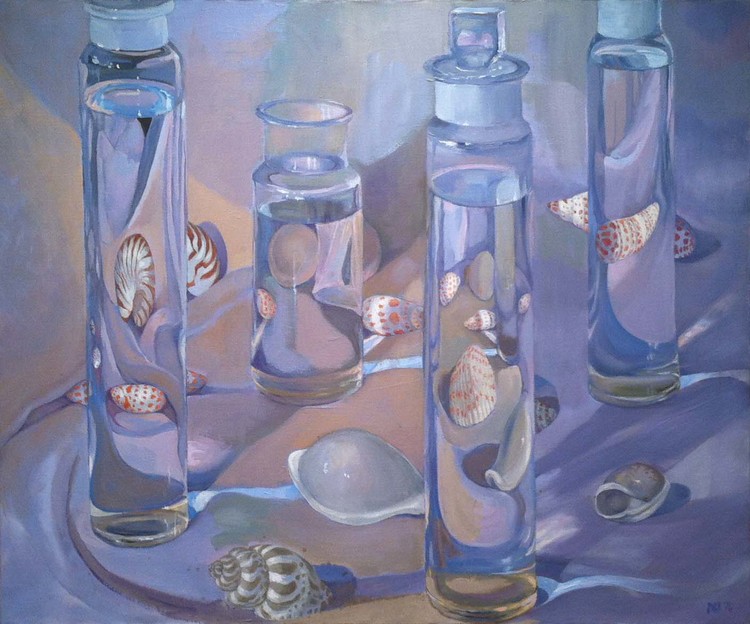
Early in her career, Barbara Swan (1922-2003) was closely associated with the Boston Expressionist school. Having studied at the School of the Museum of Fine Arts under Karl Zerbe, Swan adopted elements of expressionism’s themes and techniques. Eventually, she went on to formulate a very different kind of artistic vision, based on direct observation. In her portraits and still lifes, Swan utilized realism as a means to find a deeper understanding of the subject. In her portraits Swan sought intimacy with the sitter. In her still lifes (of bottles filled with water, patterned fabrics and art historical references) she addressed questions of how we perceive the world and what gives an object meaning.
Before attending the School of the Museum of Fine Arts, Swan earned a B.A. in art history from Wellesley College. She was among the first group of women, in 1961, to receive a fellowship from the Institute for Independent Study (then called the Bunting Institute) at Radcliffe College. Swan held two residencies at the MacDowell Colony and a two-year traveling fellowship from the School of the Museum of Fine Arts. Her work is included in the collections of the National Portrait Gallery, the Fogg Art Museum at Harvard University, the Philadelphia Museum of Art and the Museum of Fine Arts, Boston, among many others. Major exhibitions of Swan’s work have been held at the Boston Public Library, Danforth Art, the Addison Gallery of American Art, and the Museum of Art, University of New Hampshire, Durham.(alphagallery.com)


Karen Smbatyan

Karen Smbatyan (April 21, 1932 in Gyumri - December 27, 2008 in Yerevan) was an Armenian painter.He was born into an Armenian family in Gyumri. He Studied at Yerevan Fine Art College after Panos Terlemezyan. He has participated in different international exhibitions. His paintings can be found in Armenian National Gallery, "Modern Art" Museum in Washington, "Richard Manukean" Gallery in Detroit, "Arshil Gorki" and "Gallery Drown" in Paris, "Zimerlin" museum of modern arts in New Jersey, and in private collections in various countries.Videos taken from several sources
Throughout his earthly life the diverse and multidimensional artist Karen Smbatyan had to struggle and fight for his internal freedom and external liberty. As a person and citizen he intrinsically chose the path of veracity and truth. He acted with infinite honesty and stepped through life with pride and honour. The destiny of the Armenian people and his national identity have always been equally dominant and imperative as his quest for the hidden mystery of artistic creativity.


The brief of his biography reveals that the artist was born in 1932 in Gyumri. He studied at P. Terlemezyan College, however later he had to quit his studies to join the Soviet army (Estonia, Doko island). While serving in the army he still continues to work and create and his works tracing back to that period have been highly appreciate within professional circles. His artistic biography dating back to the late 50s and early 60s was characterized by Karen's search for lively, everlasting, authentic perceptions of objects through nature, life and human manifestations, adhering to animated means and forms of high realism ("Makuyk" 1954, "The sailor Nikolay Blokhin", 1954, "Ian Paulianki", 1959, portraits).
During 1966-80 he was the editor Of "Pioner" and "Tsitsarnak" children's periodicals. During that period he created the illustrations of "Jelsomino in The Land of Cheaters" and "Jan Polat" folktales by Gianni Rodari and authored the images of the periodicals with demonstrating a new fresh approach in the field. Parallel to that he was very sensitive about self-education and paid a special attention to the study and research of the roots of Armenian stylistic school spending hours in the Matenadaran exploring Armenian miniature hardly concealing his admiration and fascination by the genius of art. (Grigor Tatevaci, Toros Taronatsi).


His diary notes dating back to 1970s reveal that he was particularly concerned with his explorations of problems of color and form, their unimpeded interpretation, the free flow of mind and emotions have become direction of art and artistic belief that transmits expressive means and sacred monumental sonority. The insight contemplations open up inner self and metaphysical thinking of the artist for the viewer ("Shell" 1975, "Amulet", 1977, "Indian jug" 1975).
Having sound and deep understanding and perception of the coloristic achievements of Armenian artists (M. Saryan, H. Kalenc, Minas) Karen makes the color surface of the picture so intensive that it turns into fireworks, spiritual soaring, burning sunset. "The Art is feast of colors," he cites the idea of Delacroix which means that it is not the plot that should dominate the picture. This refers to all genres as well as to free compositions ("Varuzhan Vardanyan", 1983 "The portrait of Mshetsi", 1989, "The Garden", 1994, "Autumn", 1999).


This powerful rise of this manifestation of his creativity is an ode to the love for the nature, philanthropy. In the picture the leitmotif is the light, the solar warmth is "the peace of soul". ("The quay. Sevan", 2003, "Noonday", 2005, "Northern sun", 2006).
The simplicity of composition the completeness of the style, the seeming lack of attention for detail have been the most attractive elements of the last two decades, which allowed the artist to achieve monumental sonority. From point of view "The most luxurious luxury is simplicity" or "The painting is complete only when the unnecessary things ara removed".Wikipedia


Svend Wiig Hansen

Svend Wiig Hansen (20 December 1922, Møgeltønder – 15 March 1997, Helsingør) was a Danish sculptor and painter.
Wiig Hansen was initially undecided about his career, working as a circus clown and a singer until a job requiring his help in the completion of climbing angels convinced him he should become a sculptor. After studying at the Danish Academy under Johannes Bjerg and Einar Utzon-Frank (1946–1950), his early sculptures included his monumental burnt clay Torso (1951) inspired by Aristide Maillol and his cement Moder Jord (Mother Earth, 1953) influenced in part by precolumbian sculpture. The gigantic group sculpture of Mennesket ved havet (Men at Sea, (1994) near Esbjerg is inspired by Cycladic art and the figures on Easter Island. Slægt løfter slægt (1997), which was installed for a period on Gammel Strand in Copenhagen, depicts a naked couple bearing a naked woman.


His recognition as a painter began in 1955 with De søgende. His expression is characterized by stark colouring in his depiction of the human body, often set in a desolate landscape. Among his most important works are Menneskeridt (1959), the series Mennesker i forvandling (People in Transformation, 1963) and Jorden græder (The Earth Weeps, 1981). His work as a decorator can be seen in Kastrup Church (1978), the central hospital in Herning and in Copenhagen's Royal Theatre with his aluminium Himmelrejsen (Heavenly Journey, 1989)
Wiig Hansen received the Swedish Prince Eugen Medal in 1976 and was awarded both the Eckersberg Medal and the Thorvaldsen Medal but chose not to receive them.Wikipedia


Jean Dubuffet avant-garde artist

Dubuffet was born in 1901 in Le Havre. In 1918 he went to Paris where he gave up his course in painting at the Académie Julian after six months and started working on his own. He knew the painters Dufy and Leger and both had some influence on his otherwise 'self-taught' approach to art. By 1924 he had given up painting entirely and instead concentrated on running a wine business. In 1933 he started painting again, producing mainly puppets and masks, but in 1937 this creativity ended once again. It was only in 1942 that he finally devoted himself to painting ...
Dubuffet's return to painting was accompanied by a passion for primitive and naive art forms, as well as for paintings made by the psychologically disturbed. By 1945 he had started to collect so called 'ugly art' or Art Brut, and in 1948 he founded a society to promote this type of work. He also wrote some important statements, criticizing the cultural aims of post-Renaissance Western art, in the place of which he advocated the more spontaneous, non-verbal, and spiritually potent qualities of primitive cultural expression. This resulted in a totemic approach to image making which soon revealed itself in his first exhibition, where city life and images of men and women were presented with an aggressively simple and childish vigor. These paintings looked more like graffiti covered walls or tribal emblems than conventional oil paint.


 The driving force behind these early works was Dubuffet's entirely novel and extraordinary painting technique. He combined almost any element with the paint surface, including cement, tar, gravel, leaves, silver foil, dust and even butterfly wings. In defence of this technique he stated that 'art should be born from the materials and, spiritually, should borrow its language from it. Each material has its own language so there is no need to make it serve a language.' Such an approach has drawn him into the field of sculpture, using materials gathered at first from beside Parisian railway lines; by the 1970s he was creating enormous architectural environments in concrete.
In 1945 Dubuffet painted one of his first portraits, a drawing of Jean Paulhan, who later introduced the artist to the group of writers and intellectuals that frequently met at the house of Florence Gould. She persuaded him to make another portrait, of the writer Paul L'Eautaud. This developed into a series and eventually into the third of Dubuffet's major exhibitions entitled Plus beaux qu'ils croient (portraits) (Better looking than they think). Dhotel nuancé d'abricot was one of this group. Andre Dhotel is its subject.


 The portraits are named after the sitters, whose most curious features have been deliberately emphasized by the artist. They combine caricature, imagery and some factual elements. Dubuffet explained that for a portrait to go well: 'it must be scarcely a portrait at all. It is then that it starts to function at full strength!
Dubuffet's technique in Dhotel nuancé d'abricot can be reconstructed from a studio log book kept by him at the time. Laying the stretched canvas on the floor, he covered its entire surface with a thick, sticky pate of light colored oil paint applied with a spatula, like icing a cake. While it was still wet he took handfuls of ashes and sprinkled them over the whole area to darken the paint. Over this he dropped sand and then coal dust which would all, to a certain extent, sink into the surface. At this point some color was put on in the form of a thin 'apricot' mixture of yellow ochre, white and crimson brushed over the surface broadly. Some pure crimson was also put on, and is still visible through parts of the black crust.
The surface was now prepared to be totally covered with thick black paint troweled across with a palette knife, possibly with the addition of more ashes and dust. There was still no trace of the image at this stage - it would have looked instead like a plain smoke-blackened wall. With a broad spatula Dubuffet then carefully rubbed the materials into the surface and put the canvas on an easel to let any excess fall off.


 It was only at this stage that the head was painted in with a cream white on a palette knife. Then, using a blunt point, he incised the contours of the head through this rich sandwich of paint and material, so that sometimes the canvas texture was revealed, as, for instance, on the side of the face to the left of the chin. The lines of the hair and the rest of the features were also drawn in with this instrument, sometimes lightly, as on the chin and spectacles, or deeply, as in the neck and shoulders, breaking through to the first thick impasto. A very thin mixture of 'apricot' paint and turpentine was then brushed over the face so that it ran into the gutters made by the ploughed lines, and stained the face with a warm glaze. Some of the original light paint of the face which was outside these boundaries was then blacked over. Finally, using a fine lettering brush the lines were enhanced with the addition of crimson, yellow ochre, black and white, in particular drawn into the trenches of the teeth, hair, nose and bow tie. These colors were used in a broader way in the earlier preparation of the surface, and thus the head and background appear unified visually.The title of the work is, as usual with Dubuffet, an important final contribution. The result, in the case of Dhotel nuancé d'abricot, creates a humorous tension between what the viewer anticipated by the rather poetic description and what is actually confronted in the finished work with its primitive, earthy textures and skull-like gaze.(rogallery.com)


Ekspresjonizm George Stefanescu


George Ştefănescu-Râmnic (20 April 1914 – 29 October 2007) was a contemporary Romanian painter.
Radu Carneci wrote of him in 1984
" George Ştefănescu is a great colorist who dares bring together intense colours, as though recalling the fauvistes' age. He does it with a secret harmony descended from both the knowledge of the graphics' progress and from the inheritance creatively used, of painting on glass and other folk Romanian arts.
Thus, the painter has reached a synthesis of the artistic work, with the colour, though important as it is, left in the second plane, meant to support and illustrate the idea.
In this case, the colour plays the same part as with flowers – luring us so that we may better feel their essences, their fragrance."


George Ştefănescu was born in 1914 in the commune of Plăineşti (now Dumbrăveni, Vrancea), between the cities of Focşani and Râmnicu Sărat. His father Gheorghe was descended from a Macedonian family from Bitola, Macedonia. His mother, Sanda, born Căţănaru, was originally from the commune of Crucea de Jos, Vrancea County. From 1926 to 1933 he attended the secondary school in Râmnicu Sărat. His art teacher recommended him to the church painter Constantinescu and he became the latter's apprentice after school. In 1933, after receiving his baccalaureate, he moved to Bucharest. He took lessons with the painter Ion Theodorescu-Sion, a noted personality in the Romanian art world, for the entrance examination of the Academy of Creative Arts. From 1933 to 1936 he studied at the Academy of Creative Arts in Bucharest in the class of the painter Nicolae Dărăscu.George Ştefănescu : Balcic Landscape – Private collection, Bucharest, Romania.Wikipedia


From 1989 to 2007 he lived in Lüdinghausen, Germany.
His works are in private collections in Australia, Belgium, Brazil, Germany, France, Greece, Hungary, Italy, Israel, Japan, Canada, Cuba, Lebanon, Mexico, Austria, Romania, Singapore, Spain, Sweden, Switzerland, and the U.S..
Ştefănescu was born in 1914 in the commune of Plăineşti (now Dumbrăveni, Vrancea), between the cities of Focşani and Râmnicu Sărat.(artfinding.com)


Erik Thommesen

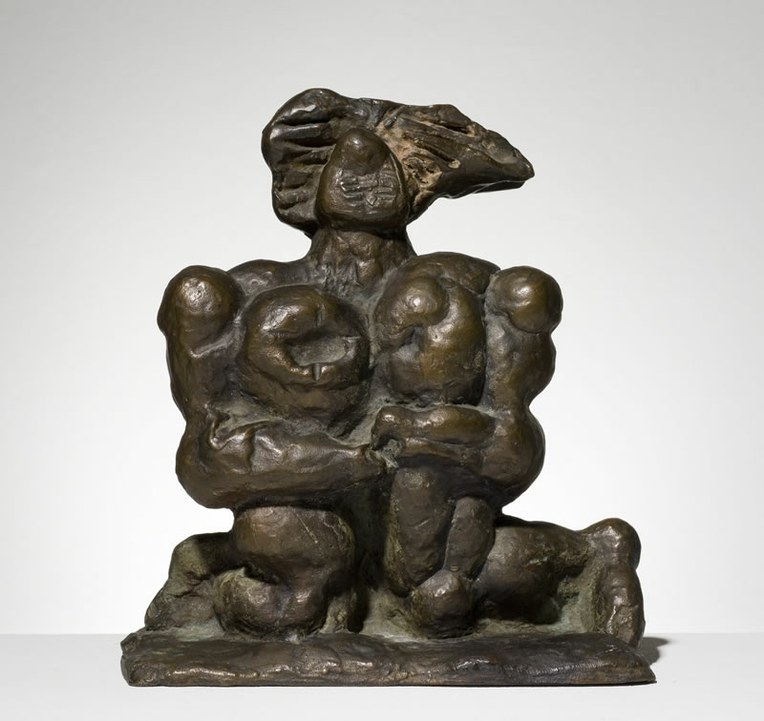
Erik Thommesen (15 February 1916 – 22 August 2008) was a Danish sculptor who worked mainly with wood, creating Expressionist representations of the human figure inspired by African sculpture


His figures are crafted in an almost Expressionist style with bowed heads or emaciated bodies. Recognizable features such as arms, legs and face are absent, leaving only the body itself. Notable items from the 1940s include a series based on the theme Pige med fletning (Girl with Braid) culminating in 1948 with a piece in which the body and the braid form a solid pillar. Another subject is the human head which develops into a block-like shape. In 1948, after discovering Astrid Noack's Naturalistic works he tried to give his own sculptures most expressiveness, often looking like blocks or tree-trunks. His work is inspired by African sculpture as well as by the work of Henri Matisse, Pablo Picasso and Aristide Maillol. Wikipedia