Emilio Scanavino (Genoa, 28 February 1922 – Milan, 28 November 1986) was an Italian painter and sculptor. Scanavino was born in Genoa. In 1938 he enrolled to the Art School Nicolò Barabino where he met Mario Calonghi, who was teaching at the school and was due to be a great influence on Scanavino’s artistic formation. In 1942 he had his first exhibition at the Salone Romano of Genoa. In the same year he enrolled at the Faculty of Architecture at the Milan University. In 1946 he married Giorgina Graglia.In 1947 Scanavino moved to Paris where he met poets and artists such as Edouard Jaguer, Wols and Camille Bryen. This experience proved to be inspirational. He was especially interested in Cubism, which he rendered into a personal interpretation when he exhibited at the Gallery Isola in Genoa in 1948. In 1950 Scanavino and Rocco Borrella joined "I sette del Numero", an artistic group revolving around the Numero Gallery in Florence. In the same year he was invited to the 27th edition of the Venice Biennale and in 1951 he had a two-person exhibition with the sculptor Sarah Jackson at the Apollinaire Gallery in London.
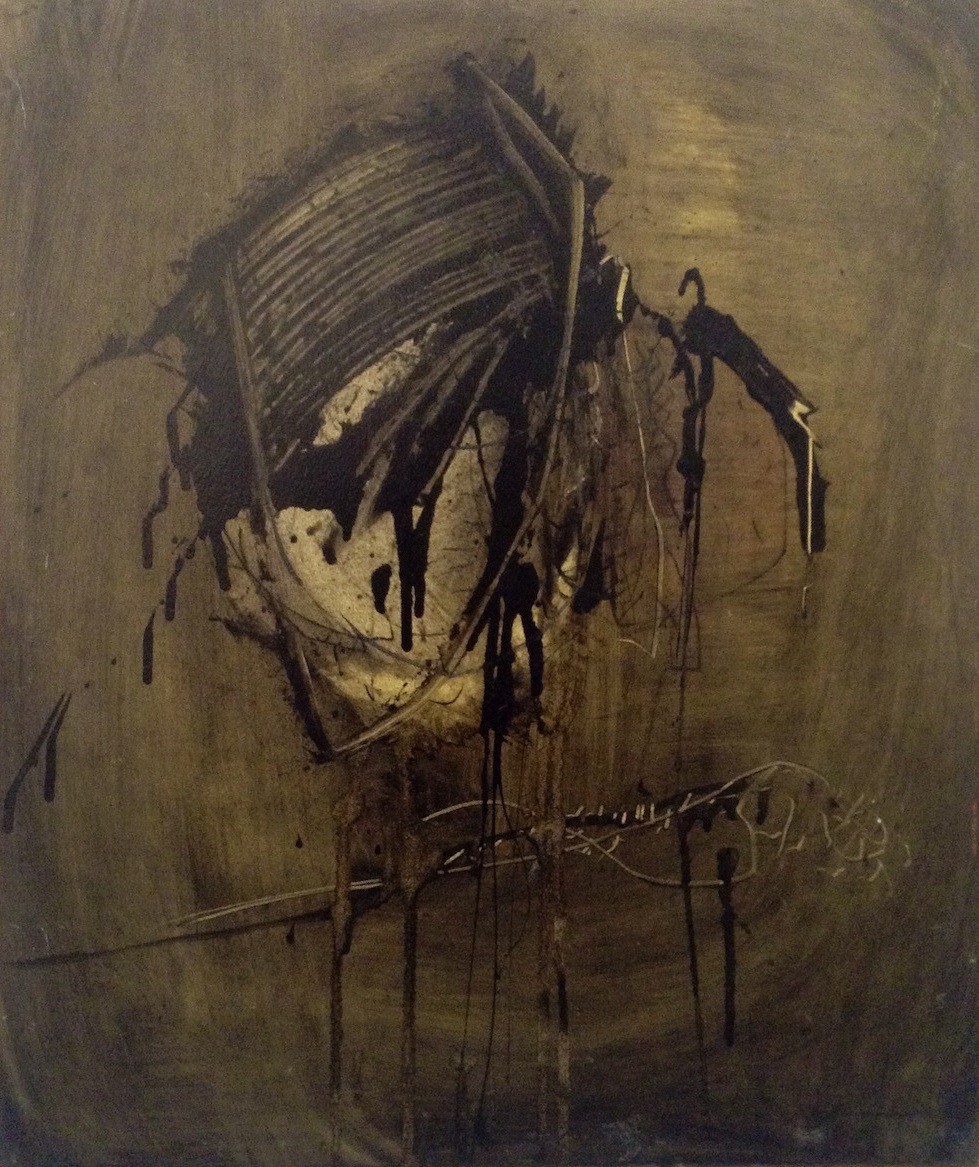
After an initial interest in figurative art, Scanavino's paintings took Post-Cubist nuances. His forms became increasingly stylized, until being completely obliterated in the works from the early 1950s. In 1954 his characteristic sign, “stylized knot”, started to appear. That is the , eventually marking his whole production. In the late 1970s years paintings, the “knot” became perfectly defined and recognizable, although his work became darker, sometimes even threatening due to the conspicuous presence of red stains resembling blood. Although Scanavino is difficult to place inside a specific artistic movement, he can be considered an informal abstractist, close to the Abstract Expressionism and Hans Hartung and Georges Mathieu's art.Wikipedia
After an initial interest in figurative art, Scanavino's paintings took Post-Cubist nuances. His forms became increasingly stylized, until being completely obliterated in the works from the early 1950s. In 1954 his characteristic sign, “stylized knot”, started to appear. That is the , eventually marking his whole production. In the late 1970s years paintings, the “knot” became perfectly defined and recognizable, although his work became darker, sometimes even threatening due to the conspicuous presence of red stains resembling blood. Although Scanavino is difficult to place inside a specific artistic movement, he can be considered an informal abstractist, close to the Abstract Expressionism and Hans Hartung and Georges Mathieu's art.Wikipedia