Exposition Art Blog: nudes
Showing posts with label nudes. Show all posts

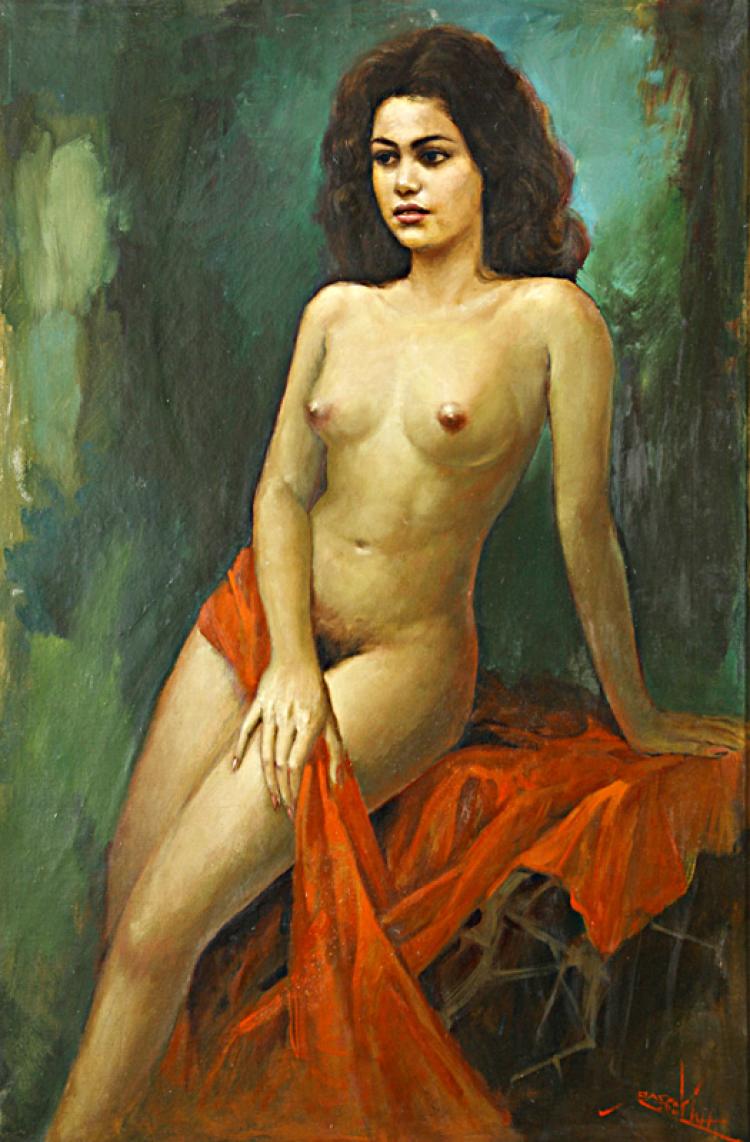
Realism Basuki Abdullah

Basuki Abdullah (Surakarta, Central Java 25 January 1915 - Jakarta, 5 November 1993) was an Indonesian painter and a convert to Roman Catholicism from Islam. His work is characterized as realism and has been exhibited in the Indonesian National Gallery. He received formal training in The Hague. During the Japanese occupation of Indonesia he was an art teacher. After the war he became known internationally, winning an art contest on the occasion of the accession in the Netherlands of Queen Juliana. His status in Indonesia provided an opportunity to paint the official portrait of President Suharto. Abdullah was beaten to death by three assailants during a break-in at his Jakarta home.Wikipedia


Watercolour painting Ignacio Barrios

Ignacio Barrios (March 10, 1930 – January 22, 2013) was a Mexican painter mostly known for his absolute commitment to watercolour painting.He earned the reputation of one of the top watercolour painters in his country of origin and possibly the most distinctive of them all.Even though the themes he depicts in his work are diverse, landscapes are perhaps his most celebrated works.
Barrios was born in the municipality of Mineral de Zacualpan, State of Mexico, Mexico, on March 10, 1930. He is the youngest of the five children of Eustolio Barrios Hernández - a local miner and farmer - and Isabel Prudencio Flores. Since his early childhood, Barrios was deeply fascinated with nature, which perhaps came to him from his father, who used to watch over the nearby forests and protect them against illegal logging every morning. And by doing so, he was also passing on to his son a true love and respect for the place where they lived. For several years, the Barrios made their living out of selling flowers and fruits which they collected around their plot. Barrios would then reflect all these memories through his paintings of still life and multicoloured flowers.


 Barrios began his work painting classical and academic landscapes. Critics admire how he has been able to move from costumbrismo, to impressionism, to surrealism. In recent years, he has occasionally put figurative art aside to seek semi-abstract creations. His work is mainly characterised by landscaping (both Mexican and international), urban environment, Art Marine, still life, human body, portraits, abstract and semi-abstract art. While his early work took him to a position of privilege amongst the most renowned landscapers, the aesthetic level he has reached in the development and reproduction of human figure is not less remarkable.


 From 1965 to 1981, his work was primarily notable for the use of gray and ochre tones that helped him find harmonious tonalities. Those were the years of Barrios' Europeanisation, since a large proportion of his artistic evolution as a painter took place in Europe. During the 80's, his work began to acquire a broader variety of colours which has advanced the expressive strength of his paintings.
Barrios' work is clearly apparent. His unique mastery of water and handling of humidity make his watercolour technique even more complex, and along with his wide impressionism traits, he has been able to, in his own words, "let water speak its own language."Wikipedia


Robert Oscar Lenkiewicz

"Robert Lenkiewicz was born in London in 1941, the son of refugees who ran a Jewish hotel in Fordwych Road, whose elderly residents included a number of Holocaust survivors. He was inspired to paint after seeing Charles Laughton in Alexander Korda's biographical film Rembrandt. At 16, Lenkiewicz was accepted at Central Saint Martins College of Art and Design and later attended the Royal Academy. However, he was virtually impervious to contemporary art fashions, being more interested in his favourite paintings in the National Gallery. Inspired by the example of Albert Schweitzer, Lenkiewicz threw open the doors of his studios to anyone in need of a roof – down and outs, addicts, criminals and the mentally ill congregated there. These individuals were the subjects of his paintings as a young man. However, such colourful characters were not welcomed by his neighbours and he was obliged to leave London in 1964. He spent a year living in a remote cottage near Lanreath in Cornwall, supporting his young family by teaching, before being offered studio space on the Barbican in Plymouth by local artist John Nash. The artist's home and studios once more became a magnet for vagrants and street alcoholics, who then sat for paintings. Their numbers swelled and Lenkiewicz was forced to commandeer derelict warehouses in the city to house the 'dossers'.


  One of these warehouses also served as a studio and in 1973 became the exhibition space for the Vagrancy Project. He first came to public attention when the media highlighted his giant mural man on Plymouth's Barbican in the 1970s. Another furore occurred in 1981 when he faked his own death in preparation for the forthcoming project of paintings on the theme of death (1982): "I could not know what it was like to be dead," said the artist, "but I could discover what it was like to be thought dead." After his first exhibition with an established art dealer, in the 1990s Lenkiewicz's work enjoyed growing commercial success and some recognition by the establishment. He received a major retrospective in 1997 at Plymouth City Museum and Art Gallery, attended by 42,000 visitors. Lenkiewicz, aged 60, died of a heart attack in 2002.


 Despite painting 10,000 works rated of 'national importance' by the British Museum he had only £12 cash in his possession (having never opened a bank account), and owed £2 million to various creditors. Since his death examples of his best paintings have fetched ever-rising prices in London auction rooms. In his obituary of Lenkiewicz, art critic David Lee observed: "Robert's greatest gift was to show us that an artist could be genuinely concerned about social and domestic issues and attempt the difficult task of expressing this conscience through the deeply unfashionable medium of figurative painting. In that sense he was one of few serious painters of contemporary history." The rise in Lenkiewicz's popularity was shown in a 2008 auction of his personal collection of his own works, the auction of his paintings and library raised £2.1million. The auction was held by Bearne's Auctioneers (now Bearnes Hampton & Littlewood) at Westpoint Arena in Exeter. Lenkiewicz never paid tax or kept any records of sales of his works. In 2009 when his estate was finally valued after lawyers spent 7 years going through personal effects he was found to have left £6.5 million. As well as paintings the estate included a £1 million book collection. Lenkiewicz was the father of 11 children, His daughter Alice Lenkiewicz is a painter, poet and editor of the literary magazine, Neon Highway. His stepdaughter, Rebecca Lenkiewicz, is an accomplished playwright who has had her work performed at the Royal National Theatre. Another stepdaughter is Bianca Eliot. Lenkiewicz's pupils include Piran Bishop, Yana Travail, Dan Wheatley, Lisa Stokes and Joe Stoneman. "(haynesfineart.com)


Dechko Uzunov

Dechko Hristov Uzunov is a world-famous Bulgarian artist. He was born on February 22, 1899 in the town of Kazanlak. He studied painting in Munich (1922–1923), and graduated in art of painting at the Academy of Fine Arts in Sofia in 1924. Later he was elected rector of the Sofia Fine Arts Academy. He was also head of the National Gallery of Arts in Sofia, and a few times reelected chairman of the Union of Bulgarian Artists. Dechko Uzunov was a member of the European Academy of Science and Arts. He won a lot of prizes and honours. Dechko Uzunov left incredibly rich work – some 13,000 works. He is one of the most renowned Bulgarian artists. He worked in all genres but mainly in portrait, figures and landscape painting. His most famous works include Varshitba (Threshing), Svetlina (Light), Detski Portret (Portrait of a Child), Moma (Lass), Prolet v Dobrudja (Spring in Dobrudja). Dechko Uzunov died on April 26, 1986 in Sofia. (daily.bia-bg.com)