Exposition Art Blog: modern sculpture
Showing posts with label modern sculpture. Show all posts

Ralph Brown

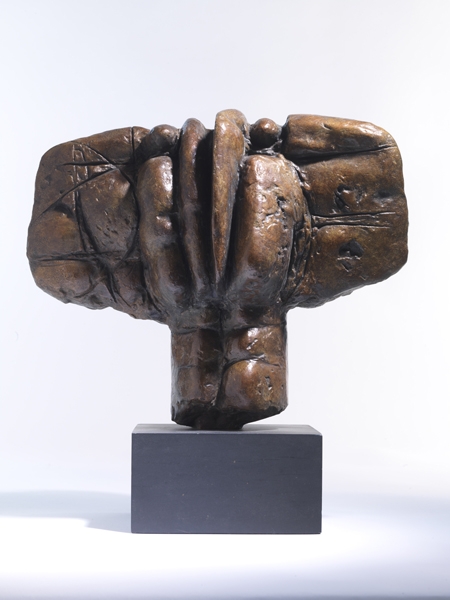
Ralph Brown (1928 – 2013) was an English sculptor who came to national prominence in the late 1950s with his large-scale bronze Meat Porters, commissioned for Harlow New Town, Essex and is known for his sensual, figurative sculptures.Like Henry Moore who befriended him and encouraged him by buying his work, Brown's art is deeply rooted in the figurative tradition. However, whilst his predecessors focused their energies on carving and maintaining 'truth to materials', Brown concentrated on modelling allowing him to interact with his material on a more intimate level. In the introductory catalogue essay for Brown's major retrospective show at Leeds City Art Gallery in 1988 Dennis Farr commented: "So much of Brown's sculpture is his search for equivalents, in formal terms, for sensual experiences.Brown came to national prominence in the late 1950s with his large-scale bronze group Meat Porters, commissioned for Harlow New Town, Essex. The piece is a tribute to physical labour with two figures hauling an ox carcass, a subject fitting to the busy market square and a form that brings dynamism to the otherwise rigid architecture. The concrete version of the piece won second prize for sculpture at the John Moore's Exhibition, Liverpool in 1959.Wikipedia




George Grard

George Grard (1901-1984) was a Belgian sculptor, known above all for his representations of the female, in the manner of Pierre Renoir and Aristide Maillol, modelled in clay or plaster, and cast in bronze.
Grard was born in Tournai to a family of modest means and entered the Académie de Tournai in 1915, but his real calling as a sculptor became apparent when he followed a course in sculpture in 1922 with Maurice De Korte (1889–1971). In his native city he met Pierre Caille, and later, in a Brussels foundry, Charles Leplae. Having won the Prix Rubens (1930), he left for Paris, where he encountered the sculpture of Charles Despiau, Aristide Maillol and Pierre Renoir, which influenced his mature style. In 1931, he set up his studio at Saint-Idesbald on the coast, where his house became a rendez-vous of artists including Pierre Caille, the Haesaerts brothers, Edgard Tytgat and Paul Delvaux.In 1935, he was commissioned to create a sculpture for the rose garden at the Exposition universelle et internationale. Two years later Henry Van de Velde asked him for a work for the Belgian pavilion of the Exposition internationale, 1937. In the nineteen-fifties Grard, still in full possession of his mature powers, received repeated public commissions: the Seated Figure at the Banque Nationale, Brussels (1950), La Mer, fronting the post office at Ostend (1955, illustration), the Naïade at Tournai (1950), and Earth and Water, near the Albert Bridge at Liège (1964).George Grard died in Saint-Idesbald in 1984.Wikipedia


Constantin Brancusi - Modern sculpture

Constantin Brâncuși (February 19, 1876 – March 16, 1957)was a Romanian sculptor, painter and photographer who made his career in France. Considered a pioneer of modernism, one of the most influential sculptors of the 20th-century, Brâncuși is called the patriarch of modern sculpture. As a child he displayed an aptitude for carving wooden farm tools. Formal studies took him first to Bucharest, then to Munich, then to the École des Beaux-Arts in Paris from 1905 to 1907. His art emphasizes clean geometrical lines that balance forms inherent in his materials with the symbolic allusions of representational art. Brâncuși sought inspiration in non-European cultures as a source of primitive exoticism, as did Paul Gauguin, Pablo Picasso, André Derain and others. But other influences emerge from Romanian folk art traceable through Byzantine and Dionysian traditions.Wikipedia