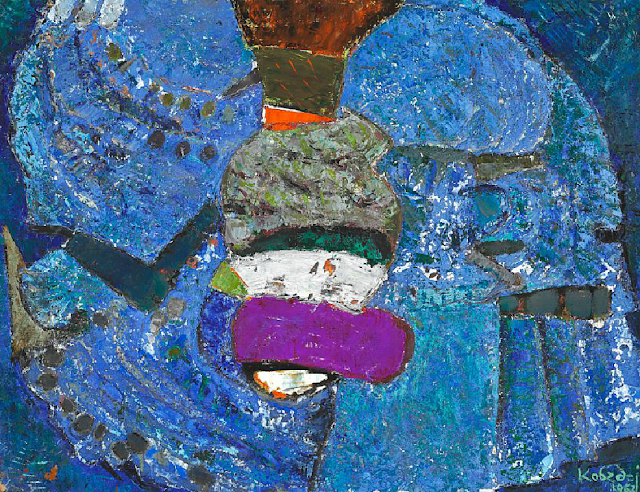
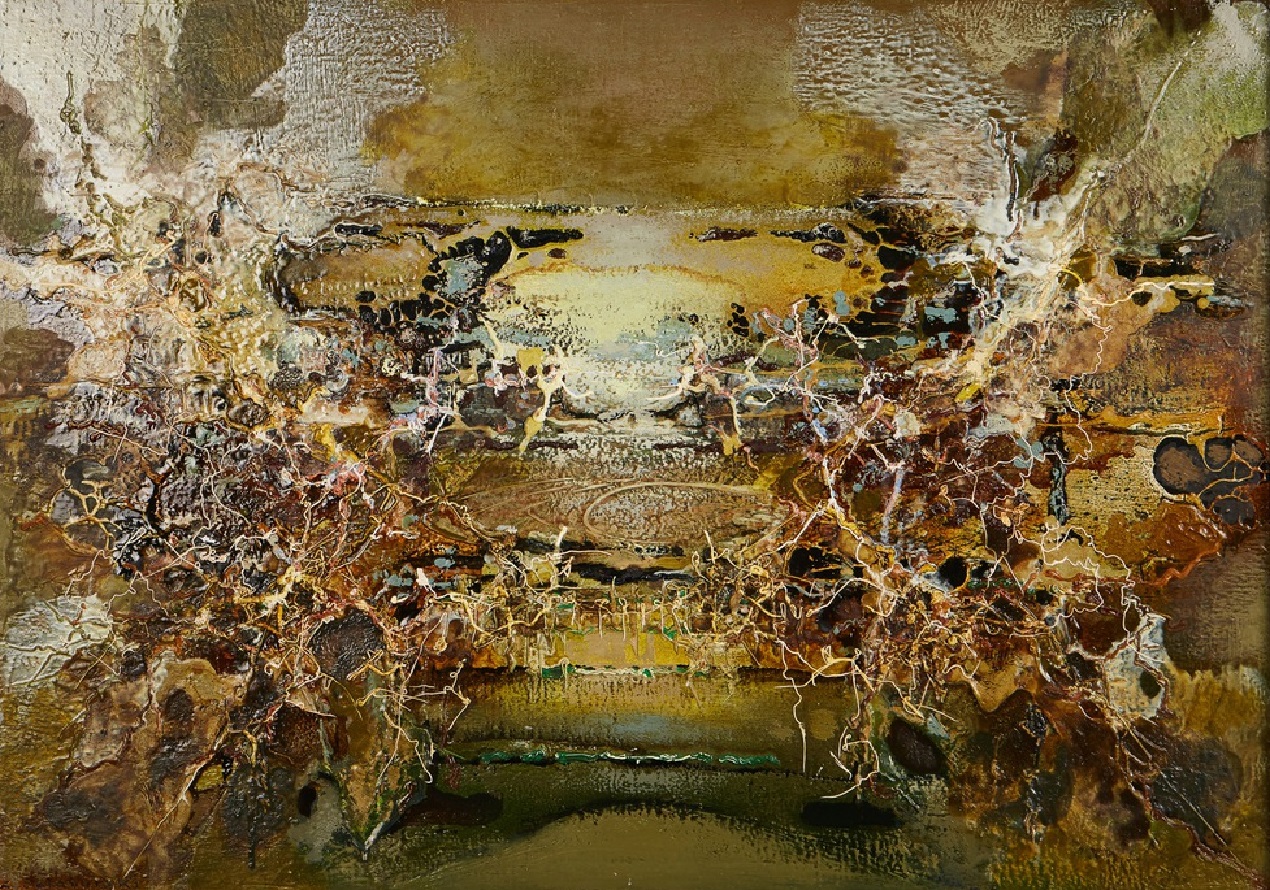
Aleksander Kobzdej (1920–1972) was a Polish painter. He was born in, what was then, Ukraine. Kobzdej is best known for being one of the most prominent representatives of the Polish Social Realist group, and for being the creator of unique Polish versions of "matter" painting.Kobzdej began studying architecture in 1939 at Lviv. He finished his degree in Gdansk Polytechnic Institute and later studied under Wladyslaw Lam at the Kraków Academy of Fine Arts.Kobzdej started off as a Post-Impressionist. His works eventually became more abstract. Toward the end of the 1940s, he exhibited bits of European Realism. "Signs of impending change appeared in Kobzdej's work at the beginning of the 1950s in a series of drawings he produced as an outgrowth of his travels to China and Vietnam (1954). These works demonstrate his interest in means of expression that do not reflect reality, and transform it instead into art. The artist abandoned the narrative bareness of representation opting for more subtle means of expression in both his paintings and drawings. His final abandonment of Socialist Realist iconography became evident in the series of paintings titled Gęstwiny / Arrays (1955). Towards the end of this same decade, the painter traveled around Western Europe. The voyage transformed his art fundamentally, to the extent that one might even say it revolutionized Kobzdej's work. He discarded representation and began to paint metaphorical compositions with a dramatic, even eschatological mood, which were impressive for their refined color schemes (see the series Idole / Idols, 1958-59; and the triptych Na śmierć człowieka / For the Death of a Man, 1964). This path led him directly to Informel art. He gradually devoted more of his efforts to researching the structure of paintings. He came to underline the material status and rank of paint itself, differentiating textures and highlighting the nuances inherent in color. A masterly example of this approach, belonging firmly within the realm of "matter" painting, is the series Szczeliny / Crevices, dating from the 1960s. These works combine the properties of flat compositions with those of the technique of relief. Though they constitute integral wholes played out on a plane, they simultaneously seek to go beyond the limitations thereof. Kobzdej achieved the effect by layering paint thickly and by introducing non-painting materials, small elements of various derivation (particles of metal, wood, plastic) that seemed to emerge from between two bands of painted canvas. The next phase in Kobzdej's explorations took the form of spatial objects composed of rectangular platens that seemed to press an untamable, pulpy mass out of an invisible tube (Powierzchnia srebrna podparta reliefem / Silver Surface Supported by a Relief, 1967). The artist resorted to yet other solutions during the last years of his life. At this time he created a series of several dozen highly original painterly and sculpted structures formed of a moldable mass "draped" on a metal mesh (Hors cadre, 1969-72). Kobzdej also created a series of paintings intended for specific interiors (Baby gołuchowskie / Gołuchów Babushkas - for Gołuchów Castle), and designed scenery, posters, and book illustrations."(Author: Małgorzata Kitowska-Łysiak, Art History Institute of the Catholic University of Lublin, Faculty of Art Theory and the History of Artistic Doctrines, December 2001.)