Exposition Art Blog: European sculpture
Showing posts with label European sculpture. Show all posts

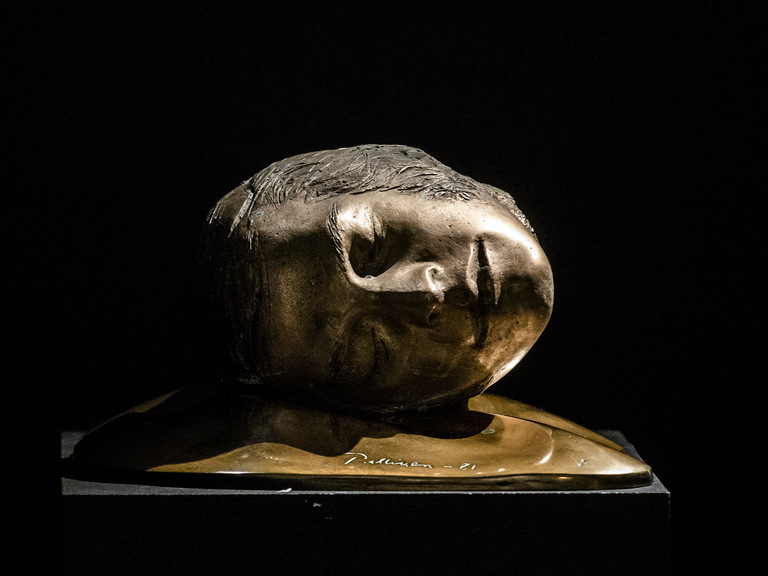
Laila Pullinen - Modernist Sculpture


Laila Annikki Pullinen-Ramsay ( 1933 Terijoki – 2015 ) was a Finnish artist and sculptor. Her work exemplifies modernism, in particular classical modernism in sculpture. She was one of the few Finnish women artists to achieve international recognition.
Pullinen studied art first in Academy of Fine Arts, Helsinki 1953–1956, the Accademia Pietro Vannucci in Perugia 1958 and Accademia di Belle Arti di Roma 1961–1962. She started to exhibit her works in international exhibitions from the late 1950s. In Finland several dozens examples of her sculpture can be found decorating public places such as Helsinki-Vantaa Airport and Nissbacka Park of Sculpture. Her works have also been acquired by several international art museums and collections. In 1968 she was awarded Order of the Lion of Finland. She was also the first female president of the Union of Finnish Sculptors.In her art Pullinen often employed traditional materials, such as stone and bronze, but occasionally she could try very innovative sculpting methods. For example, she used explosives to sculpt a relief for The 1967 International and Universal Exposition in Montreal, Quebec, Canada. As a personality she was known as a strong-willed and communal character, as she was a well-known figure in artist circles and worked to improve the position of sculptors.Wikipedia




https://milenaolesinska.blogspot.com/p/blog-page_50.html

Barry Flanagan - Sculpture


"Barry Flanagan (1941- 2009 ) is most recognised for his bronze sculptures of hares, but started out as a minimalist sculptor working with sand, plaster, wood and rope. He participated in some of the most important exhibitions of the 1960s, notably When Attitudes Become Form at the Kunsthalle Bern and the ICA (1969)." .."His oeuvre consists of bronze representations of anthropomorphic figures, animals, and creatures of lore. Flanagan’s work employs an elongated stylization of form, similar to Alberto Giacometti, but incorporates it towards a humorous end. He developed his idiosyncratic style within the context of his peers, who were focused on making austere, Minimalist sculpture.."
"Flanagan studied at Birmingham College of Art and Crafts before going on to St. Martin’s School of Art in London in 1964. Between 1967 and 1971 he taught at St. Martin’s School of Art and the Central School of Arts and Crafts. Flanagan represented Great Britain at the Venice Biennale in 1982. In 1991, Flanagan was elected to the Royal Academy of Arts and awarded an OBE." (waddingtoncustot.com)


Andre Ramseyer

André Ramseyer (January 31, 1914 in Tramelan – January 15, 2007 in Neuchâtel) was a Swiss sculptor, who lived in Neuchâtel. He had been working in Neuchâtel since 1942, after working in l'Ecole d'art à La Chaux-de-Fonds between 1932 and 1935, and staying in Paris (between 1935 and 1936) and Italy for a few short periods of time. In Neuchâtel, he taught Art and the History of Art until 1956. He returned to Paris in 1949, but went back to Neuchâtel later that year. He stopped working in the 1990s, although he kept the key to his studio in his pocket until the day he died.
He was heavily influenced by Henry Moore. His sculptures can be seen in many public spaces, mostly in Switzerland. 


Igor Mitoraj - post-modern art

"Igor Mitoraj spent most of his life in the West, mainly in France and Italy. The Colombian sculptor Fernando Pole Bolero, one of the most expensive contemporary artists in the world, urged him to buy a house in Pietrasanta, the Italian capital of marble, city of sculptors, where artists such as Michelangelo worked. Mitoraj considered this Italian studio ‘his place on Earth’ though he had lived in Paris, tried to settle in Mexico to learn the art of the Aztecs, and travelled around Greece studying ancient works of art.Antiquity was one of the main sources of inspiration for the artist. His sculptures make direct references to the mythology and history of Greece and Rome, sometimes contained already in the title: Icarus, Centauro, Eros, Mars, Gorgon, Paesaggio Ithaka. As art critics have noted, while evoking the beauty and perfect proportions of classical sculptures, Mitoraj re-interpreted them in a contemporary way. He visualised the imperfection of human nature by deliberately damaging and cracking the surface of statues.Mitoraj’s style is now being recognised by art lovers around the world. The sculptures’ lips, which always have the shape of those of the artist, are among the characteristic features of his works, serving as a sort of an informal ‘signature’


 Igor Mitoraj was born on 26th March, 1944 in Oederan in the Ore Mountains, and was the son of a Polish forced labourer and a French prisoner of war, an officer of the Foreign Legion. When the war was over, he returned to his grandparents in Poland with his mother. Mitoraj spent his childhood and youth in Grojec. After graduating from the Art School in Bielsko-Biała, he was admitted to the Academy of Fine Arts in Kraków in 1963, where he studied painting under the direction of Tadeusz Kantor.
In 1968, after obtaining a degree, Mitoraj went to Paris to study at the École Nationale Supérieure des Beaux Arts. He started there as a painter and graphic artist; in 1976 he had an exhibition in the La Hune gallery in the Latin Quarter, linked to the bookshop of the same name.Later he took up sculpture. It was not long before he was offered to prepare an exhibition for the ArtCurial gallery in Paris, managed by the nephew of the then French President Mitterand. In order to prepare the works for this exhibition, Mitoraj spent a year in the centre of bronze foundries and marble masons in Pietrasanta, Italy. There he created his first works made of bronze, as well as his first monumental sculptures of white marble from the nearby Carrara.Mitoraj is considered one of the greatest contemporary sculptors. His works can be found in dozens of museums, foundations and headquarters of the largest corporations in the world.


 After the exhibition in the ArtCurial in 1977 Mitoraj’s sculptures and drawings have been shown at 120 solo exhibitions throughout the world. His sculptures, often of gigantic size, stand in emblematic points of many cities – including Paris (La Defense), Rome, Milan, Lausanne, London, Kraków, Scheveningen near The Hague, in the US and Japan.
In an interview, the artist recalled his first years as an emigrant with melancholy:
 I find it absurd when someone says that I have made it in life. I have worked for my success for over 30 years. I earn money with art and it gives me freedom. I have indeed been very lucky, because I have never had to ask for my works to be shown in galleries and I have never been forced to put them out to tender, but before I became free, I had to go through the mill. When I first started my artistic career, I was earning a living by carrying pianos and furniture to the sixth floors of Parisian buildings.
In 2009 Mitoraj created the so-called Angelic doors for the Church of Our Lady of Grace in Warsaw’s Old Town. He had previously created similar doors for the Santa Maria degli Angeli Church in Rome. According to the artist, ‘some may be shocked by the completely unconventional image of the Madonna, looking down towards two angels captured in motion’.On 5th October, 2005, Mirotaj was honoured by the then Minister of Culture Waldemar Dąbrowski with a Gold Medal for Merit to Culture Gloria Artis during a ceremony in the Kraków City Hall. On 24th April, 2012, he was awarded the Commander’s Cross of the Order of Polonia Restituta by the President Bronisław Komorowski ‘for outstanding contribution to Polish and world culture, for creative and artistic achievements’; the honouring ceremony took place on 3rd May, 2012."
(Source: PPA, October 2014, transl. Bozhana Nikolova, April 2015 culture.pl )