Exposition Art Blog: sculptur
Showing posts with label sculptur. Show all posts

Robert Morris - Conceptual Art


 Robert Morris (1931 - 2018 )was an American sculptor, conceptual artist and writer. He was regarded as having been one of the most prominent theorists of Minimalism along with Donald Judd but he also made important contributions to the development of performance art, land art, the Process Art movement, and installation art. Morris lived and worked in New York. In 2013 as part of the October Files, MIT Press published a volume on Morris, examining his work and influence, edited by Julia Bryan-Wilson
"Robert Morris has comported himself for decades as the least minimal of the original minimalists. While sharing most of the core group’s characteristics — including the complementary artist/writer mode — he has in both word and deed proved more committed than the others to contingency and experimentation. Alternating, often abruptly, between cool objects and evocations of calamity, his artistic outlook remains — as the spot-on title of his collected writings suggests — a Continuous Project Altered Daily. Though no slouch when it comes to minimal severity, his thinking often drifts closer in sensibility to Robert Smithson’s macro riffing than to Donald Judd’s ideological finalities.Minimalist theory made much of the viewer’s movement through space as part of what defined the sculptural. Morris, having come to this notion following a wider path of study than the others — a path that included engineering, art history, philosophy, and dance — found ways to follow intuitive offshoots that generated outward from minimalism’s basic premise. He took labyrinths and passageways, which were favored minimalist tropes, and superseded their phenomenological values with emotionally charged contexts that included prison architecture and Midwestern stockyards. Thus the jarring incongruence — to cite an extreme example — between his ascetic, process-oriented felt hangings of the 1970s and the apocalyptic Firestorm reliefs that soon followed. Keeping to a highly subjective route, he seems able to shuttle convincingly between the austere space of the artistically reductive and the emotionally charged arena of darker human experience, discovering along the way many disturbing links between the two."(hyperallergic.com)


Amilcar Augusto de Castro - Brazilian Art


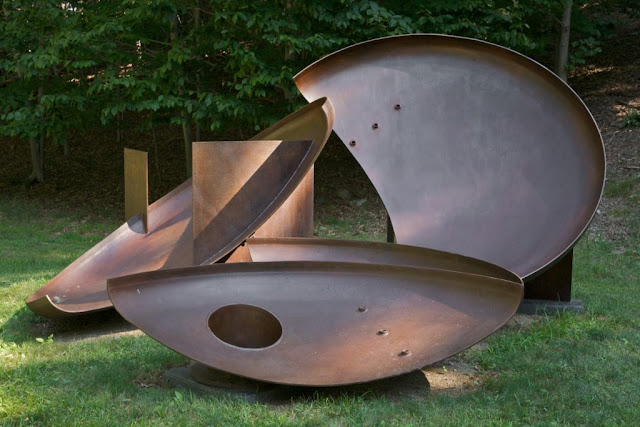
Amílcar Augusto Pereira de Castro (6 June 1920 – 21 November 2002) was a Brazilian artist, sculptor and graphic designer.
Starting his career as a graphic designer, de Castro revolutionized the design of Brazilian newspapers in the 1950s, notably Jornal do Brasil.
From the 1960s he focused on sculpture and – alongside Lygia Clark, Ligia Pape and Helio Oiticica – was one of the leading figures of the Brazilian neo-constructivist movement.De Castro is particularly famous for large, bold simple iron forms nearly always characterized by a design based on "one cut, one fold."His method can be linked both to his earlier work with graphic design and paper, and to the mining heritage of his home state of Minas Gerais.De Castro did not just produce steel sculptures, he also used wood, marble and glass. Reflecting his training under Alberto de Guignard and his work as a graphic designer, he also produced thousands of graphic works, drawings prints and large scale paintings, as well as objects and jewelry.Wikipedia


Isaac Witkin - New Generation of sculptors


"Isaac Witkin (American, 1936–2006), Succoth, 1975. Steel. Gift of Jacques and Donatella Lennon, 91.2.1 | Isaac Witkin rejected the idea that the human figure is necessary to sculpture, and instead explored abstraction in his work. The sculpture consists of welded steel plates painted bright orange. Each plate has an irregular geometric shape, some straight and rigid and others elegantly curved. The sheets slice into one another, delicately balancing on precise contact points. Their sharp edges pierce the space around them, as if Witkin is not only carving the sculpture but also carving air. The overlapped and stacked forms allow for a constantly changing play of light and shadow, assuming different configurations based on the viewing angle. Witkin had a consistent interest in how the scale of a sculpture can be determined by its relationship to the human body. He once stated that “I aim to establish a freedom to move in multiaxial space in a way that draws the spectator in and around the sculpture to experience different aspects of an evolving dynamic.”(wcma.williams.edu)


Robert Morris - Spectral Shrouds - Conceptual Art

Robert Morris (1931 - 2018 )was an American sculptor, conceptual artist and writer. He was regarded as having been one of the most prominent theorists of Minimalism along with Donald Judd but he also made important contributions to the development of performance art, land art, the Process Art movement, and installation art. Morris lived and worked in New York. In 2013 as part of the October Files, MIT Press published a volume on Morris, examining his work and influence, edited by Julia Bryan-Wilson
"Robert Morris has comported himself for decades as the least minimal of the original minimalists. While sharing most of the core group’s characteristics — including the complementary artist/writer mode — he has in both word and deed proved more committed than the others to contingency and experimentation. Alternating, often abruptly, between cool objects and evocations of calamity, his artistic outlook remains — as the spot-on title of his collected writings suggests — a Continuous Project Altered Daily. Though no slouch when it comes to minimal severity, his thinking often drifts closer in sensibility to Robert Smithson’s macro riffing than to Donald Judd’s ideological finalities.Minimalist theory made much of the viewer’s movement through space as part of what defined the sculptural. Morris, having come to this notion following a wider path of study than the others — a path that included engineering, art history, philosophy, and dance — found ways to follow intuitive offshoots that generated outward from minimalism’s basic premise. He took labyrinths and passageways, which were favored minimalist tropes, and superseded their phenomenological values with emotionally charged contexts that included prison architecture and Midwestern stockyards. Thus the jarring incongruence — to cite an extreme example — between his ascetic, process-oriented felt hangings of the 1970s and the apocalyptic Firestorm reliefs that soon followed. Keeping to a highly subjective route, he seems able to shuttle convincingly between the austere space of the artistically reductive and the emotionally charged arena of darker human experience, discovering along the way many disturbing links between the two."(hyperallergic.com)