Exposition Art Blog: Italian painter.
Showing posts with label Italian painter.. Show all posts

Bruno Canova "The Art of War"


 Bruno Canova was born in Bologna in 1925, was drafted in 1943 to military service in the Navy and shortly after he was arrested for attempting to organize a partisan group in La Spezia and interned in a labor camp in the Sudetenland German Brüx .After the liberation, he studied graphic design in the Boarding Schools of the “Convitti della Rinascita”, in Rome and Milan. Among his teachers: Luigi Veronesi, Max Huber, Albe Steiner, Lucio Lombardo Radice, Gabriele Mucchi. After his debut in 1949 in Prague, in an exhibition of Italian graphics and after having been, for some years, the political cartoonist of “L’Unità”, he devoted himself only to his work as an artist in Rome, the city where he would spend all his life and where he frequented, among others, Mario Mafai, Alberto Ziveri, Renato Guttuso, Renzo Vespignani, Salvatore Scarpitta, Ugo Attardi, Pier Paolo Pasolini. In 1965 he won the Premio Suzzara and participated in the Quadrennial of Rome, where his work was noticed by Carlo Ludovico Ragghianti, who wrote him a letter of great appreciation. In this period he develops a research on the city and its suburbs, and composes spreadsheets and drawings in black and white with a few chromatic elements in an assembly close to the experiences of historical avant-gardes. Draftsman and engraver of great quality, in the early eighties his path opens onto color and to a painting where the memory of the Roman School merges his analytical vision with the suggestions of the Northern Renaissance in a search which lasted until the last day. Marked as he was by his dramatic war experiences, from 1966 Bruno Canova worked continuously in the exhibition "The Art of War" that was exposed in public spaces in many Italian cities, with works where drawing and painting merge documents, newspapers and vintage posters, on the wake of the Dadaist collage and the outcomes are often close to certain conceptual experiences. Among his many exhibitions, we must remember his solo shows at the Villa Pignatelli in Naples (1975), at the Palazzo dei Diamanti in Ferrara (1976), at the National Central Library of Rome (1993) and in the Museum of Roman Laboratory of the University "La Sapienza" (1998 ), at the Quadrennial in Rome in 1965 and 1986, and the participation in the Italian Pavilion, section Lazio, 54th Venice Biennale at the Palazzo Venezia in Rome. He died in Lacco Ameno ( Ischia ) July 31, 2012.(.wikiart.org)


Nicola Simbari - Neo-Impressionism


Nicola Simbari (July 13, 1927 - December 11, 2012) was an Italian painter.
Though born in San Lucido, Calabria, Nicola Simbari was raised in Rome, where his father was an architect for the Vatican. He studied at the Accademia di Belle Arti di Roma and in the 1940s he began devoting himself to painting in a studio at Via del Babuino in central Rome. Simbari's early exposure to the architectural world had a lasting impression on his art, as he incorporated geometric forms and architectural structures into almost all of his paintings. He began to develop a distinct style stemming from impressions of life, nature, and the Mediterranean, impressions which abstractly reflect themselves in the purely vivid and passionate colors of his work. Simbari's originality and commercial appeal brought his art to exhibitions in London and New York by the 1950s, solidifying his international reputation.
Rendered in a distinctive style akin to Neo-Impressionism, Simbari's works employ broad swatches of bright pastel hues to form stylized representations of people and places. His oeuvre features recurring landscape scenes of Mediterranean environments, often with partially nude women bathing or in the process of dress. 


https://milenaolesinska.blogspot.com/p/blog-page_50.html

Carol Rama


"Olga Carolina Rama, called Carol Rama, was born in Turin in the 1918. He started painting again as a teenager without having any academic training, but stimulated by the attendance of important protagonists of the Turin, Italian and international cultural milieu, including Felice Casorati, Edoardo Sanguineti, Massimo Mila, Albino Galvano, Carlo Mollino, Paolo Fossati, Carlo Monzino , Luciano Berio, Eugenio Montale, Andy Warhol, Man Ray.
Following painful family incidents, including the mother's psychiatric treatment and the probable suicide of his father, his art becomes a way to exorcise suffering and inner fears.
It initially came to the visionary nature of surrealism, then to Dubuffet and art brut, and later to join the abstract research of the MAC-Movimento d'Arte Concreta in the early Fifties and the poetics of the object trouvé in the 1960s and 1970s, until cycles of more recent works (his last work dates back to 2007) develops a completely personal and autonomous path, adopting different materials, themes and styles capable of giving voice to his dream universe characterized by a provocative iconography, suspended between transgression, eccentricity, autobiography and explicit eroticism."(www.rossorubino.tv)


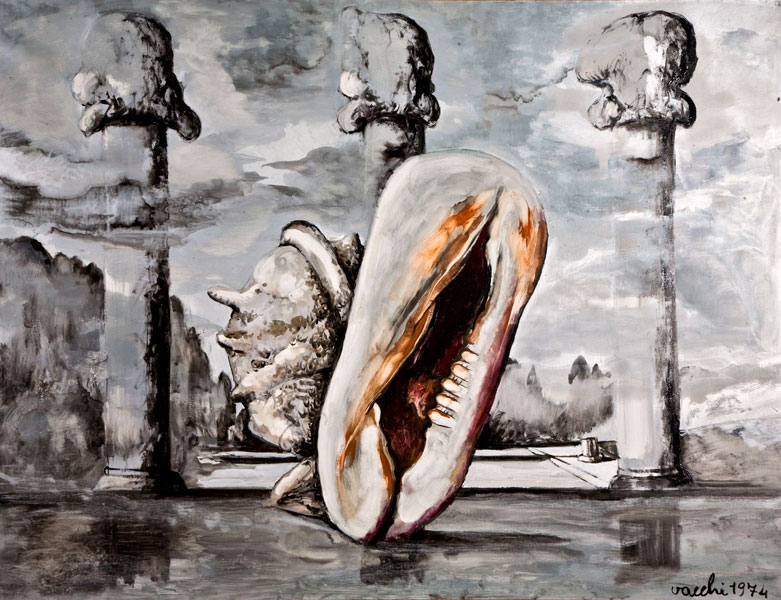
Sergio Vacchi

Sergio Vacchi (1 April 1925 – 14 January 2016) was an Italian painter.
Born in Castenaso, Bologna, Vacchi abandoned his studies in law to pursue his passion for painting. A self-taught artist, in 1951 he held his first solo exhibition in Milan at the prestigious Galleria del Milione. After a period close to post-cubism, between 1956 and 1962 he embraced the informalism.In the early 1960s, Vacchi moved to Rome, and there he started a cycle of gouaches and paintings collectively known as Il Concilio (i.e. "The Council"), which raised large controversities with the Roman Catholic Church because of their grotesque and sometimes blasphemous representation of the church. When in 1964 Vacchi was invited to the Venice Biennale, the patriarch of Venice forbade Catholics to visit his room. Following some cues present in Il Concilio, Vacchi embraced a new art movement, known as Nuova Figurazione ("New Figuration"), of which the first significant example was Morte di Federico II di Hohenstaufen. In the following years the painting cycles Galileo Galilei semper... and Pianeta followed.In the 1990s Vacchi devoted himself to cycles of portraits and self-portraits, and particularly to Greta Garbo's portraits.In 1997 he moved to Siena, where he founded the foundation Fondazione Vacchi.He stopped painting in the late 2000s, because of the Parkinson's disease that had affected him.Wikipedia