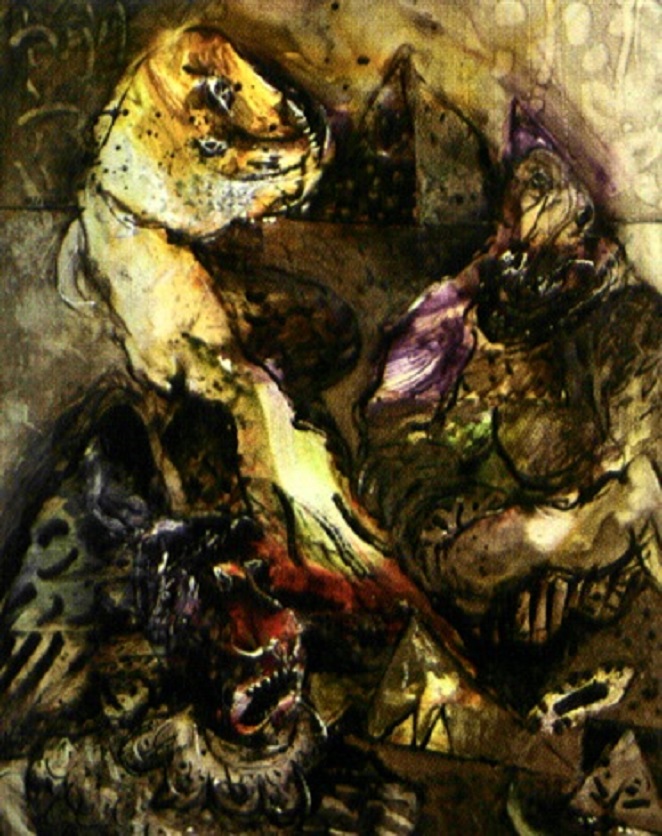
"Stani Nitkowski was born on May 29, 1949. Born to a miner father, of Polish origin, who came to Anjou to work in the slate quarries, and of a Piraean mother, Stani Nitkowski found himself, at 23, in a wheelchair because of myopathy. He quickly abandons abstraction, and begins to draw with ink. His meeting with Robert Tatin, a painter in Cossé-le-Vivien, will encourage and influence him. His first exhibition was in Angers in 1974. On the advice of Jean Dubuffet and Robert Tatin, he meets Cérès Franco who welcomes him in his gallery L'Œil de Bœuf several times. At the same time, Roland Vanuxem becomes his merchant. His work as an artist is deeply marked by his illness. His work is strong, black, tortured in the image of his life. Upset by the death of his son in February 2001, Nitkowski chose to disappear in April, at age 52. "(www.artsper.com)
Painting is like silent poem, said Simonides, poet from ancient Greece.Paintings are icons, doors to the Platonian world above the heavens. Paintings on my blog are just those icons, which lead a viewer into the magic world of harmony and beauty. Artists who present their achievements on my blog have a very different cultural and national background, they represent variety of artistic traditions and schools
Showing posts with label French artist. Show all posts
Raymond Hains - Decollage & Nouveau Réalisme
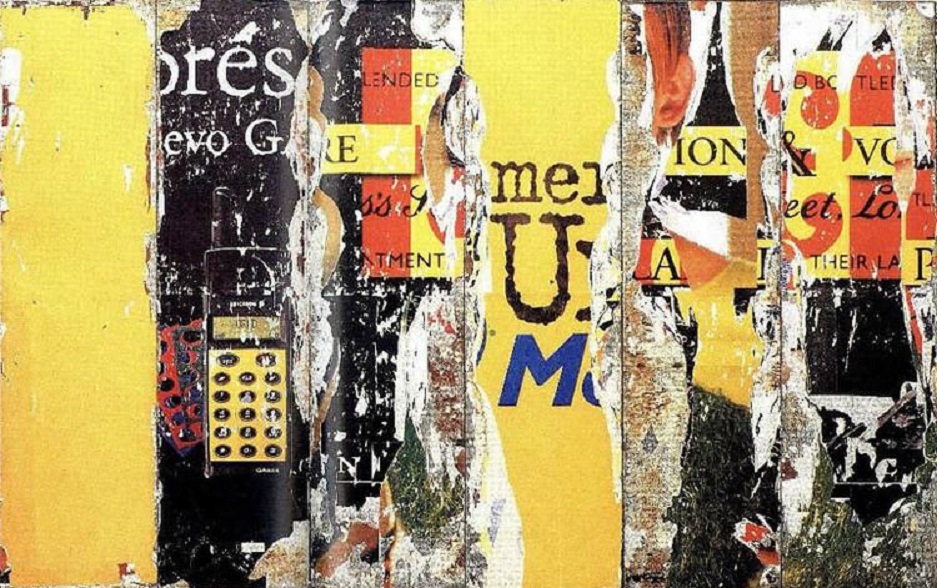
"Raymond Hains was a French Conceptual artist best known for his décollages made from weathered French posters. Opposed to the heroic existentialism championed by Abstract Expressionism, Hains found meaning from vernacular objects and images. “The picture should not be considered as a world in itself, but the world itself should be seen as a picture,” he once said. Born on November 9, 1926 in St-Brieuc, France, he studied sculpture at the École Nationale des Beaux-Arts in Rennes, before transitioning to photography after discovering a book entitled Photographie Française 1839-1936 in 1944. It was his apprenticeship to Emmanuel Souguez, and Souguez’s use of photomontage, that inspired the artist to create his first photograms, including LES ROBOTS, ST-BRIEUC (1947). In 1960, he helped to found the Nouveau Réalisme movement, along with the artists Yves Klein, Jacques Villeglé, François Dufrêne, and Jean Tinguely. Over the course of his career, he vacillated between found-object installations, sculpture, décollage, and photography. Hains died on October 28, 2005, in Paris, France. Today, his works are held in the collections of the Centre Georges Pompidou in Paris, the Musée d’Art Moderne et d’Art Contemporain in Nice, and The Museum of Modern Art in New York."(artnet)
Yves Klein - Blue
Yves Klein 1928-1962 "French artist chiefly noted for his blue monochrome paintings and for his audacious experiments with new techniques and new attitudes to art. Born in Nice; both his parents were painters. Began to paint in the late 1940s and formulated his first monochrome theories. Lived in Japan 1952-3. Became expert at judo, which he later taught in Spain and in Paris, where he lived from 1955. First public one-man exhibition at the Galerie des Solitaires, Paris, 1955. Early monochrome pictures in orange, yellow, pink, red and green, but from 1957 worked mainly in blue; also made from 1960 a number of monogolds, with gold leaf. Murals for the opera house at Gelsenkirchen 1957-9. Began in 1957 to experiment with fire paintings and 'immaterial zones of sensibility', and in 1958 with 'Anthropométries' made by a nude model pressing herself against the canvas under his direction. Member of the group Nouveaux Réalistes with Arman, Raysse, Spoerri, Tinguely, Pierre Restany and others 1960. Died in Paris of a heart attack, at the age of 34."(tate.org.uk)
"The abstract painting that dominated French art in the 1950s was invariably premised on the notion that an artist could communicate with the viewer through the power of abstract form. But skeptics of modern, abstract art have always alleged that the viewers, like the faithful devotees of a false god, do more of the work than the artist, investing the forms with their own feelings rather than discovering the artist's. Viewed in this light, Klein's monochrome blue paintings might be read as a satire on abstract art, for not only do the pictures carry no motif, but Klein insisted there was nothing there at all, only "the void."Klein's pictures may also be read in a contradictory fashion. He was genuinely fascinated by mystical ideas, by notions of the infinite, the undefinable, the absolute, and his use of a single rich and suggestive tone of blue might be seen as an attempt to free the viewer from all imposed ideas and let her mind soar. For, as Klein believed, lines in pictures were a form of "prison grating," and only color offered the path to freedom.Throughout Klein's work, from his canvas monochromes to his later performances, there is a stress on immediate experience that reflects aspects of the Performance art movement of the 1960s. Although he was never specifically opposed to creating art objects, many of Klein's later works seem to want to abandon the object as a vehicle for art and instead find ways to more directly transmit ideas and experiences."(.theartstory.org)
Piotr Kowalski - Contemporary Sculptor & Visual Artist
Piotr Kowalski was an artist, sculptor, and architect. He was born 2 March 1927, in Poland, and died 7 January 2004 in Paris, France.Piotr Kowalski.Piotr Kowalski worked in non-traditional materials including electronic and mechanical devices, neon art, large earth works, explosions and other natural phenomena including plant growth and gravity. His work often expressed science or natural laws in direct and tangible ways, immediate to the senses.A refugee of World War II, a graduate of MIT, he immigrated to France as an architect for UNESCO and spent most of the rest of his life in Paris. Along with gallery works, he installed several large outdoors projects.Piotr Kowalski was born 2 March 1927 in Lviv, then in Poland,now Ukraine. By 1946 he was a refugee of the war living in Brazil. He attended Massachusetts Institute of Technology from 1947 to 1952, receiving a Bachelors in Architecture, and maintained relations with MIT throughout his life. He worked as an architect for I. M. Pei from 1952 until 1953, then joined Marcel Breuer as an architect at UNESCO in Paris.He became a fellow at the Center for Advanced Visual Studies at MIT in 1978, and continued in that position until 1985.In 1985, he became president of the Ars Technica Association connected to the Cité des Sciences et de l'Industrie uniting philosophers, artists, scientists such as Jean-Marc Levy-Leblond, Claude Faure, Jean-Max Albert, Sara Holt, Piero Gilardi, Jean-Claude Mocik, reflecting on the relationship between art and new technologies.He was named professor at École nationale supérieure des Beaux-Arts de Paris in 1987.Wikipedia
Subscribe to:
Posts (Atom)