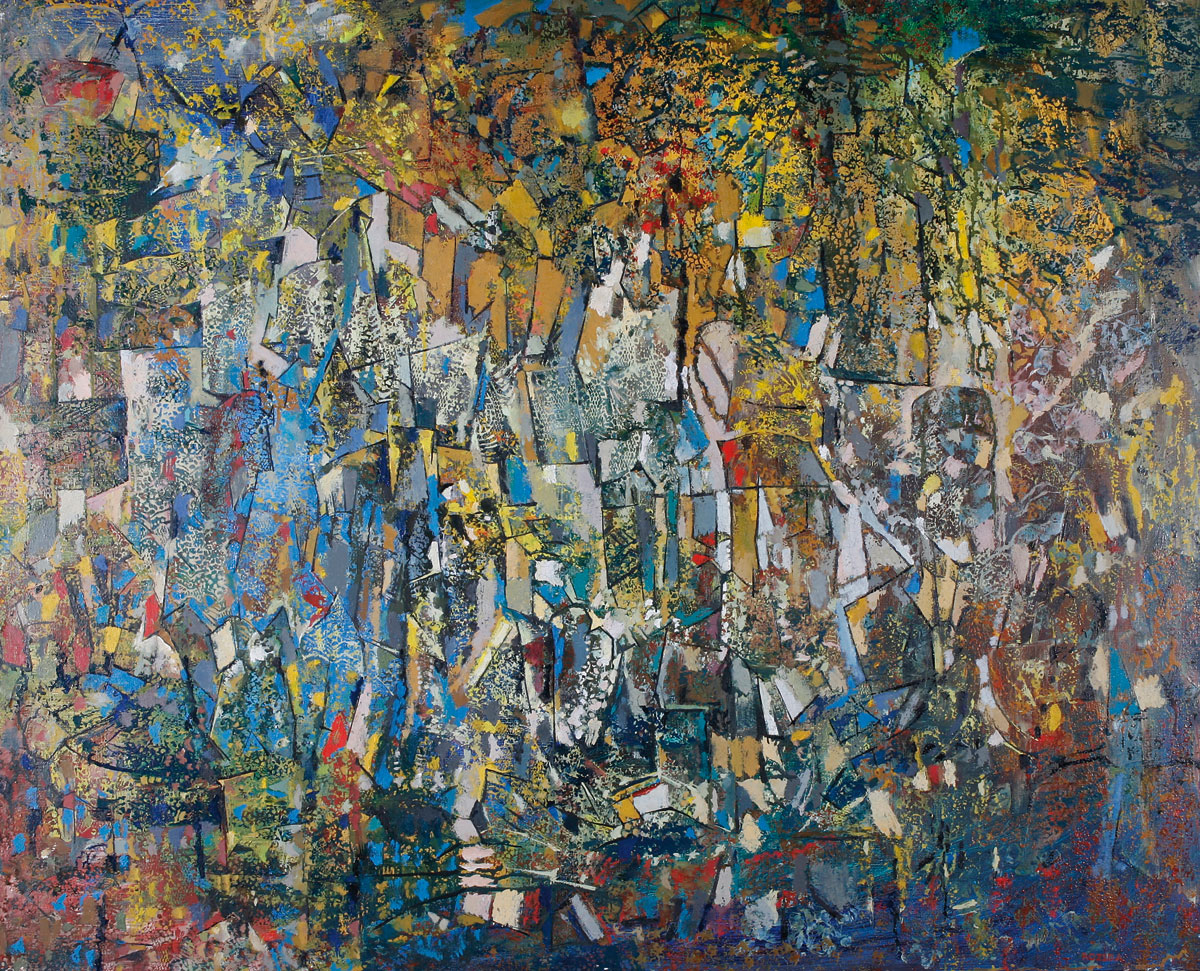
Endre Rozsda ( 1913 - 1999, Paris) was a Hungarian-French painter. By the evidence of his writings, Endre Rozsda was mainly preoccupied with the problem of capturing time through the medium of painting. Time that can be experienced and explored by the subjective mind.
"For Rozsda, subjectivity represented more than the depiction of emotions, he somehow wanted to capture consciousness itself through painting – the process during which the human being creates his or her own world. In accordance with this, the painterly representation of time – depicting time past and time unfathomable – rather than the representation of perspectival space, became the other guiding principle of Rozsda’s painting. Rozsda’s painting “technique” – the nonfigurative structure of the paintings and their rotation during the working process, which eliminates the illusion of real space while mysteriously also retaining it (in many pieces and in its details) – also points in this direction of surreal space and time”, art historian, Sándor Hornyik, explains....From the start of the 1970s his paintings feature more detail than ever before. ..Accordingly, he built up images by allowing small details to rearrange themselves in random variations – in the mind of the beholder. Endre Rozsda had the ambition of making the viewer part of the creative process. To reach that end, he developed a method where first he breaks the world into an infinite variety of – some figurative, some abstract – component parts, then allows each viewer to use these as building blocks and construct a new totality along his/her vision, free association and imagination. Surrealism offered Rozsda the tool to give pictorial representation to his personal memories and fantasy, yet he aimed for something more: he wished to make the viewer his collaborator whose gaze helps to re-create an atomized and deconstructed world. Wikipedia
"For Rozsda, subjectivity represented more than the depiction of emotions, he somehow wanted to capture consciousness itself through painting – the process during which the human being creates his or her own world. In accordance with this, the painterly representation of time – depicting time past and time unfathomable – rather than the representation of perspectival space, became the other guiding principle of Rozsda’s painting. Rozsda’s painting “technique” – the nonfigurative structure of the paintings and their rotation during the working process, which eliminates the illusion of real space while mysteriously also retaining it (in many pieces and in its details) – also points in this direction of surreal space and time”, art historian, Sándor Hornyik, explains....From the start of the 1970s his paintings feature more detail than ever before. ..Accordingly, he built up images by allowing small details to rearrange themselves in random variations – in the mind of the beholder. Endre Rozsda had the ambition of making the viewer part of the creative process. To reach that end, he developed a method where first he breaks the world into an infinite variety of – some figurative, some abstract – component parts, then allows each viewer to use these as building blocks and construct a new totality along his/her vision, free association and imagination. Surrealism offered Rozsda the tool to give pictorial representation to his personal memories and fantasy, yet he aimed for something more: he wished to make the viewer his collaborator whose gaze helps to re-create an atomized and deconstructed world. Wikipedia