Exposition Art Blog: American ceramic artist
Showing posts with label American ceramic artist. Show all posts

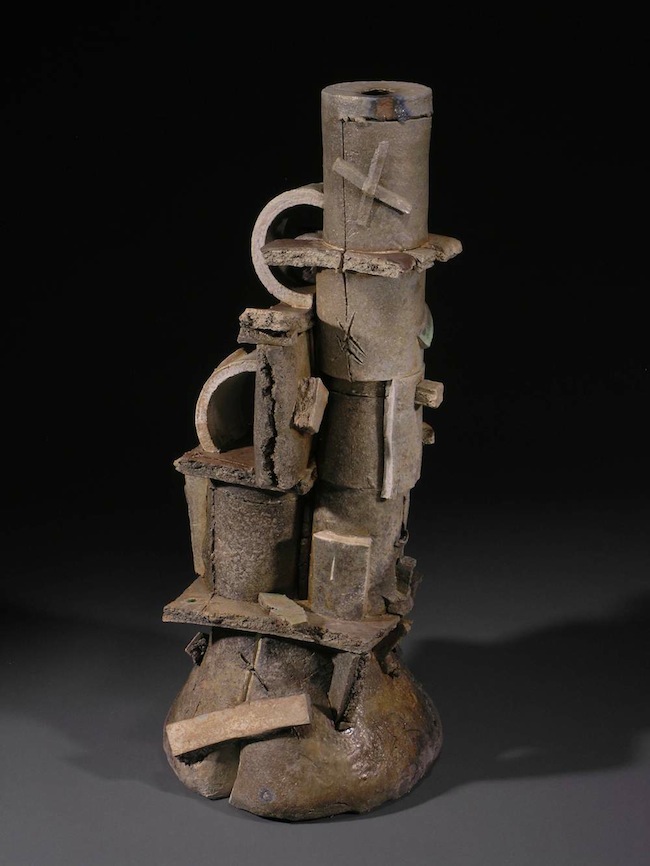
Daniel Rhodes - American Ceramic Artist


Daniel Rhodes ( 1911 –1989) was an American ceramic artist, sculptor, author and educator. During his 25 years (1947–1973) on the faculty at the New York State College of Ceramics at Alfred University, in Alfred, New York (a division of the State University of New York), he built an international reputation as a potter, sculptor and authority on studio pottery.
"Daniel Rhodes was an accomplished painter, and, as a ceramic artist, he manipulates the clay as if it were paint and splashes, scrubs down or builds up for expressive forms, textures and surfaces. The individual elements Rhodes calls “fortuitous forms” are used in an architectural way to build solid constructs that appear woven, wrapped or bound. The natural clay surfaces are terra cotta in tone with color and value subtly altered by the application of slips. Textures are dramatic and pronounced and pay tribute to the elemental surfaces of mountains, valleys, eroded terrains and the moon. Rhodes’ experiences in Japan are evident in many of the pieces especially the ones he calls “Guardians”. They are strong in presence, ancient in spirit and look as if they had recently been discovered in some remote village of an archaic Japan, now long vanished. There are numerous large- scale heads that seem to represent and humanize in an immediate fashion the connection between maker and object; a vessel containing the memories of his life, his dreams and aspirations."(chelsearivergallery.com)


https://milenaolesinska.blogspot.com/p/blog-page_50.html

Toshiko Takaezu - Ceramic Art

"Toshiko Takaezu was an American ceramicist known for her subtly colored glazed vessels. In one of her more famous series, Moonpots, the pots were not functional, with their tops purposefully sealed off. Her studies in Zen Buddhism and traditional Japanese pottery, led her to approach ceramics using intuition and simple gestures. “In my life I see no difference between making pots, cooking, and growing vegetables. They are all so related,” she said. “It is so gratifying and I get so much joy from it, and it gives me many answers in my life.” Born on June 17, 1922 in Pepeekeo, HI, she was the daughter of Japanese immigrants. Toshiko went on to receive her formal training from the University of Hawaii and the Cranbrook Academy of Art in Michigan, where she later taught. The artist died on March 9, 2011 in Honolulu, HI. Today, her works are in the collections of the Smithsonian American Art Museum in Washington, D.C., the Milwaukee Art Museum, and the Honolulu Museum of Art."(artnet)


Donald Lester Reitz - Ceramic art

Donald Lester Reitz (November 7, 1929 – March 19, 2014) was an American ceramic artist, recognized for inspiring a reemergence of salt glaze pottery in United States. He was a teacher of ceramic art at the University of Wisconsin–Madison from 1962 until 1988. During this period, he adapted the pottery firing technique developed in the Middle Ages, which involved pouring salt into the pottery kiln during the firing stage. The method was taught in European ceramic art schools, but largely unknown in United States studio pottery.In 1982, Reitz was in a serious car accident involving a truck and was hospitalized for several months. While recovering from his injury, he began to create a series of ceramic pieces that came to be known by a collective name, Sara Period. In 2007, Reitz suffered a heart attack and would undergo close to a dozen surgeries, including a valve replacement. He continued producing works with the help of studio assistants.Reitz died on March 19, 2014, at the age of 84 of heart failure and was eulogized by The New York Times and the American Craft Council. His works are featured in several museums including the Smithsonian Institution, American Museum of Ceramic Art, and Museum of Fine Arts, Boston.
Later in the 1980s and 90s, he became involved with wood firing ceramics as a collaboration with several artists, traveling to many ceramics studios to utilize different kilns for their varied effects. In 1988, he retired from the University of Wisconsin, but continued to work at his private studio in Clarkdale, Arizona.
Reitz was named on Ceramics Monthly's list of "greatest living ceramic artists worldwide" in 1988 and 2001. In 2002, he was awarded the American Craft Council's Gold Medal award.In 2007, he suffered a heart attack and underwent a series of eleven surgeries, including a valve replacement. However, he continued producing works for several more years, this time, with the help of studio assistants and collaborative artists. He would take elements they molded in cylindrical shapes, modify and assemble them into abstract sculptures, statuettes and table top pieces.Wikipedia


Ceramic Art Toshiko Takaezu

Toshiko Takaezu (17 June 1922 – 9 March 2011) was an American ceramic artist and painter.Takaezu was born to Japanese immigrant parents in Pepeekeo, Hawaii, on 17 June 1922. She attended Saturday classes at the Honolulu Museum of Art School (1947–1949) and attended the University of Hawaii (1948, 1951) where she studied under Claude Horan. From 1951 to 1954, she continued her studies at Cranbrook Academy of Art in Bloomfield Hills, Michigan (1951), where she befriended Finnish ceramist Maija Grotell, who became her mentor. In 1955, Takaezu traveled to Japan, where she studied Zen Buddhism and the techniques of traditional Japanese pottery, which influenced her work.She taught at several universities and art schools: Cranbrook Academy of Art, Bloomfield Hills, Michigan; University of Wisconsin, Madison, Wisconsin; Cleveland Institute of Art, Cleveland, Ohio (10 years); Honolulu Academy of Art, Honolulu, Hawaii; and Princeton University, Princeton, New Jersey (1967–1992), where she was awarded an honorary doctorate.Takaezu treated life with a sense of wholesomeness and oneness with nature; everything she did was to improve and discover herself. She believed that ceramics involved self-revelation, once commenting, "In my life I see no difference between making pots, cooking and growing vegetables... there is need for me to work in clay... it gives me answers for my life." When she developed her signature “closed form” after sealing her pots, she found her identity as an artist. The ceramic forms resembled human hearts and torsos, closed cylindrical forms, and huge spheres she called “moons.” Before closing the forms, she dropped a bead of clay wrapped in paper inside, so that the pieces would rattle when moved. The most important part of her ceramic pieces is the hollow space of air within. She relates this to the idea that what’s inside a person is the most important.She retired in 1992 to become a studio artist, living and working in the Quakertown section of Franklin Township, Hunterdon County, New Jersey, about 30 miles northwest of Princeton. In addition to her studio in New Jersey, she made many of her larger sculptures at Skidmore College in Saratoga Springs, New York. She lived in Hawaii for 10 years and died March 9, 2011 in Honolulu.Wikipedia