Exposition Art Blog: Austrian artist
Showing posts with label Austrian artist. Show all posts

Gunter Damisch


 "Gunter Damisch (1958 - 2016 ) was an Austrian artist known for his lush paintings of rhizome-like forms and undulating lines. “My pictorial system is strongly guided by the idea of transformation and metamorphosis. These ambiguities fascinate me,” he once explained. Born on May 20, 1958 in Steyr, Austria, he went on to study under Arnulf Rainer at the Academy of Fine Arts in Vienna, during which time he was a member of the punk band Molto Brutto. After finishing school, Damisch began exhibiting his work and established himself in the Viennese contingent of the Neue Wilde movement, alongside Otto Zitko and Hubert Scheibl. In the decades that followed, the artist was the subject of exhibitions both in Austria and abroad. Damisch died on April 30, 2016 in Vienna, Austria. Today, his works are held in the collections of a number of Austrian museums, including the Lentos Kunstmuseum Linz, the Museum Moderner Kunst Stiftung Ludwig in Vienna, and the Museum Liaunig in Neuhaus."(artnet)
"Gunter Damisch works as a painter, draftsman and graphic designer but in recent years he has turned his attention increasingly to sculpture, developing a highly personal and complex cosmological view of the world. This world is inhabited by a large number of invented beings that can be ascribed to either a microcosmic biological or a macrocosmic spiritual world.
These beings drift in the streams of air, water, earth and fire emerging from a universe that has been subjected to a never-ending process of change by the creator. Gunter Damisch’s “Flämmler”, lucid amblers between time and space, can be seen in this context as metaphors for the fleetingness of human existence, at least for its consummation in a processual dimension."(artsper.com)


Franz West - Unconventional Objects - Installations and Sculptures


 Franz West (16 February 1947 – 25 July 2012) was an Austrian artist.He is best known for his unconventional objects and sculptures, installations and furniture work which often require an involvement of the audience...."From abstract and interactive sculpture to furniture and collage, Franz West’s oeuvre possesses a character that is at once lighthearted and deeply philosophical. Belonging to a generation of artists exposed to the Actionist and Performance Art of the 1960s and 70s, West instinctively rejected the idea of a passive relationship between artwork and viewer. Opposed to the existential intensity requisite to his performative forebears (such as Actionism), he produced work that was vigorous and imposing yet unbounded and buoyant. In the seventies, he began creating compact, portable, mixed media sculptures called “Adaptives” (“Passstücke”). These “ergonomically inclined” objects were actualized as artworks only when touched, held, worn, carried, or otherwise physically or cognitively engaged. Transposing the concepts engendered by these formative works, he explored sculpture increasingly through the framework of the ongoing dialogue between viewers and objects, while probing the internal aesthetic relations between sculpture and painting. Manipulating everyday materials and imagery in order to examine art’s relation to social experience, West revolutionized the interplay of concealment and exposure, action and reaction, both in and outside the gallery."(gagosian.com)


Franz West

Franz West (16 February 1947 – 25 July 2012) was an Austrian artist.
West began making drawings around 1970 before moving on to painted collages incorporating magazine images that showed the influence of Pop Art.His art practice started as a reaction to the Viennese Actionism movement has been exhibited in museums and galleries for more than three decades.Over the last 20 years he had a regular presence in big expositions like Documenta and the Venice Biennale.
West's artwork is typically made out of plaster, papier-mâché, wire, polyester, aluminium and other, ordinary materials. He started to produce paintings, but then turned to collages, sculptures, portable sculptures called "Adaptives" or "Fitting Pieces", environments and furniture – "welded metal chairs and divans, some minimally padded and upholstered in raw linen."For his early sculptures, West often covered ordinary objects—bottles, machine parts, pieces of furniture and other, unidentifiable things—with gauze and plaster, producing "lumpy, grungy, dirty-white objects".In the late 1990s, West turned to large-scale lacquered aluminum pieces, the first (and several after) inspired by the forms of Viennese sausages, as well as the shapes of the Adaptives. With their monochrome colors and irregular patchwork surfaces, these works were also meant for sitting and lying.The Baltimore Museum of Art with help from former Senior Curator of Contemporary Art, Darsie Alexander, hosted the very first "comprehensive survey" to ever been done in the U.S. of Franz West's artwork which contained his latest artwork designed specifically for the Baltimore Museum of Art, The Igo and the Id. – which "consists of two configurations of rumpled, ribbon-like loops rising some 20 feet high. One is bright pink, the other neatly painted in blocks of green, yellow, blue and orange. Both have round stools projecting from the lower ends of the loops.Around 1980 West started to create "plaster objects, usually a few feet long, meant to be placed over the face, worn around the waist or held in the crook of the neck. Although they suggest masks and props for the commedia dell'arte, their shapes are usually ambiguous: no matter how figurative and sexual Mr. West's objects may be, they remain abstract. The pieces can be worn on the street or carried like a partner in an enraptured solipsistic dance. They leave the wearer looking both protected and trapped." His friend Reinhard Priessnitz called these "Passstücke", which was rendered into English as "Fitting pieces"; but West came to prefer another translation, "Adaptives"Wikipedia


Friedensreich Hundertwasser

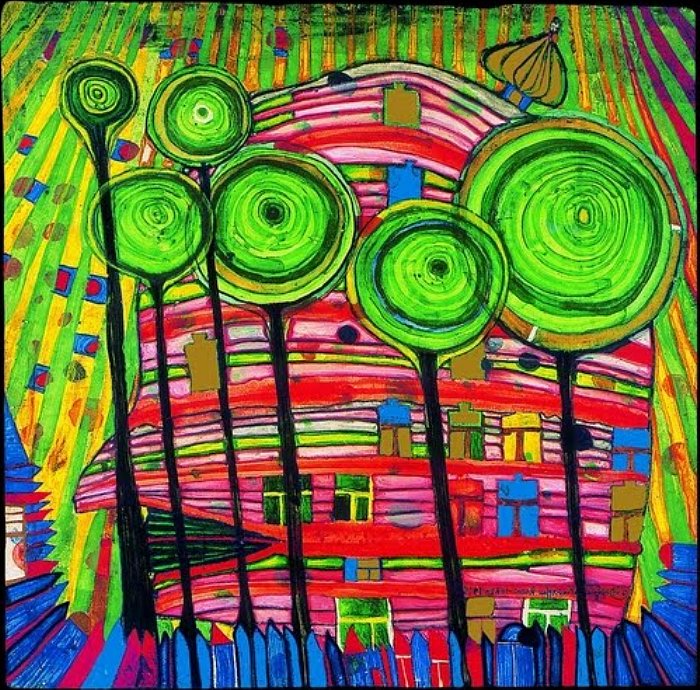
Friedensreich Regentag Dunkelbunt Hundertwasser (December 15, 1928 – February 19, 2000) was an Austrian-born New Zealand artist and architect who worked also in the field of environmental protection. His real name being Stowasser, his pseudonym Hundertwasser (by which he is known worldwide) comes from sto in Slavic languages, meaning "hundred".He stood out as an opponent of "a straight line" and any standardization, expressing this concept in the field of building design. His best known work is considered Hundertwasserhaus in Vienna, Austria which has become a notable place of interest in the Austrian capital characterized by imaginative vitality and uniqueness.Hundertwasser's original and unruly artistic vision expressed itself in pictorial art, environmentalism, philosophy, and design of facades, postage stamps, flags, and clothing (among other areas). The common themes in his work utilised bright colours, organic forms, a reconciliation of humans with nature, and a strong individualism, rejecting straight lines.
He remains sui generis, although his architectural work is comparable to Antoni Gaudí (1852–1926) in its use of biomorphic forms and the use of tile. He was also inspired by the art of the Vienna Secession, and by the Austrian painters Egon Schiele (1890–1918) and Gustav Klimt (1862–1918).He was fascinated by spirals, and called straight lines "godless and immoral" and "something cowardly drawn with a rule, without thought or feeling" He called his theory of art "transautomatism", focusing on the experience of the viewer rather than the artist. This was encapsulated by his design of a new flag for New Zealand, which incorporated the image of the Koru a spiral shape based on the image of a new unfurling silver fern frond and symbolizing new life, growth, strength and peace according to the Māori people.Wikipedia