Exposition Art Blog: Gutai group
Showing posts with label Gutai group. Show all posts

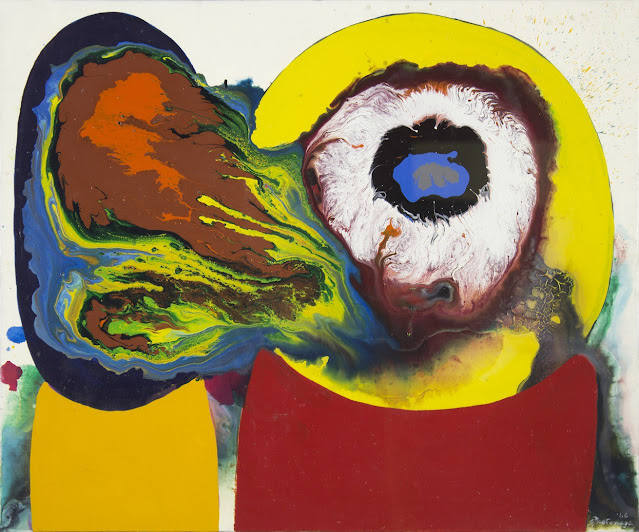
Sadamasa Motonaga - Gutai Group


 Sadamasa Motonaga (Japanese, 1922–2011) was a Japanese abstract painter and a founding member of the avant-garde Gutai group. He was born on November 26, 1922 in Mie Prefecture, Japan and initially sought to be a cartoonist before turning his attention to painting, studying under the tutelage of Jiro Yoshihara. A pronounced sense of humor remained in his work throughout his lengthy career, creating paintings which are characterized by simple lines and a gentle palette of muted primary colors. Motonaga gradually expanded his practice to include printmaking, stage design, and children’s books, all while continuing his ongoing elliptical investigation into abstract painting. His awards include the Légion d’Honneur from the French government and the Japanese Purple Ribbon Award; he was the first abstract artist to receive the latter. He died on October 3, 2011 in Kobe, Japan, and his work has been the subject of many retrospectives, including at Hyogo Prefectural Museum of Art in Kobe in 1998, Hiroshima City Museum of Contemporary Art in 2003, and the Mie Prefectural Museum of Art in 2009. The first Western retrospective of his work was held at the Dallas Museum of Art in 2014.(artnet.com)



Senkichiro Nasaka - Gutai Group


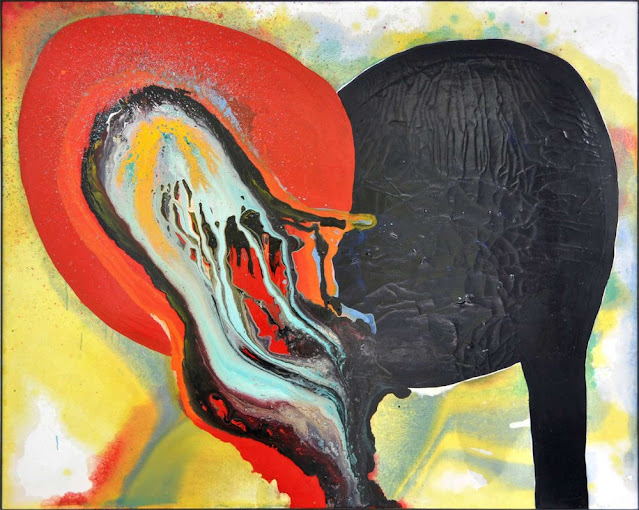
 Senkichiro Nasaka (Japanese, 1923–2014)
"After studying art colleges, Senkichiro Nasaka enters the Kyoto City Painting University: encounters Kazuo Shiraga who is in the same class. Nasaka makes a career switch from Japanese painting to Oil painting in 1960s. It is until in 1965 that Nasaka presents his work to the 15th Gutai Art Echibition and becomes member of Gutai Art Association subsequently. During his Gutai period, there is a great change in the style from tableaux works influenced by Art Informel to hardedge imagery such as light art and kinetic art, which becomes representative style of the later Gutai. At Guggenheim Museum’s retrospective exhibition Gutai: Splendid Playground in 2013, Nasaka reproduces his past work made of aluminum tubes, which are running across the whole exhibition space like a scaffold. Nevertheless, the works from his early period of Gutai, characterized by nuanced marriage of various colors are particularly in high demand among collectors."(ocula.com)


Yasuo Sum - Japanese Avant-garde Art


"Yasuo Sumi was born in 1925 - 2015. After joining Gutai in 1955, Sumi becomes a member of Art Club, the group represented by Taro Okamoto. He participated in all the Gutai exhibitions from the first to the 21st one. Furthermore he has been invited to many exhibitions organized by public museums such as Tokyo City Modern Art Museum, Kyoto City Modern Art Museum, Hyogo Prefecture Museum, Osaka City Modern Art Museum, Ashiya City Museum, Chiba City Art Museum, Miyagi Prefecture Art Museum, Fukuoka City Art Museum, Kitakyushu City Art Museum, Itami City Art Museum, Shibuya Art Museum. He also held many exhibitions in the most famous galleries in Tokyo, Osaka and Itami. Sumi has been invited to the 45th Venice Biennale (Path to the East) with a project promoted by the Japan Foundation and the Italian Government. He held many exhibitions abroad, such as Galerie National du Jeu de Paume in Paris; New York's Martha Jackson Gallery, New York Cultural Exchange Center (solo exhibition) in US; Auckland Museum in Australia; Rome Contemporary Art Museum, Torino Figurative Gallery, Torino International Aesthetic Studio, Milan Art Center, Fondazione Morra in Naples. in Italy; Rauma Art Museum, Helsinki Art Academy in Finland; Rotterdam Design House in Netherlands; Off Center in Canada; and also in England and China. Plenty of his works have become property of public national museums all over the world. Sumi is today an active member of the AU Group and participates to the group exhibitions.He uses abaci, vibrators and combs for his works. While painting and performing Sumi always wears a pair of geta (woodden japanese shoes) and a bangasa (japanese umbrella), and uses a soroban (japanese abacus). But the use of these instruments is peculiar: sorobans are, for example, used, together with japanese ink to create straight and curved lines on papers and canvas. Bangasa is used to blow violently canvases, thus making them damaged. Vibrators are used to spread rhytmically colours on papers and canvases."(abc-arte.com )


https://milenaolesinska.blogspot.com/p/blog-page_50.html

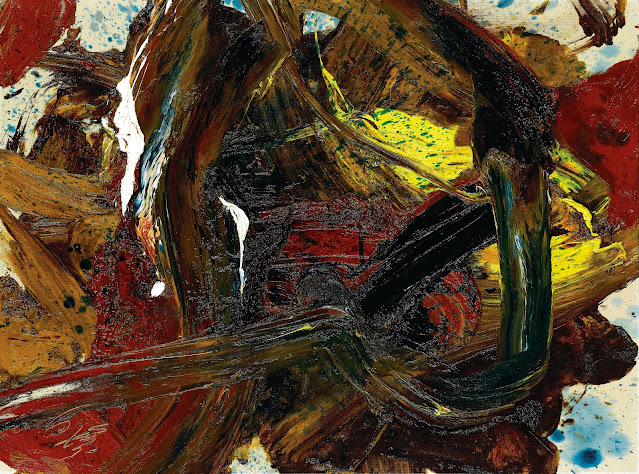
Chiyu Uemae - Monochromatic Abstract Painting


While GUTAI being highly acclaimed in recent years, Uemae is one of the oldest witnesses of the group and its period. In contrast to Shimamoto, the charm of Uemae ( 1920 – 2018 ) consists in the elaborated matières and its accumulation of introspective energies. Experiencing various jobs such as crane operator, apprentice to traditional dyeing factory in Kyoto, Uemae studies firstly Chinese “Nan-ga” as self-taught, then shifts to oil painting. In 1953, Uemae meets Yoshihara, since then, the artist takes part in every Gutai exhibition until its dissolution. His wide-ranging creation from two-dimensional works which are composed of pattern accumulation by painting knife or of sensitive stitch to sculptural works made of wood or saw dust, comes from his broad experience in his adolescence.Uemae artist  went his own way. “My life’s work has been dedicated to absorbing new artistic styles, and pursuing my own unique approach to painting,” he said of his own practice, adding that this “was entirely possible despite my being a member of the Gutai group.” It was a surprising sentiment from an artist who had relentlessly sought Yoshihara’s approval and stayed with the group until it disbanded in 1972. Doggedly focused on the flat picture plane (though he does occasionally make sculpture) and eschewing performance, Uemae was forced onto the “solitary path” 


https://milenaolesinska.blogspot.com/p/blog-page_50.html