Burhan Dogancay (11 September 1929 – 16 January 2013) was a Turkish-American artist. Dogancay is best known for tracking walls in various cities across the world for half a century, integrating them in his artistic work.
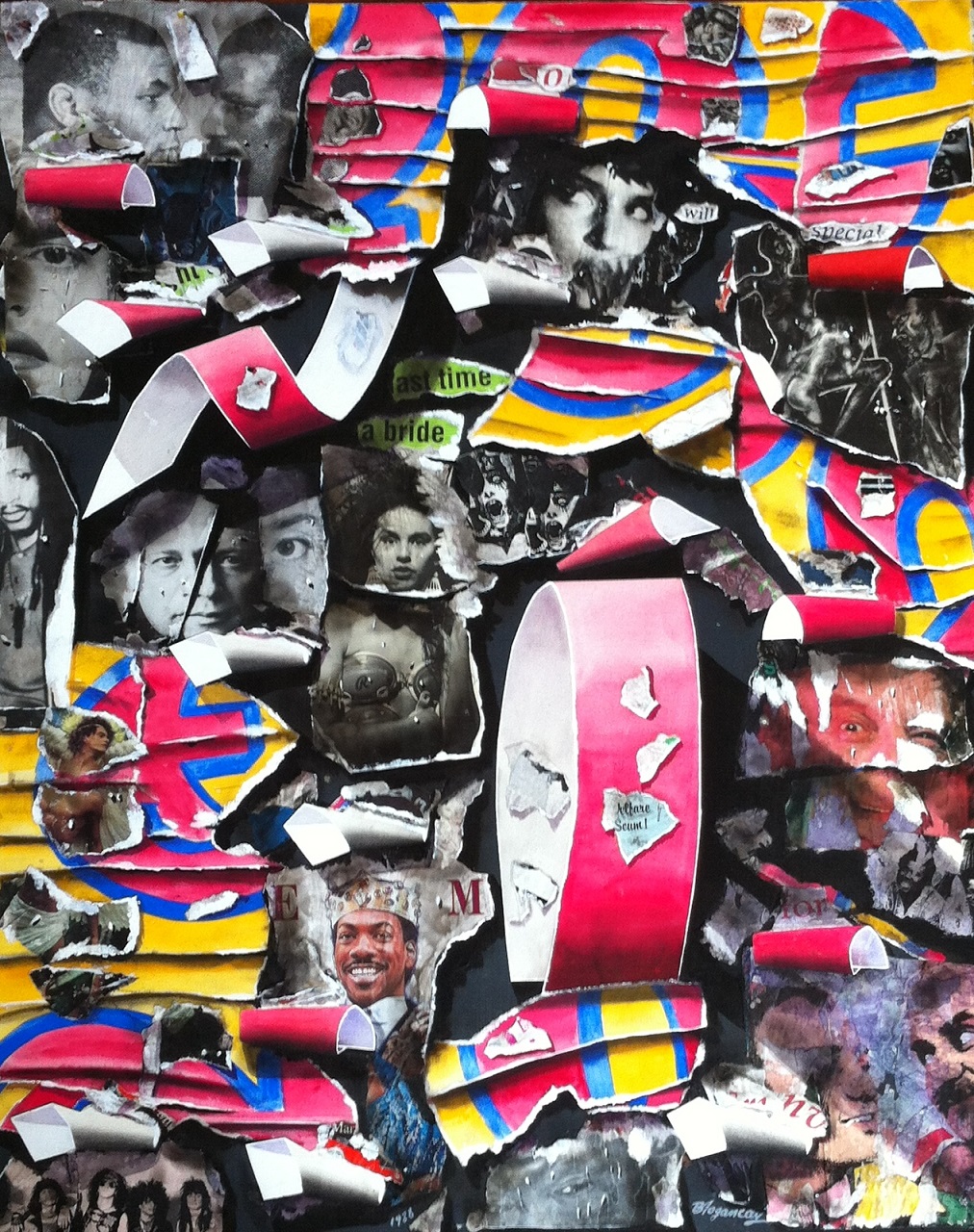
With posters and objects gathered from walls forming the main ingredient for his work, it is only logical that Dogancay's preferred medium has been predominantly 'collage' and to some extent 'fumage'. Dogancay re-creates the look of urban billboards, graffiti-covered wall surfaces, as well as broken or neglected entrances such as windows and doors in different series. The only masters with whom he compares himself are those from the last heroic period of art that he experienced and in which he was an active participant, notably Robert Rauschenberg and Jasper Johns. Dogancay, however, has always preferred to reproduce fragments of wall surface in their mutual relations just as he found them, and with minimal adjustment of color or position, rather than up-end them or combine them casually in the Rauschenberg manner.In large measure his practice has been one of simulation in the spirit of record-keeping, carried out with the collector's rather than the scavenger's eye. In many cases, his paintings evoke the decay and destruction of the city, the alienated feeling that urban life is in ruins and out of control, and that we cannot put the pieces together again. Pictorial fragments are often detached from their original context and rearranged in new, sometimes inscrutable combinations. So the diversifications of his complex and uniformly experimental painterly oeuvre will always range from photographic realism to abstraction, from pop art to material image/montage/collage. In the 1970s and 1980s he gained fame with his interpretation of urban walls in his signature ribbons series, which in contrast to his collaged billboard works such as the Cones Series, Doors Series or Alexander's Walls consist of clean paper strips and their calligraphically-shaped shadows. These brightly intense curvilinear forms seem to burst forth from flat, solid-colored backgrounds. The graceful ribbonlike shapes take on a three-dimensional quality, especially as suggested by the implied shadows. This series later gave rise to alucobond–aluminum composite shadow sculptures and Aubusson Tapestries.Wikipedia
With posters and objects gathered from walls forming the main ingredient for his work, it is only logical that Dogancay's preferred medium has been predominantly 'collage' and to some extent 'fumage'. Dogancay re-creates the look of urban billboards, graffiti-covered wall surfaces, as well as broken or neglected entrances such as windows and doors in different series. The only masters with whom he compares himself are those from the last heroic period of art that he experienced and in which he was an active participant, notably Robert Rauschenberg and Jasper Johns. Dogancay, however, has always preferred to reproduce fragments of wall surface in their mutual relations just as he found them, and with minimal adjustment of color or position, rather than up-end them or combine them casually in the Rauschenberg manner.In large measure his practice has been one of simulation in the spirit of record-keeping, carried out with the collector's rather than the scavenger's eye. In many cases, his paintings evoke the decay and destruction of the city, the alienated feeling that urban life is in ruins and out of control, and that we cannot put the pieces together again. Pictorial fragments are often detached from their original context and rearranged in new, sometimes inscrutable combinations. So the diversifications of his complex and uniformly experimental painterly oeuvre will always range from photographic realism to abstraction, from pop art to material image/montage/collage. In the 1970s and 1980s he gained fame with his interpretation of urban walls in his signature ribbons series, which in contrast to his collaged billboard works such as the Cones Series, Doors Series or Alexander's Walls consist of clean paper strips and their calligraphically-shaped shadows. These brightly intense curvilinear forms seem to burst forth from flat, solid-colored backgrounds. The graceful ribbonlike shapes take on a three-dimensional quality, especially as suggested by the implied shadows. This series later gave rise to alucobond–aluminum composite shadow sculptures and Aubusson Tapestries.Wikipedia