Exposition Art Blog: Isaac Witkin
Showing posts with label Isaac Witkin. Show all posts

Isaac Witkin - New Generation of sculptors - Abstract Sculptures


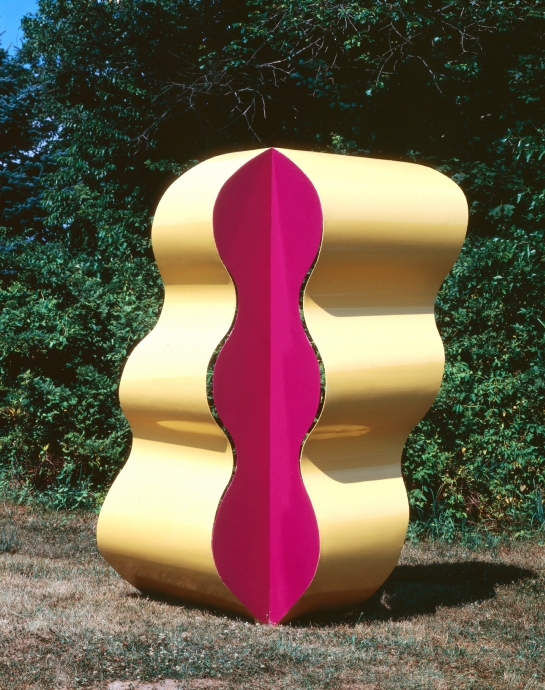
Isaac Witkin internationally renowned modern sculptor, was born in Johannesburg, South Africa on 10 May 1936, and he died 23 April 2006. Witkin entered Saint Martin's School of Art in London in 1957. Studying under Sir Anthony Caro and alongside other luminaries in training such as Phillip King, William G. Tucker, David Annesley and Michael Bolus, Witkin learned and helped create a new style of sculpture that led to their being called the New Generation of sculptors when their innovating abstract forms of modern sculpture reached and changed the art world. Witkin's work, abstract works of usually brightly colored fiberglass or wood, in particular was noted for its "witty, Pop-Art look".
"Isaac Witkin rejected the idea that the human figure is necessary to sculpture, and instead explored abstraction in his work. The sculpture consists of welded steel plates painted bright orange. Each plate has an irregular geometric shape, some straight and rigid and others elegantly curved. The sheets slice into one another, delicately balancing on precise contact points. Their sharp edges pierce the space around them, as if Witkin is not only carving the sculpture but also carving air. The overlapped and stacked forms allow for a constantly changing play of light and shadow, assuming different configurations based on the viewing angle. Witkin had a consistent interest in how the scale of a sculpture can be determined by its relationship to the human body. He once stated that “I aim to establish a freedom to move in multiaxial space in a way that draws the spectator in and around the sculpture to experience different aspects of an evolving dynamic.”




https://milenaolesinska.blogspot.com/p/blog-page_50.html

Isaac Witkin - New Generation of sculptors


"Isaac Witkin (American, 1936–2006), Succoth, 1975. Steel. Gift of Jacques and Donatella Lennon, 91.2.1 | Isaac Witkin rejected the idea that the human figure is necessary to sculpture, and instead explored abstraction in his work. The sculpture consists of welded steel plates painted bright orange. Each plate has an irregular geometric shape, some straight and rigid and others elegantly curved. The sheets slice into one another, delicately balancing on precise contact points. Their sharp edges pierce the space around them, as if Witkin is not only carving the sculpture but also carving air. The overlapped and stacked forms allow for a constantly changing play of light and shadow, assuming different configurations based on the viewing angle. Witkin had a consistent interest in how the scale of a sculpture can be determined by its relationship to the human body. He once stated that “I aim to establish a freedom to move in multiaxial space in a way that draws the spectator in and around the sculpture to experience different aspects of an evolving dynamic.”(wcma.williams.edu)


New Generation of sculptors Isaac Witkin

Isaac Witkin, internationally renowned modern sculptor, was born in Johannesburg, South Africa on 10 May 1936, and he died 23 April 2006. Witkin entered Saint Martin's School of Art in London in 1957. Studying under Sir Anthony Caro and alongside other luminaries in training such as Phillip King, William G. Tucker, David Annesley and Michael Bolus, Witkin learned and helped create a new style of sculpture that led to their being called the New Generation of sculptors when their innovating abstract forms of modern sculpture reached and changed the art world. Witkin's work, abstract works of usually brightly colored fiberglass or wood, in particular was noted for its "witty, Pop-Art look".


After graduating from Saint Martin's in 1960, Witkin was an apprentice of Henry Moore until 1963. Witkin's work was well received in his first solo show at Rowan Gallery, London and in an important 1964 show at Whitechapel Gallery, also in London, where Witkin and his fellow Saint Martin's "New Generation" sculptors made their big entry into the English art world. In 1965 his work received a first prize in the Paris Biennale. His piece, "Nagas", was included in the seminal 1966 exhibit, "Primary Structures" at the Jewish Museum in New York representing the British influence on the "New Art" anchored by Anthony Caro.
Witkin then moved from pupil to teacher, teaching at Saint Martin's for two years. He then moved to the United States. At Bennington College, Bennington, Vermont, Witkin worked with a community of artists known as "the Green Mountain boys" who either taught at the school or were part of the local arts community, including notables such as painter Kenneth Noland, Helen Frankenthaler, Larry Poons, Paul Feeley and Jules Olitski and art critic Clement Greenberg.


Witkin’s works at this time were in the style of formalist abstractions, moving from the fiberglass and wood of his earlier works to heavy welded steel industrial structures with complex Cubist compositions. These were well received in America, notably during a 1966 show at the Jewish Museum, in New York City, and various other showings in that city thereafter. In 1978 Witkin moved to New Jersey, becoming associated with the Johnson Atelier, Princeton, New Jersey, where he was an artist in residence.
During this time Witkin developed the style which would form the remainder of his works. Here he discovered a process of pouring molten bronze into wet sand on the ground to create organic appearing forms. By assembling these forms he engaged in "...creating language out of the behavioral flow of metal, wresting order from chaos" as he is quoted as describing the process in his obituary at The Times Online website. The remainder of his works were primarily in bronze, both poured and then cast, colored by chemicals to have a variety of patinas. However, some later work was also done in stone, though in the same style as the poured bronzes.Wikipedia