Exposition Art Blog: Cuban artist
Showing posts with label Cuban artist. Show all posts

Juan T. Vázquez Martín - Cuban Abstract Painting


Juan T. Vázquez Martín (born December 23, 1940 - January 31, 2017 ) Cuban abstract painter. A Cuban painter who lived and worked in Havana.
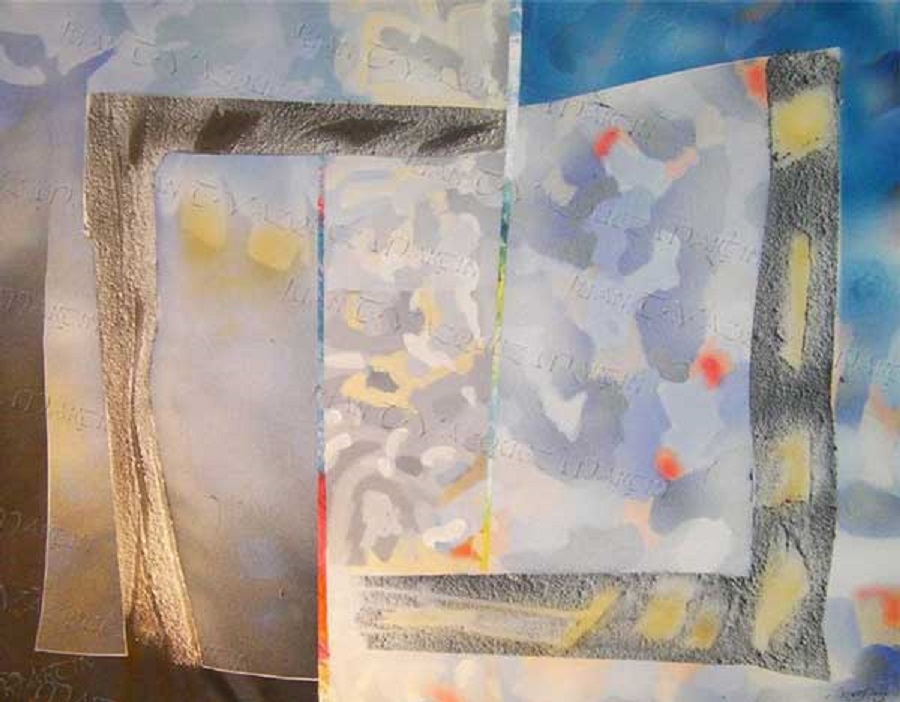
'Looking at Juan Vázquez Martín's paintings, what is immediately recognisable, is the Renaissance concept of 'the window', the dissolution of forms discovered by Kandinski, as well as the sense of textural beauty introduced by the contemporary painters of the matière school.In essence, this involves a private display that allows the artist to make a series of paintings on canvas or cartridge paper, revealing to the viewer an ensemble of optical sensations that reflect the internal world of the artist.We should not forget - because it was forgotten during the period of aesthetic and generational reductionism of the 1980s - that Vázquez Martín was a direct heir, in the 1960s, of the national abstract movement of the 1950s.
Nor should we lose sight of the fact that Juan Vázquez Martín, even when beleaguered in his career, never deviated from his artistic logic - a logic that kept alive and active non-representational forms of plastic art. He used the criterion of symbiotic expression by joining figurative and abstract elements in his overall scheme of things, coalescing them into ectoplasmatic forms, almost veils, that distinguished him in the Cuban canon of painters of the late 1960s and early 1970s. This distinguishing feature of his artistic personality is revealed in simply 'beautiful paintings' - it should be no crime to say so! - paintings in which perceptions of the environment are blended with intimate poetry.Trying to define Vázquez Martín's works of art, applying a label to his paintings from one period to another, is almost impossible, save for a tendency towards 'abstract' painting; if pressed, you might call them 'lyric' or 'art autre', 'post' or 'neo' colour paintings.His style is a skilful blend of the organic with geometry, of order with dissonance, of precise vision with suggestion. It is a whole language in itself, sincretic, and bearing a strong current of delight springing from the possibilities that he coaxes from the materials, methods and tools he uses to work with, the very keys to his paintings. "(Critique by Manuel López Oliva, Cuban Painter and Art Critic, 1996. Translated by Marigold Best and Rayner Reissenberger.)




Felipe Jesus Consalvos

"Felipe Jesus Consalvos (1891 – c. 1960) was a Cuban-American cigar roller and artist, known for his posthumously-discovered body of art work based on the vernacular tradition of cigar band collage.
A large body of Consalvos' art work was discovered in 1983 at a Philadelphia garage sale. The body of work consists of over 800 collages on paper, found photographs, musical instruments, furniture, and other objects. Consalvos' playful and often subversively political work—on which he is thought to have collaborated with his son, Jose Felipe Consalvos -- appropriated cigar bands and cigar-box paper, along with magazine images, family photographs, postage stamps, and cut-up money. Following extensive conservation work, Consalvos' work was first exhibited in a solo show in 2004 at Fleisher/Ollman Gallery in Philadelphia. Subsequently, his work has appeared in a number of public exhibitions and collections, including the Philadelphia Museum of Art, the American Folk Art Museum, and the Art Institute of Chicago."(Greaves 2008). Consalvos has been described by art critic Roberta Smith as a "self-starting modernist" who is "nearly on a par with folk-art greats like Henry Darger, Martin Ramirez and James Castle." According to Smith, Consalvos' work "belongs to the collage continuum from Hannah Höch to Barbara Kruger."


Enrique Zaldivar

Enrique Zaldivar Cuban artist is a graduate of the Professional Academy of Fine Arts ''El Alba'' in Holguin, Cuba.
In his works are a mix of magical realism, surrealism and illustration. almost monochrome works with a deep poetic sense which addresses issues such as the meaning of life, freedom, religion, death, loneliness, power. He tells stories from the universal themes, so establishing an easy relationship with the viewer and makes it part of its history.


www.enriquezaldivar.com


Voices in de wind / Enrique Zaldivar
Acrylic on cardboard / 12x16 inches

The big mystery / Enrique Zaldivar
Acrylic on cardboard / 17x21 inches 

Series The descent of the angel / Enrique Zaldivar
Acrylic on canvas / 12x16 inches

I come from everywhere / Enrique Zaldivar
Acrylic on canvas / 16x20 inches

Painting & Sculpture

Eduardo Abela

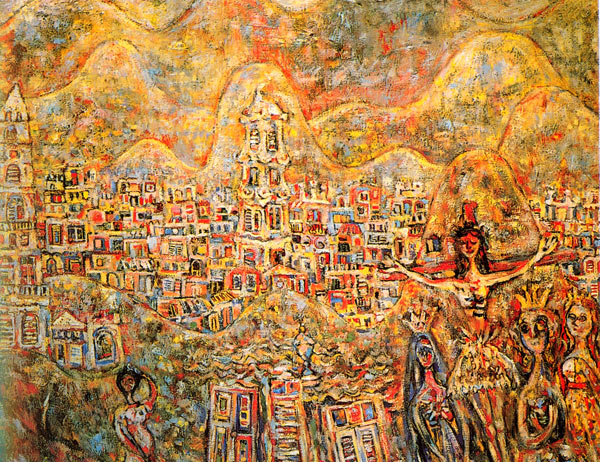
Eduardo Abela (1889–1965) was a Cuban painter and comics artist. Born in San Antonio de los Baños, he studied at the San Alejandro Academy of Fine Arts, graduating in 1921. For the next decade he lived abroad, first in Spain and then in France. In Paris he became acquainted with numerous Cuban intellectuals; among them was Alejo Carpentier, who encouraged him to develop his talent to depict native Cuban themes. Encounters with the work of Jules Pascin and Marc Chagall further shaped his style. Upon his return to Cuba, Abela created the character of "El Bobo" ("The Fool") as a protest against the Machado government. This he drew for El Diario de la Marina from 1930 until 1934. Abela's criollo character played the fool to satirize the difficult social and political situation in Cuba under Machado.


 In the second half of the 1930s Abela returned to painting, employing a naturalistic style influenced by early Renaissance painting and the Mexican mural movement. At this time he focused on an idealized view of the Cuban peasant and the countryside, as seen in his most renowned painting, Los Guajiros (1938), in which the Classical sobriety and order is the result of his contact with Italian medieval and Renaissance art.He also continued to paint, serving later in his career as a cultural attaché to Mexico and Guatemala, and in 1937 operating the short-lived Free Studio of Painting and Sculpture. Abela died in 1965.Wikipedia


Collage Felipe Jesus Consalvos

Felipe Jesus Consalvos (1891 – c. 1960) was a Cuban-American cigar roller and artist, known for his posthumously-discovered body of art work based on the vernacular tradition of cigar band collage.
A large body of Consalvos' art work was discovered in 1983 at a Philadelphia garage sale. The body of work consists of over 800 collages on paper, found photographs, musical instruments, furniture, and other objects. Consalvos' playful and often subversively political work—on which he is thought to have collaborated with his son, Jose Felipe Consalvos -- appropriated cigar bands and cigar-box paper, along with magazine images, family photographs, postage stamps, and cut-up money. Following extensive conservation work, Consalvos' work was first exhibited in a solo show in 2004 at Fleisher/Ollman Gallery in Philadelphia. Subsequently, his work has appeared in a number of public exhibitions and collections, including the Philadelphia Museum of Art, the American Folk Art Museum, and the Art Institute of Chicago. (Greaves 2008).


 Consalvos has been described by art critic Roberta Smith as a "self-starting modernist" who is "nearly on a par with folk-art greats like Henry Darger, Martin Ramirez and James Castle." According to Smith, Consalvos' work "belongs to the collage continuum from Hannah Höch to Barbara Kruger." (Smith 2006).Wikipedia


René Portocarrero

Was born in the neighborhood of El Cerro, Havana, in 1912. Start painting since early age and at 14, starts in San Alejandro. Having a strong temperament and unable to adapt to this apprenticeship, leaves the institution and starts working on his own. His work was first exhibited in the Salon de Bellas Artes, in Havana. He was a professor at the Paintings and Sculptures Free Studies directed by Abela in 1939. Travels through Haiti, Europe and the US, where he opened an exhibition in the Julian Levy Gallery, in New York, in 1945. He has worked on many murals and ceramics.
His works are among the permanent collections of the Museums of Modern Arts of: Sao Paulo, Rio de Janeiro, New York, San Francisco; National Gallery in Canada; Bellas Artes, Caracas; Milwaukee Art Center; Union Panamericana, Washington; Modern Arts of Paris; Museum of Fine Arts, Houston; Art Museum, Indianapolis; Bellas Artes, Montevideo; Bellas Artes, Buenos Aires; Instituto de Arte Contemporaneo, Lima, Peru; Museo Nacional, Havana. (rogallery.com)


Pedro Reinaldo Álvarez


Pedro Reinaldo Álvarez Castelló (1967-2004) was a Cuban painter who rose to prominence during Cuba's Special Period. Alvarez was a native of Havana, Cuba. He studied art at the Escuela Nacional de Bellas Artes "San Alejandro" from 1980-1985 and the Instituto Superior Pedagogico Enrique Jose Varona from 1986-1991. He was a member of the National Union of Writers and Artists of Cuba. He married a Cuban woman and had a child. When he wasn't travelling to promote his work, he divided his time between Malaga, Spain and Havana.
Álvarez works sizzle with the heat of the dramatic dances he depicts. An artist whose work largely focuses on dance themes, such as the tango, he was originally employed in electrical circuitry until his all-consuming passion for dancing compelled him to express it in painting. A prolific artist, Álvarez worked at a blazing pace, expressed in swift, sweeping brushstrokes, which has become more leisurely following a move to rural Spain two years ago. ( tutt art )


Art that inspires you