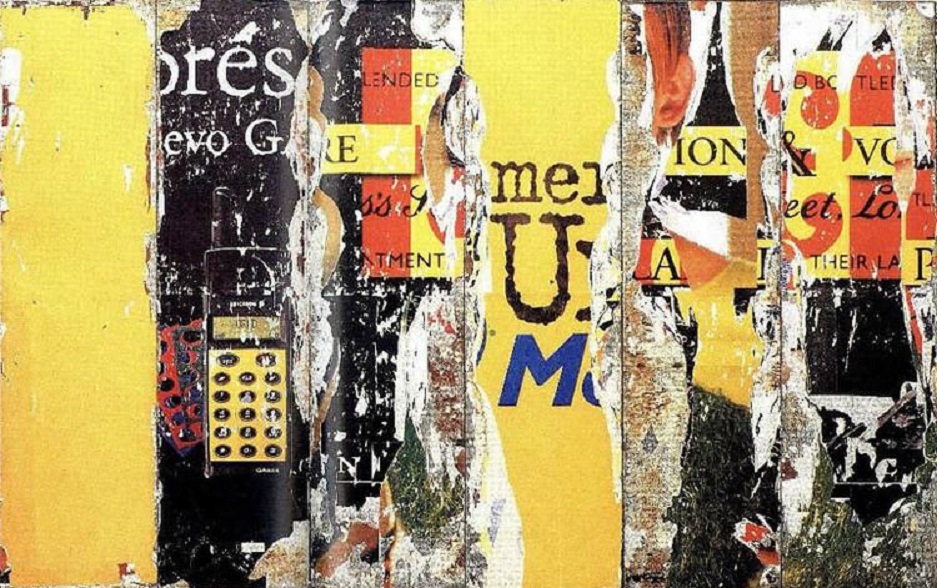
"Raymond Hains was a French Conceptual artist best known for his décollages made from weathered French posters. Opposed to the heroic existentialism championed by Abstract Expressionism, Hains found meaning from vernacular objects and images. “The picture should not be considered as a world in itself, but the world itself should be seen as a picture,” he once said. Born on November 9, 1926 in St-Brieuc, France, he studied sculpture at the École Nationale des Beaux-Arts in Rennes, before transitioning to photography after discovering a book entitled Photographie Française 1839-1936 in 1944. It was his apprenticeship to Emmanuel Souguez, and Souguez’s use of photomontage, that inspired the artist to create his first photograms, including LES ROBOTS, ST-BRIEUC (1947). In 1960, he helped to found the Nouveau Réalisme movement, along with the artists Yves Klein, Jacques Villeglé, François Dufrêne, and Jean Tinguely. Over the course of his career, he vacillated between found-object installations, sculpture, décollage, and photography. Hains died on October 28, 2005, in Paris, France. Today, his works are held in the collections of the Centre Georges Pompidou in Paris, the Musée d’Art Moderne et d’Art Contemporain in Nice, and The Museum of Modern Art in New York."(artnet)
Painting is like silent poem, said Simonides, poet from ancient Greece.Paintings are icons, doors to the Platonian world above the heavens. Paintings on my blog are just those icons, which lead a viewer into the magic world of harmony and beauty. Artists who present their achievements on my blog have a very different cultural and national background, they represent variety of artistic traditions and schools
Showing posts with label decollage art. Show all posts
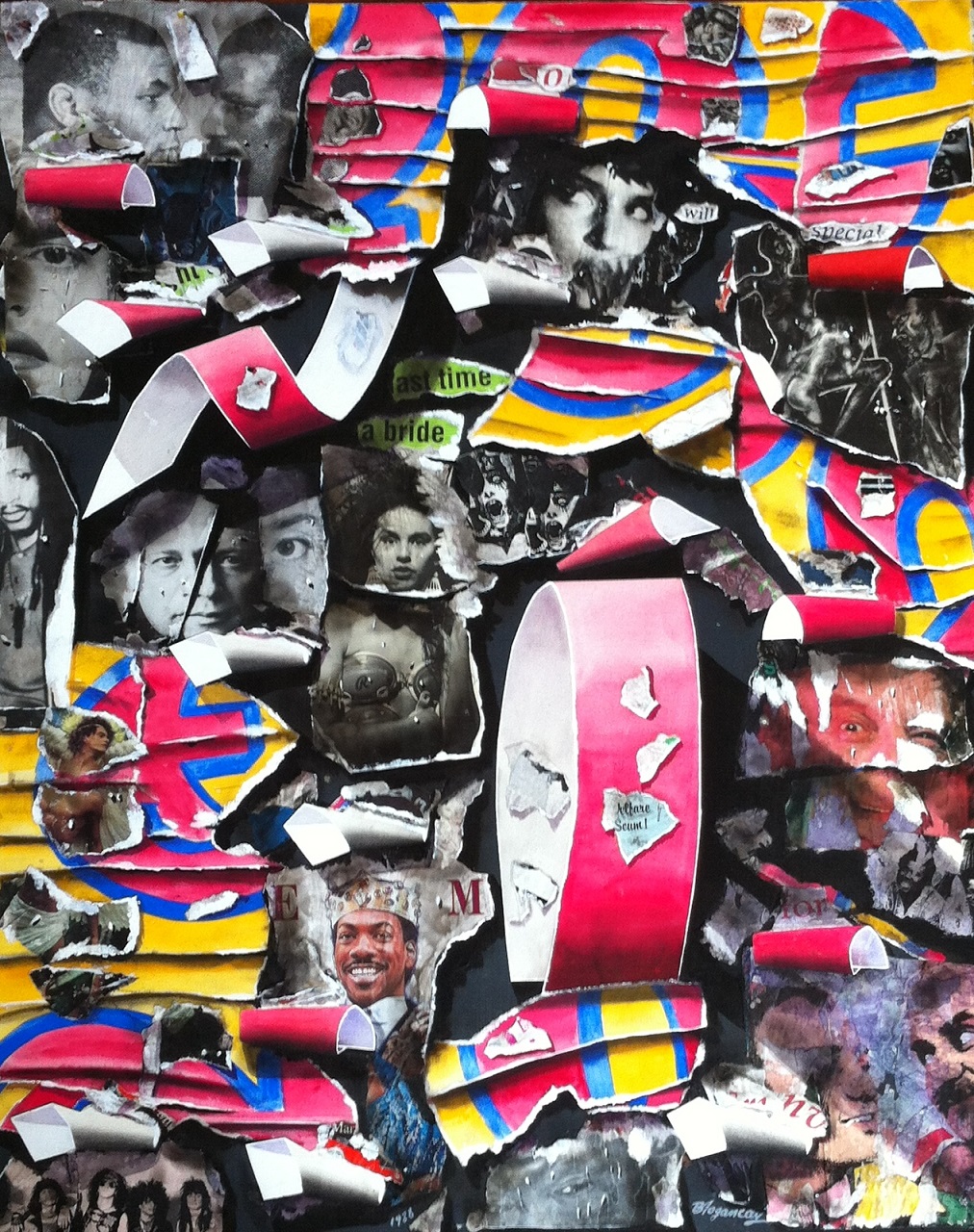
Burhan Dogancay - Painting and collage
Burhan Dogancay (11 September 1929 – 16 January 2013) was a Turkish-American artist. Dogancay is best known for tracking walls in various cities across the world for half a century, integrating them in his artistic work.
With posters and objects gathered from walls forming the main ingredient for his work, it is only logical that Dogancay's preferred medium has been predominantly 'collage' and to some extent 'fumage'. Dogancay re-creates the look of urban billboards, graffiti-covered wall surfaces, as well as broken or neglected entrances such as windows and doors in different series. The only masters with whom he compares himself are those from the last heroic period of art that he experienced and in which he was an active participant, notably Robert Rauschenberg and Jasper Johns. Dogancay, however, has always preferred to reproduce fragments of wall surface in their mutual relations just as he found them, and with minimal adjustment of color or position, rather than up-end them or combine them casually in the Rauschenberg manner.In large measure his practice has been one of simulation in the spirit of record-keeping, carried out with the collector's rather than the scavenger's eye. In many cases, his paintings evoke the decay and destruction of the city, the alienated feeling that urban life is in ruins and out of control, and that we cannot put the pieces together again. Pictorial fragments are often detached from their original context and rearranged in new, sometimes inscrutable combinations. So the diversifications of his complex and uniformly experimental painterly oeuvre will always range from photographic realism to abstraction, from pop art to material image/montage/collage. In the 1970s and 1980s he gained fame with his interpretation of urban walls in his signature ribbons series, which in contrast to his collaged billboard works such as the Cones Series, Doors Series or Alexander's Walls consist of clean paper strips and their calligraphically-shaped shadows. These brightly intense curvilinear forms seem to burst forth from flat, solid-colored backgrounds. The graceful ribbonlike shapes take on a three-dimensional quality, especially as suggested by the implied shadows. This series later gave rise to alucobond–aluminum composite shadow sculptures and Aubusson Tapestries.Wikipedia
Wolf Vostell - pioneer of Happening and Video Art
Wolf Vostell (14 October 1932 – 3 April 1998) was a German painter and sculptor, considered one of the early adopters of video art and installation art and pioneer of Happening and Fluxus. Techniques such as blurring and Dé-coll/age are characteristic of his work, as is embedding objects in concrete and the use of television sets in his works.Wolf Vostell was born in Leverkusen, Germany, and put his artistic ideas into practice from 1950 onwards. In 1953, he began an apprenticeship as a lithographer and studied at the Academy of Applied Art in Wuppertal. Vostell created his first Dé-collage in 1954. In 1955-1956, he studied at the École Nationale Superieur des Beaux Arts in Paris and in 1957 he attended the Düsseldorf Academy of Arts. Vostell's philosophy was built around the idea that destruction is all around us and it runs through all of the twentieth century. He used the term Dé-coll/age, (in connection with a plane crash) in 1954 to refer to the process of tearing down posters, and for the use of mobile fragments of reality. Vostell’s working concept of décollage is as a visual force that breaks down outworn values and replaces them with thinking as a function distanced from media.
His first Happening, Theater is in the Street, took place in Paris in 1958, and incorporated auto parts and a TV. In 1958, he took part in the first European Happening in Paris and he produced his first objects with television sets and car parts. He was impressed by the work of Karlheinz Stockhausen, which he encountered in 1964 in the electronic studios of the German radio station WDR, and in 1959 he created his electronic TV Dé-coll/age. It marked the beginning of his dedication to the Fluxus Movement, which he co-founded in the early 1960s. Vostell was behind many Happenings in New York, Berlin, Cologne, Wuppertal and Ulm among others. In 1962, he participated in the Festum Fluxorum, an international event in Wiesbaden together with Nam June Paik, George Maciunas. In 1963 Wolf Vostell became a pioneer of Video art and Installation with his work 6 TV Dé-coll/age shown at the Smolin Gallery in New York, and now in the collection of the Museo Reina Sofía in Madrid. The Smolin Gallery sponsored two innovative Wolf Vostell events on TV; the first, Wolf Vostell and Television Decollage, featured visitors to the gallery who were encouraged to create poster art on the walls. In 1967 his Happening Miss Vietnam dealt with the subject of the Vietnam war. In 1968, he founded Labor e.V., a group that was to investigate acoustic and visual events, together with Mauricio Kagel, and others.
Wolf Vostell was the first artist in art history to integrate a television set into a work of art. This installation was created in 1958 under the title The black room is now part of the collection of the art museum Berlinische Galerie in Berlin. Early works with television sets are Transmigracion I-III from 1958 and Elektronischer Dé-coll/age Happening Raum[3](Electronic Dé-coll/age Happening Room) an Installation from 1968. In 1974, his first major retrospective took place in the ARC 2 at the Musée d'Art Moderne de la Ville de Paris, an expanded version of which was shown at the Neue Nationalgalerie, in 1974.
Vostell also gained recognition for his drawings and objects, such as images of American B-52 bombers, published under the rubric "capitalist realism" and as a result of his inclusion of television sets with his paintings. Nam June Paik and Vostell were both participants in the Fluxus movement and the work of both artists involved a critique of the fetishization of television and the culture of consumption. The catalogue raisonné of his screen prints and posters has been published in the Nouvelles de l'estampe by Françoise Woimant and Anne Moeglin-Delcroix in 1982.In 1992, the town of Cologne honoured Vostell with a major retrospective of his work. His pieces were distributed over 6 exhibition venues: Stadtmuseum Köln, Kunsthalle Köln, Rheinisches Landesmuseum Bonn, Kunsthalle Mannheim, Schloss Morsbroich Leverkusen and Städtisches Museum Mülheim / Ruhr. Under the artistic direction of David Vostell, the documentary Vostell 60 - Rückblick 92 (Vostell 60 - Review 92) was created.Vostell's grave is at the Cementerio Civil de la Almudena in Madrid.Wikipedia
Writer and Collage artist Claude Pélieu
Claude Pélieu (December 20, 1934 – December 24, 2002) was a French postmodernist poet and graphical artist. He lived in France until 1963, when he moved to the United States, where he spent the rest on his life. Pélieu wrote in French, German and English.Pélieu was born to Pierre and Marguerite Pélieu on December 20, 1934 in a clinic in Pontoise, Val d'Oise, north of Paris. They lived in the village of Beauchamp, near Pontoise.
After graduation in 1952, Claude Pélieu entered the School of the Beaux-Arts in Paris. In 1952 he participated in a group show in Paris at the Galerie du Haut-Pavé in the Center Saint-Jacques on the rue Danton. Through priest Gilles Vallée, Claude met the future architect Henri Caubel who would later arrange retrospective shows of Claude Pélieu’s collages between 1999 and 2001. From 1952 to 1953, Pélieu worked as a library aide at La Maison des amis des livres, a bookstore founded by Adrienne Monnier, a friend of Sylvia Beach, a second cousin of Mary Beach (Claude Pélieu’s second wife).
Claude Pélieu’s first texts were published in 1955 in Le Libertaire (or Lib), a political journal close to the Lettrist movement. At that time he was politically active in the libertarian movement. This was the beginning of Claude Pélieu’s interest in the poetry of Jacques Prévert but also in collage. He continued to draw assiduously (the sale of drawings provided a meager living). In 1956, he participated in a group show at the bookstore/gallery The Sun in the Head organized by the mother of Jean-Jacques Lévêque, Marguerite Fos.
On July 14, 1959 Claude met Lula at a ball at the Vieux colombier Street. Lula and Claude had a passionate relationship often accompanied by misery. They married on May 11, 1960.
Pélieu met Mary Beach in 1962, and one year later Claude and Lula separated. The poet had an addiction to heroin. In November 1963, Pélieu left for San Francisco with Mary Beach.
In the United States, Claude Pélieu lived in San Francisco, New York and Hawaii. Automatic Pilot was published at the end of 1964, translated from French into English by Mary. She also translated, with the assistance of Claude, several books by William Burroughs, Bob Kaufman and Allen Ginsberg.
Years from 1969 to 1979 were particularly prolific for Pélieu, who had a dozen or so books published through 1979, mostly by Bourgois, Soleil Noir, and 10/18.
Between 1979 and 2002, Claude Pélieu devoted himself to collage while continuing to write and publish irregularly. At the end of the 1990s, several exhibits of his collages took place in France. He also had several new books published right up to his death December 24, 2002 in Norwich, New York.Wikipedia
In the United States, Claude Pélieu lived in San Francisco, New York and Hawaii. Automatic Pilot was published at the end of 1964, translated from French into English by Mary. She also translated, with the assistance of Claude, several books by William Burroughs, Bob Kaufman and Allen Ginsberg.
Years from 1969 to 1979 were particularly prolific for Pélieu, who had a dozen or so books published through 1979, mostly by Bourgois, Soleil Noir, and 10/18.
Between 1979 and 2002, Claude Pélieu devoted himself to collage while continuing to write and publish irregularly. At the end of the 1990s, several exhibits of his collages took place in France. He also had several new books published right up to his death December 24, 2002 in Norwich, New York.Wikipedia
![]() |
| Mary Beach and Claude Pelieu |
![]() |
| Mary Beach and Claude Pelieu |
Subscribe to:
Posts (Atom)