Exposition Art Blog: kinetic art
Showing posts with label kinetic art. Show all posts

Otto Piene - Experimental Abstract Painting


 German artist specializing in kinetic and technology-based art, often working collaboratively. He lived and worked in Düsseldorf, Germany; Cambridge, Massachusetts; and Groton, Massachusetts.
"Otto Piene ( 1928 -2014 ) studied at the Academy of Art in Munich and later during the late 1950s at the Kunstakademie Düsseldorf where he met Heinz Mack and co-formed the highly influential Group Zero in 1957, latterly joined by Gunther Uecker. ZERO, in contrast to Abstract Expressionism, emphasized art void of colour, emotion, and individual expression.
Piene was highly experimental and motivated by non-traditional art materials and techniques. Best known for his paintings made with smoke and fire (Rauchbilder), Piene applied solvent to pigmented paper and lit it on fire, developing organic images in the residual soot. The “raster” (grid) paintings of stencilled paint, also cast in ceramic, inspired The Light Ballet; a series of sculptural installations in which light was projected from moving globes and brass columns through grids allowing the light to ‘dance’ on the wall.
His technological exploration into light continued with holograms, lasers and strobing, and Piene become the first fellow of the MIT Center for Advanced Visual Studies in 1968. Piene went on to serve as the director of the MIT Center for Advanced Visual Studies from 1974 to 1993. His works can be found in numerous museum collections around the world, including The Museum of Modern Art in New York, the Walker Art Center in Minneapolis, the National Museum of Modern Art in Tokyo, the Stedelijk Museum in Amsterdam, and the Centre Georges Pompidou in Paris. In 2014, the Guggenheim Museum in New York opened a large-scale historical survey of the work of the ZERO group."(mayorgallery.com)


Jesus Rafael Soto

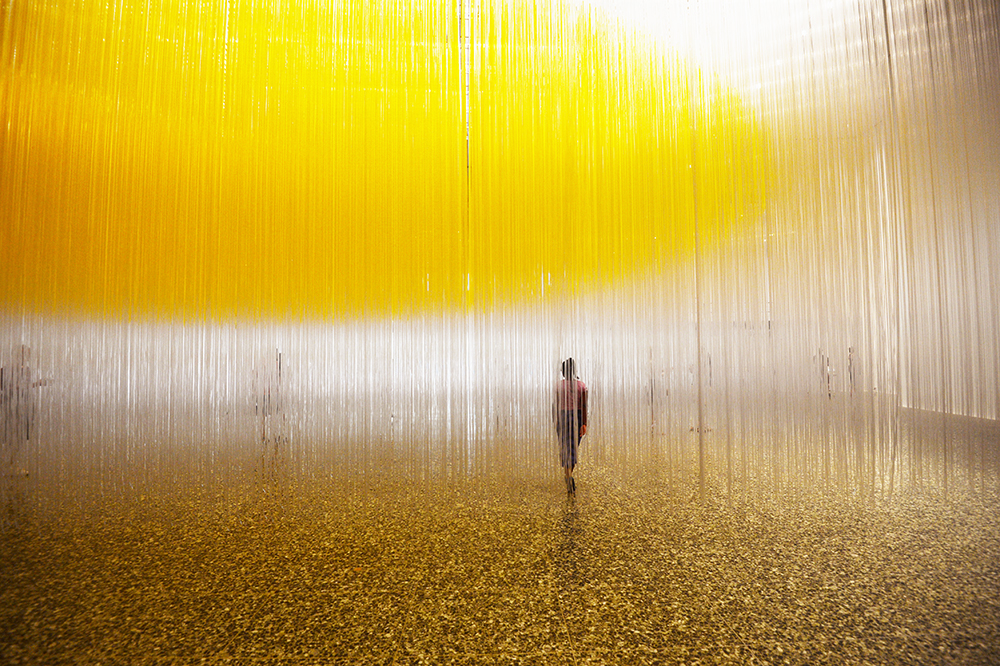
"Energy is one of the most striking elements of Soto's work and his experiments with optical effects are representative of some of the most successful of the Op Art-Kinetic Art movements. Soto's work, however, surpasses the mere exploitation of optical effects and he presents in his paintings a concentration of energy which attain a point where the paintings become a mirage, kinesthetically like a mental tension.Soto's use of the moire effect plays a prominent role in his early works of transition from the tradition of hard-edge abstraction founded by Modrian to the more fluid expression he presently uses. The influence of Modrian's balancing of lines and composition can be found in Soto's work, with Soto's added touch of a personal search for an art which would be its own master, wholly independent of the natural world, an attitude reflective of Modrian's.
Soto's work with identical and multipliable elements was aimed at reducing the sign to total anonymity, in the effort to get away from subjective art. When the transition to kinetic art came Soto's way in 1955 he began to make plexiglass superimpositions. Spirals traced upon perspex were superimposed in depth. The optical effect that resulted was in the relationship between the surfaces. Soto's painting began to emerge and assume a sculptural dimension when he suspended wire and rods of metal in front of the background. This striping of the background seems to create the effect of attacking and partly absorbing the forms which are placed in front of it. Soto's work established a concrete relationship with the viewers perception as disconcerting and fascinating as a mirage."(rogallery.com)