Exposition Art Blog: Czech painter
Showing posts with label Czech painter. Show all posts

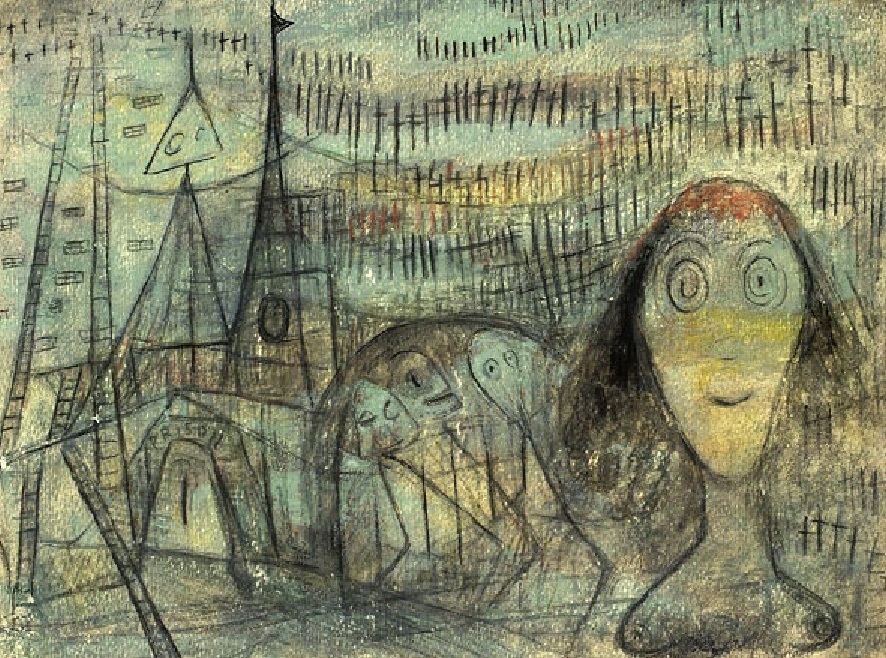
Alen Divis


 Alen Divis ( 1900 – 1956) was a Czech painter known for his melancholic art. Having spent much of his life abroad, often working in solitude, he remained rather unknown during his life but has had a postmortem revival in the art world.
In 1947, after the end of the Second War and the liberation of Czechoslovakia, Diviš returned to his native country, more than two decades after he had first left for Paris. Upon his return, he achieved a brief period of success. His written memoirs of Santé were published in a weekly paper, and in February 1948, his recent work was exhibited in Prague. The same month, however, brought the Communist coup d'état which would marginalize artists of his type out of work. He spent the rest of the decade producing illustrations for Karel Jaromír Erben's mid-19th century collection of ballads
"He became a sort of mythological figure in Czech modern art. He was known as an artist that was forgotten and then sort of miraculously rediscovered. He was someone who was very secretive, whose art was very dark. He was more a figure coming from a romantic literature than from life..."


Mikulas Medek - Czech modern painting - Art Informel


Mikulas Medek (November 3, 1926 - August 23, 1974) was a Czech painter. He was a grandson of the impressionist painter Antonín Slavíček, son of the General of the Czechoslovak Army and Catholic writer Rudolf Medek and brother of the journalist Ivan Medek. He is considered one of the most important representatives of Czech modern painting and one of the most important exponents of the post-war period.Medek's work initially relies on the tradition of surrealism, later it brings new elements of the spiritual dimension. In 1952, he entered his "existential period" with the central theme of the human character in space, and at the turn of the 1950s and 1960s he came to abstract painting. As a result, so-called "prepared paintings" of color matter, arranged in the form of surface symbols and rationally distributed color formations have come into being. He brings the theme of the basic question of the meaning of human life directly to the color of its original image-making techniques (emails, etc.). In the last period of his life, he developed imaginative painting and also devoted himself to a book illustration.His work, thanks to non-public exhibitions (so-called "Confrontation"), became a model for younger radical artists. After 1960, Medek was allowed to realize some public monumental works, which included the altarpiece of the church in Jedovnice (1963), made together with sculptor Jan Koblasa and the compositions for the interiors of the Czechoslovak office. airlines in Damascus, Košice (1963), Paris (1964), Prague (1969) and New York (1970).The central theme of Medek's work is the theme of human destiny, which is combined with the emotive expression of the intensive experience of the mystical character in an inwardly unified and unusually impressive whole, which speaks to the spectator with extreme urgency. Symbolism of sign systems creates special visual metaphors of human existence in its tragic, painful and mysterious dimensions. Wikipedia


Vaclav Tikal - Czech Surrealist Painter

Václav Tikal (24 December 1906 in Ptetin village, Plzeň Region – 26 November 1965 in Prague) 
was a Czech surrealist painter and ceramist


Frantisek Muzika - Czech Avant Garde - Surrealism

Frantisek Muzika (26 June 1900 – 1 November 1974) was a Czech artist and a prominent representative of avant-garde in Czechoslovakia in the first half of the 20th century. He was a member of Devětsil since 1921 and Mánes since 1923.
Muzika was a painter, graphic designer, stage designer, illustrator, editor and professor at the Academy of Arts and Industrial Design (UMPRUM) in Prague.
Muzika was born in Prague, Czechoslovakia. After finishing his study at the Academy of Arts, Prague in 1924, he received a one-year scholarship from the French government for studying at École des Beaux-Arts. In Paris he also received private lessons from František Kupka at his atelier. In Paris he met Max Jacob, who took him to meet Léonce Rosenberg. On Sundays he had regular meetings with Joseph Bernard, where he also met Maillol and Bissière, with whom he exhibited at Salon d'Automne.In 1925, after he returned from Paris, his experiences with the work of Georges Braque and Pablo Picasso led Muzika to change his style of painting.
 “Over the course of more than fifty years, Muzika’s work thus underwent several developmental changes. It always, however, remained faithful to itself and to the starting points of Muzika’s generation. It never let itself to be tempted down the wrong path by briefly fashionable trends or cheaply earned successes; it never got bogged down in the stagnant waters of convention or dissipated in its own discoveries and approaches.”In his final years, he suffered from cardiac disease. He died 1 November 1974 in his atelier, with his final, unfinished work, "Staircase" ("Schodiště") on the easel.Wikipedia


Czech modern painting Mikuláš Medek

Mikuláš Medek (November 3, 1926 in Praha - August 23, 1974 in Praha) was a Czech painter. He was a grandson of impressionist painter Antonín Slavíček, son of general of the Czechoslovak Army and catholic writer Rudolf Medek and brother of journalist Ivan Medek. He is considered one of the most important exponents of the Czech modern painting in the post-war period.He was the husband of the photographer Emila Medková
"Medek’s paintings are pervaded with the theme of human destiny: they consider all fates as one great, internally cohesive whole and speak to them with startling urgency. In complex structures of signification and ambiguously multifarious symbols, Mikuláš Medek constructs original visual metaphors for humanity’s existence, in its tragic yet equally grotesque, absurd, painful, and secretive dimensions. The thematic depth and the expressive force of line and colouration here form an indissoluble entity, giving the impression that Medek’s paintings have arisen as a rare and magical revelation of the painting craft and the creative spirit."(galerierudolfinum.cz)