Exposition Art Blog: New Zealand artist
Showing posts with label New Zealand artist. Show all posts

Vivian Isabella Lynn


Vivian Isabella Lynn ( 1931 – 2018) was a New Zealand artist
"Vivian Lynn will be known to many as the artist who notoriously used hair in a number of large-scale installations dating from the early 1980s, such as Guarden Gates (1982) and The Gates of Goddess: A Southern Crossing (1986).
These are landmark works in New Zealand’s art history for their trenchant re-coding of materials and subjects that aimed to expose the binary logic of western patriarchal culture and its consequences, as well as provide positive statements about women’s experience.
But perhaps less well known is the fact that Vivian Lynn has been a practising artist since the late 1950s, working across a range of media – painting, drawing, printmaking, book-making, and installation – to develop a formally and iconographically complex body of work that asks fundamental questions about the nature of being, especially if one is a woman..."(adamartgallery.org.nz)


Guy Ngan - New Zealand Modern Sculptor

Guy Ngan was born in Wellington in 1926, to Chinese parents, yet calls himself ‘Pacific Chinese’. He spent time in China before returning to New Zealand and then studying art in London. He has been a significant presence in the New Zealand art scene, and was director of the New Zealand Academy of Fine Arts from 1976 to 1986.In 2006 a major retrospective of his work was held at the City Gallery Wellington. Guy Ngan has lived in Stokes Valley for 50 years and he created the sculpture that resides at the entrance to Stokes Valley and has recently been commissioned by the Lower Hutt City Council to design and build another large sculpture for the Stokes Valley shopping centre. His collaborations with architect Ron Sang have led to some important large scale works including the Newton Post Office mural; now in the Auckland Art Gallery collection.
"Ngan made many contributions to the arts as an administrator. From 1976 to 1986 he was director of the New Zealand Academy of Fine Arts. He was on the council of the New Zealand Industrial Design Council, and the National Art Gallery (to later be merged into Te Papa), and vice president of the New Zealand Academy of Fine Arts. He was awarded an OBE in 1983 and inducted into the Massey University College of Creative Arts Toi Rauwharangi Hall of Fame.
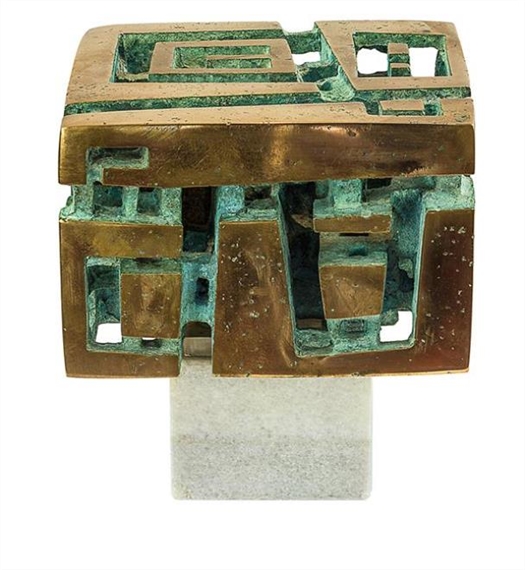
Guy Ngan’s work was often inspired by the history of early settlement in the Pacific, and explored his own place and identity in this part of the world. He described himself as Pacific Chinese, reflecting the theory that Polynesians, including Maori, originally came from Asia, particularly Taiwan. His work featured the three fingered ‘tiki hand’, as he called it, that suggested to him the claws of sea birds that the early migrations followed. The large anchor stones with holes for a rope that Maori used were another motif that inspired a body of work. And some of his cubic bronze sculptures suggest his Chinese ancestry in their resemblance to the faces of Chinese ‘chops’ used for stamping a signature."(tepapa.govt.nz)


Ralph Hotere - Black Paintings

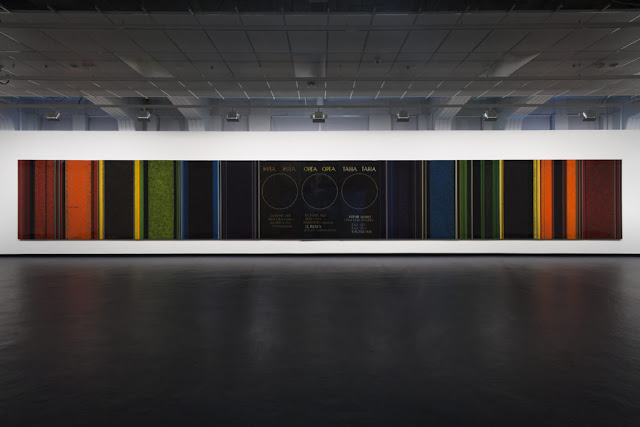
"Ralph Hotere was an important Maori painter and sculptor. Known for his minimal Black paintings, composed of simple bands or crosses of color laid over dark backgrounds. “There are very few things I can say about my work that are better than saying nothing,” the artist said. Born Hone Papita Rakura Hotere in 1931 in the Northland Region of New Zealand, he was very politically active and used his paintings as a platform for his message. A documentary, called Hotere, about his art and work, was released in 2001. The artist died on February 24, 2013 in Dunedin, New Zealand."(artnet.com)
The themes of the black paintings extended to later works, notably the colossal Black Phoenix (1984–88), constructed out of the burnt remains of a fishing boat. This major installation incorporates the prow of the boat flanked by burnt planks of wood. Other planks form a pathway leading the prow. Each plank has had a strip laid bare to reveal the natural wood underneath beneath. Several of the boards are inscribed with a traditional Maori proverb, Ka hinga atu he tete-kura haramai he tete-kura ("As one fern frond (person) dies - one is born to take its place"). A slight change has been made in the wording of the proverb, replacing haramai (transfer, pass over) to ara mai (the path forward), possibly indicating the cleared pathway of bare wood in front of the boat's burnt prow. The work measures 5m by 13m by 5.5m. Politics were entwined in the subject matter of Hotere's art from an early stage. Alongside the Black Paintings series, which continued until not long before his death. Hotere's political works also continued. When Aramoana, a wetland near his Port Chalmers home, was proposed as the site for an aluminium smelter, Hotere was vocal in his opposition, and produced the Aramoana series of paintings. Similarly, he produced series protesting against a controversial rugby tour by New Zealand of apartheid-era South Africa (Black Union Jack) in 1981, and the sinking of the Greenpeace flagship Rainbow Warrior (Black rainbow) in 1985. More recently, his reactions to Middle-East politics resulted in works such as Jerusalem, Jerusalem and This might be a double cross jack. Wikipedia




Len Lye - Experimental Photography

Leonard Charles Huia Lye ( 5 July 1901 – 15 May 1980), was a Christchurch, New Zealand-born artist known primarily for his experimental films and kinetic sculpture.
"Len Lye is an artist from New Zealand who is known for his experimental films, photograms and kinetic sculpture.
In the beginning he worked with the idea of motion being an artistic language and was heavily influenced by the arts of South Pacific and African countries when he visited there.  He began to make experimental films without a camera by using manipulated and often destroyed film.
He used methods such as scratching the emulsion, dyes, stencil-work, air-brushes, pens, stamps, combs, surgical instruments, etc. to manipulate and texturize the film and celluloid. His film stills put together created a blur and motion of flashing lines and marks. Some of his famous films include: A Colour Box, Colour Flight, and Free Radicals.
Later in his work, he experimented with photograms in his films, and then began making separate photogram work. He started a series of photographic portraits using photograms including some well-known artists such as Georgia O'Keefe, Joan Miro and Le Corbusier. Exposing the light-senstive paper with the "sitter", as he calls them, in front of it, a lovely silhouette is left. With not much information or detail about the sitter in the silhouette, he added other elements to provide clues as to who the sitter is which often created new layers of meaning.Lye often was more concerned with the motion of an object or person than it's actual appearance. He was intrigued by the "notion of individuality" and "the physical factors" that inform each person's makeup.  Many consider his work to be meditations on identity and some say that he bases his abstract art on intuition and feeling, revealing parts of the subconscious."(unccphotography.blogspot.com)


Guy Ngan - New Zealand artist

Guy Ngan  (3 February 1926 – 26 June 2017) was a New Zealand artist who worked across a large range of media, including sculpture, painting, drawing, design and architecture. He is known for his incorporation of Māori motifs such as the tiki. Many of his works are in prominent places, such as the tapestry in the Beehive and sculpture at the Reserve Bank, while many others are dotted around the country in smaller towns and suburban locations such as Stokes Valley.Ngan was born in 1926 in Wellington to Chinese parents Wai Yin and Chin Ting, but he called himself “Pacific Chinese”.During his young years, he was educated in China. In 1938 a Japanese bomb dropped next door while they were having breakfast. Ngan’s father took Guy and his brother to Hong Kong and put them on a boat to New Zealand and they never saw him again. Guy Ngan attended Newtown School but he was unhappy and then stayed with relatives in Miramar. In 1951, he studied at Goldsmith’s School of Art at the University of London. In the same year he was allowed entry to the Royal College of Art, in London. In 1954, he graduated and was given the Royal College Continuation Scholarship for one year. He was paid £600. In 1955 the British Council awarded him with a scholarship and an allowance of £12 a week and all travel expenses paid for.In 1956 he returned to New Zealand. He worked as a consultant at the architecture division for the Ministry of Works. He worked here until 1960 and then went to work for Stephenson and Turner Architects until 1970. Ngan then became the director of New Zealand Academy of Fine Arts for 20 years. During this time he encouraged New Zealand artists to promote their art talents at museums. He also encouraged Māori and cultural art.Ngan worked as a painter, artist, architect and designer. Many of his work are displayed in important and historical buildings across New Zealand, including the Beehive. Other public installations are at the Stokes Valley roundabout and the "Elevating Worm" sculpture in the Stokes Valley shopping centre.Wikipedia