Exposition Art Blog: muralist
Showing posts with label muralist. Show all posts

Alejandro Jesus Obregon


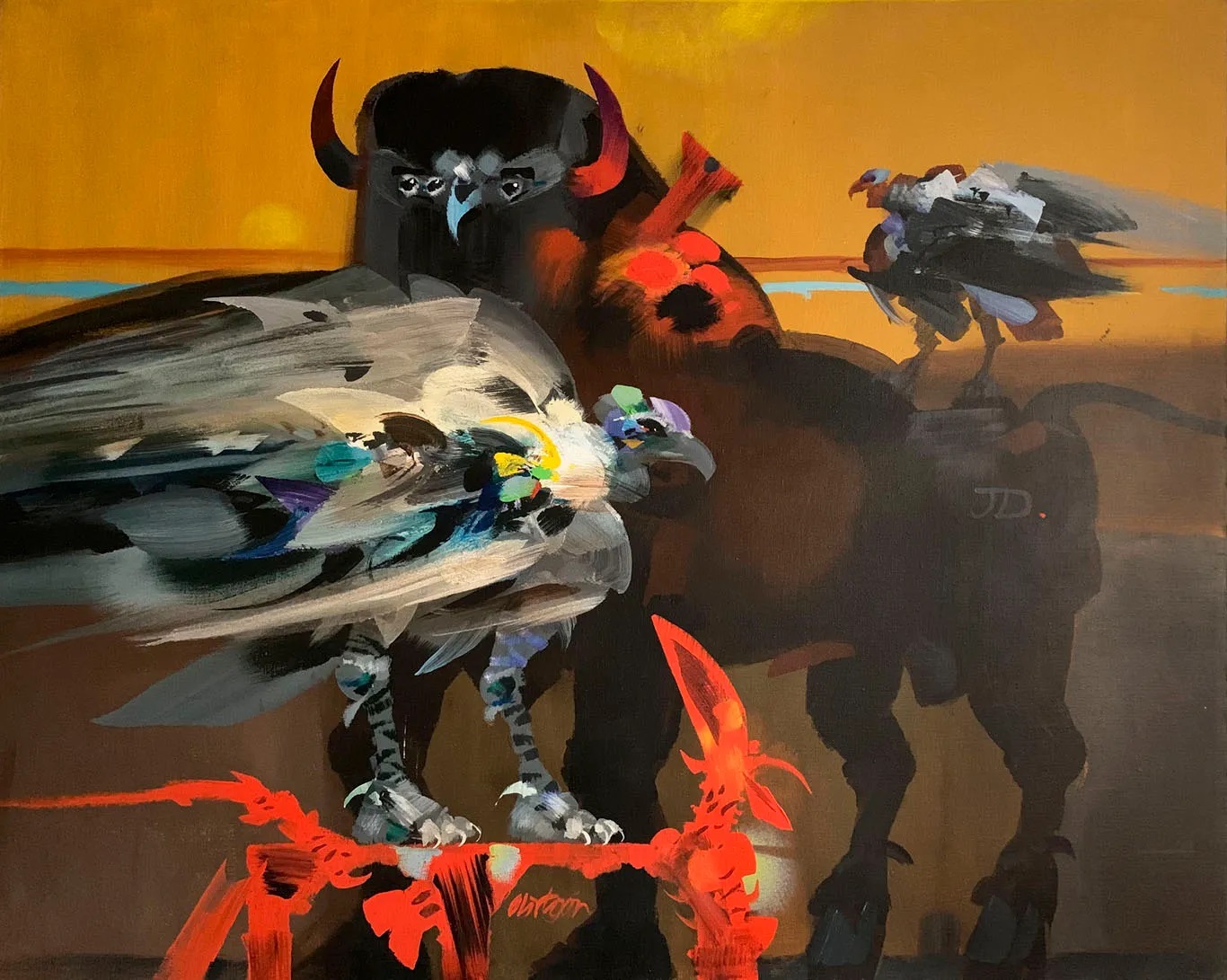
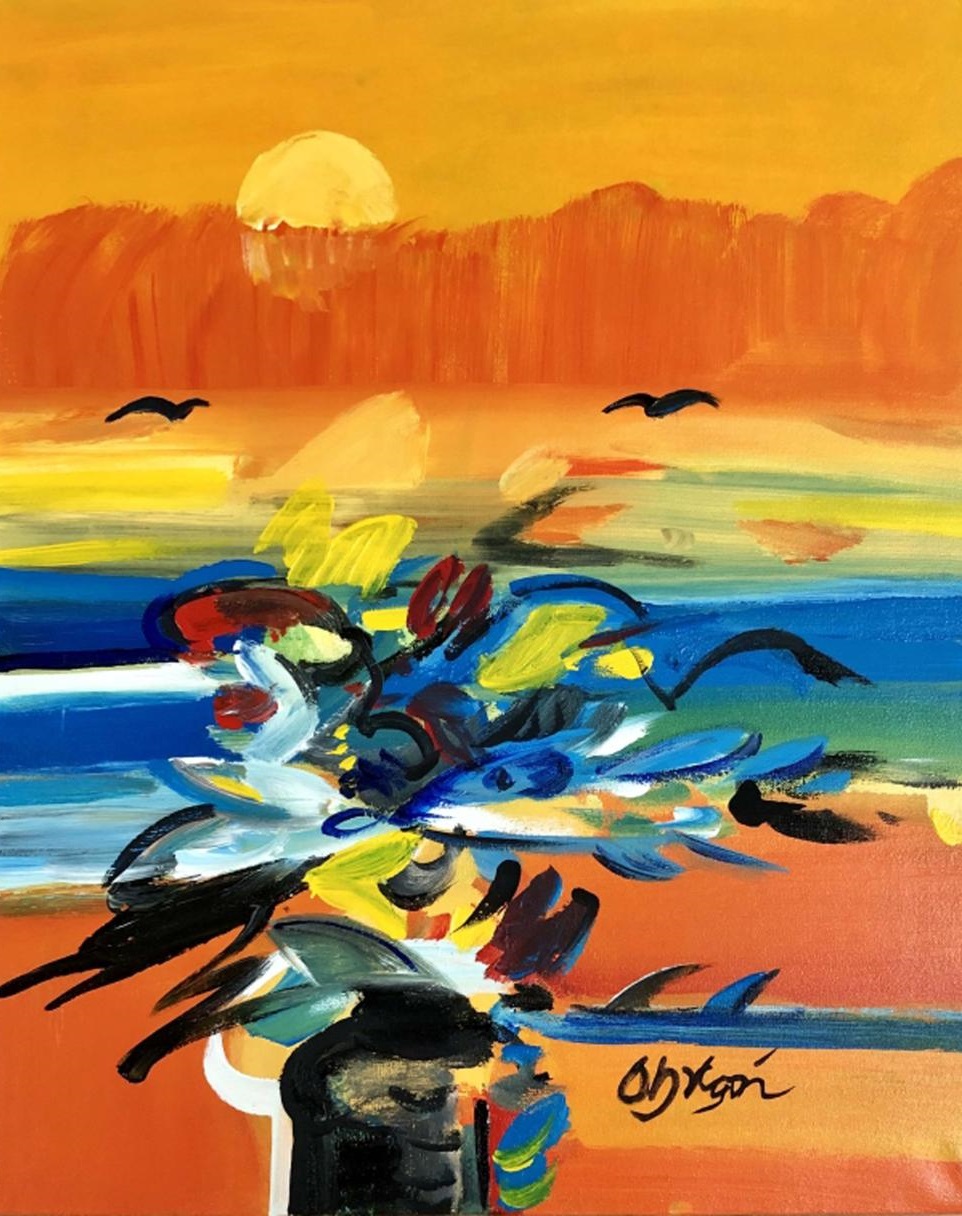
Alejandro Obregon (1920 - 1992), Colombian artist. Born in Barcelona, Spain, Obregón always considered himself self-taught although he studied art in England, the United States, and France. His career was difficult at its inception because of his inability to master pictorial techniques. In 1943 he had his first solo show and launched his career. He developed special symbols—like the falcon and colorful flowers—to depict the Colombian landscape and its inhabitants. His figures are painted in large and strong brush strokes.
A geometrical and rational Obregon with constructivist tendencies developed between 1947 and 1959, when another more expressionistic and irrational Obregon evolved. With undoubted daring, the artist has since combined emotion with dynamic equilibrium in his figures, radically changing the habitual Colombian colors of blacks and greys to his vivid tones.
But it was the condors and the bull-condors, like that of 1961, which would doubtlessly reign over the artist’s new universe. Obregón had seen his first condor in a cage at the National University. “He looked like a Jesuit priest, all covered with brilliant black and with a white collar.” He patted the bird’s head and then pulled out a tail feather, receiving several pecks that left a scar Obregon still has. At least 40 condors have been painted by the artist, and they placed Obregon at the head of Colombian art, making the 60s his decade.Critic Marta Traba identified a series of characteristic elements in Obregon's work: personal poetic values; self-sufficiency in regard to reality, indeed starting from it; expressive intention; freedom of form; search for identity based on the landscape, zoology, and flora; elliptic space people by magic elements; and contempt for urban culture.Also unique to Obregon is that instead of faithfully painting what he sees, he made extensive use of his personal imagination and vitality.From his still lifes of the 1950s to his landscapes of the sky, the sea and the buildings of Cartagena de Indias, where he worked until his death, Obregón's work is multifaceted. He conveys his feeling for the geography and wildlife of Colombia, his love of family and his passion for women. His subjects remind the viewer of loyalty, friendship, memory and ultimately of the wonder of life, however insignificant it may seem in terms of the cosmos. 


Jean-Paul Mousseau

Jean-Paul Mousseau (January 1, 1927 – February 7, 1991) was a Quebec artist. He was a student of Paul-Émile Borduas and a member of the Automatist school. He was a founding member of the Association on Non-Figurative Artists of Montreal. He designed murals for the Hydro-Québec building and the Peel Metro in Montreal. Jean-Paul Mousseau studied painting at the age of thirteen while at the College Notre-Dame in Montreal under Frère Jérome (1940–45). He became a student of Paul-Emile Borduas at the Ecole du Meuble, Montreal. He was a member of the group of painters known as the Automatistes. In 1948, he was one of the signatories of the Refus global manifesto.At the end of the 1950s he was one of the first Quebec artists who saw the necessity of integrating art into the urban environment. His most important contributions are original murals and other collaborations with architects. Wikipedia


Efraín Enrique Recinos

Efraín Enrique Recinos  (May 15, 1928 – October 2, 2011) was a Guatemalan contemporary architect, muralist, urbanist, painter and sculptor.
Recinos' works adorn the facades and interiors of many of Guatemala's landmark buildings, including the National Library of Guatemala. However, he is best known as the architect of the Centro Cultural Miguel Ángel Asturias, which serves as the county's national theater and largest cultural complex, opened in 1978. Recinos designed the large, white structure set on a hill to resemble a jaguar, using insipiration from more traditional Mayan motifs.The government considers the theater as a National Heritage site.Additionally, Recinos also painted the murals located in the Guatemalan National Music Conservatory. Other examples of his work can be found inside La Aurora International Airport and the National Mortgage building. The government of Guatemala awarded him the Order of the Quetzal, one of the country's highest honors for his artistic contributions during his career.Wikipedia


Optical Art - Rogelio Polesello

Rogelio Polesello (26 July 1939 – 6 July 2014) was an Argentine painter, muralist and sculptor. He was best known for making Op art (or optical art) known in Latin America. He won two Konex Awards; one in 1982 and another in 2012. He was born in Buenos Aires.Rogelio Polesello studied at the Escuela Nacional de Bellas Artes Manuel Belgrano and the Escuela Nacional de Bellas Artes Prilidiano Pueyrredón, both in Buenos Aires. In 1959, he joined the Asociación Arte Nuevo, founded by Aldo Pellegrini and Carmelo Arden Quin. The paintings he included in his first solo exhibition at the Galería Peuser (Buenos Aires, 1959) followed the aesthetics of Op Art and were based on Gestalt theories. Their geometric forms, generally in black and white, added to or subtracted from the whole according to perceptive principles that produced specific optical effects.Polesello died from a heart attack on 6 July 2014 in Buenos Aires. He was 75.Wikipedia