Exposition Art Blog: Romanian artist
Showing posts with label Romanian artist. Show all posts

Sergiu Rusu - The Rhapsody


Sergiu Rusu

  Contact : sergoart@yahoo.com
 
Romania


The Rhapsody - oil on canvas 60/80 cm/2016
Price 1500€

https://milenaolesinska.blogspot.com/p/art-for-sale.html


Ion Tuculescu - Expressionist Painting & Abstract Art


Ion Tuculescu (1910 – 1962) was a Romanian expressionist and abstract oil painter, although professionally he worked as a biologist and physician. His artwork became well-known posthumously, when, in the spring of 1965, a major retrospective exhibition revealed him as one of the important post-World War II European modern artists.
In his early years, Ţuculescu's work was marked by the influence of figurative Expressionism, gathering themes and subjects from Romanian folklore. He did not abandon their influence as he moved toward abstract expressionism, making use of decorative elements originating in the folk art of his native region, Oltenia.


Aurel Cojan - European Avant-Garde


Aurel Cojan ( March 3, 1914, Beceni, Buzau, d. December 2005, Paris, France) was a painter and decorator Romanian artist. During 1932-1934, he attended the Bucharest Academy of Fine Arts, Painting Department, having as teachers and Camil Ressu Şirato Francis. In 1969 he obtained political asylum in Paris.
***
Éric Suchère, “L’effroyable jeunesse d’Aurel Cojan”,  in Beaux-Arts Magazine 1995: “From rough to smooth, from slaps to caresses, all imaginable textures, all the different ways of impressing color on a surface are used. Colors that struggle amongst themselves, against the canvas, that rub together and clash against each other to the point of dizziness. This blowing apart of the internal structure of a painting could be compared with the idea of the “current of consciousness” in Joyce’s texts, where it is a question of bringing together, in one same character, a whole group of auditive, olfactive and visual sensations and showing how they disturb the thought process. With Aurel Cojan, the receptor is the canvas, the sensations are transmitted through color. If his painting seems discreet, it is however of an extreme violence, comparable not to murmur but to a thousand screams rending forth at the same time”.
***
“Aurel Cojan sort de l’ombre”, L’Oeil no. 499, September 1998: “If Cojan’s paintings sometimes take on an abstract appearance, reality is always there, beneath the surface, and the artist only cultivates haziness with a poetic intention, delivering up a world that is physical, if impalpable”.


Daniela Isache

 “The Clown” (2018), oil on canvas, 40 x 34 cm.
This is the portrait of a clown who is laughing, but beyond his smile,
we can see a world full of sadness.
Romania


European Abstract Art - Romul Nutiu

Romul Nutiu (July 28, 1932 – April 5, 2012)was one of the most constant artists dedicated to Abstraction from the Romanian art scene. Even though he had not left the country to work abroad along his life, his international career has tremendously risen since 2008, when he started a fruitful collaboration with Dr. Joana Grevers, art dealer and historian based in Munich, Germany.His career evolved from the early sixties, when he was a young artist, eager to experience new ways of relating to painting and continued fluently until his death in 2012. Even though there are variations of style and appraisal, his painting had always been vivid, colourful and tenacious.'The artistic biography of Romul Nuțiu lays under the sign of a happy exception', said art historian Ruxandra Demetrescu. 'In the 7th decade of the last century he was one of the first Romanian artists that had professed the Abstract Expressionism and/or European Informal. He remained faithful to abstraction in general and then he converted painting into object. The innovative character corresponds naturally in his case with that of an avantgardist (even in the literal sense of the word). 'In the 70s, in Timisoara, a few artists acknowledge and try to change the moral hazard of political strategies. For Nuțiu, the personal input is abstract. The relationship history/present, the studio poetics, the new approach of the artistic medium, image as material are syntagms for what painting and object painting represent. In order to understand the concept in regard to the 70s slang, one must admit the decisive personal approach of painting.The relation to Abstract Expressionism and Art Informel is best described by the artist: 'In 1957, when I graduated, my belief was strictly connected to the idea that the perception of things is rather important for the creation act, but being limited, one has to appeal to the subconscious through experiment, challenge and transcendence. My informal was born from hard work and devotion. At that moment, I knew few things about contemporary art, and what I learned in school was just some academic knowledge that was only partially useful. Later on, when I started to travel, I came in contact with the European informal. In the big museums I found out that my way was somehow synchronized, having a polarity to what I was seeing. Abstract expressionism and the European informal made me understand that I have to keep my own authenticity and sensitivity.Wikipedia


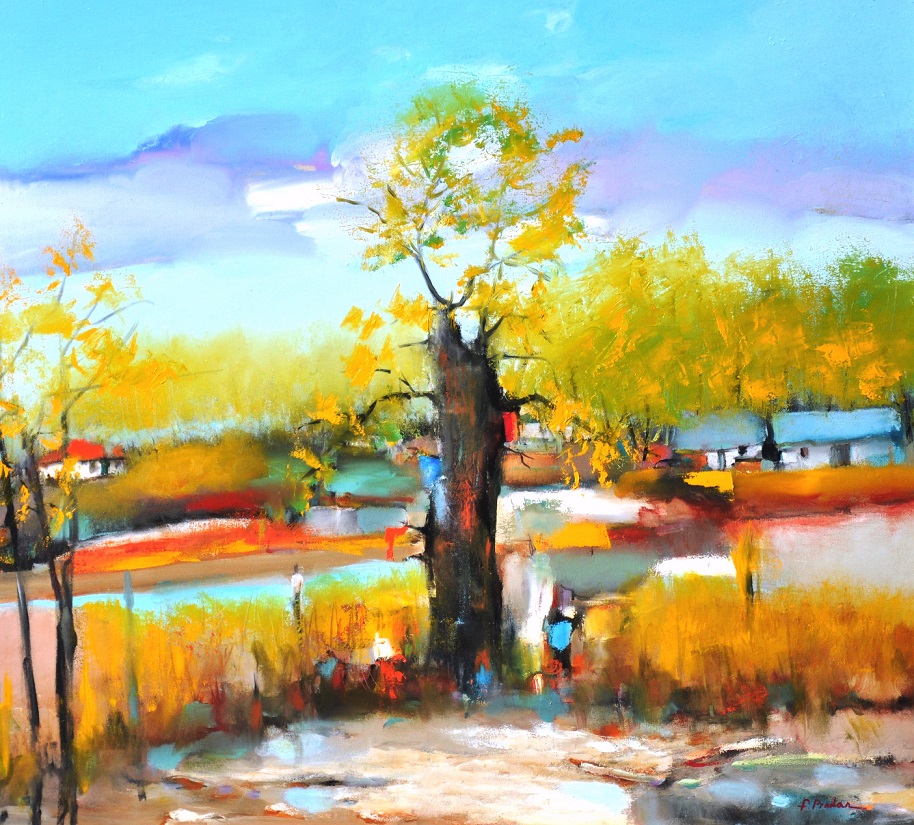
Florin Prodan

Painter – Florin Prodan
Personal details
Date of birth: November 4th 1962
Place of birth: Hlipiceni, Botosani, ROMANIA
Professional details
Graduated I.P. Iasi.
Studied free art.
Member of Plastic Artists Union – President of Botosani branch
Founding member of “Stefan Luchian” Foundation

***

 Feeling – Colour - Wit in Florin Prodan’s painting
 
From the engineering field he took information about perspective, the sense of proportion, volumetric units and he was taught the lesson about colour, as any plastic artist, from the succession of seasons, reason for which he called one of his exhibitions as “Seasons”.
The painter has around 30 personal exhibitions and many other group exhibitions in the country, in Bucharest, Iasi, Botosani, Suceava, Piatra Neamt, as well as many works in private collections in the countries like France, England, Germany, Canada, USA, Greece, Italy, China. Among seasons, he focuses more on spring, summer and autumn. Spring for the chlorophyll green which symbolises life in its more active shape and autumn for the polychromic air with symphonic sounds.
 The winter landscapes with snow clouds are the ones that show the silver white of snowflakes, the “milky” and cold atmosphere, how winter enters the “rest” state.
By his works, the painter leads us to the idea that he is the supporter of calm romance of nature. His paintings are dedicated, mainly to nature, it is a plain air painting and the artist is, as Iohannes Iten was saying, of Bauhaus School, an impressive optic. The impressions gathered from the most typical and hidden places of nature, there are not simple sensory experiences, chosen by chance, but they are attentively selected and instrumented from compositional point of view, according to an artistic intuition, connected with the engineer sense of free form – subject to poetic fantasy law.
Therefore, the main source of inspiration represents nature and people with their concerns – it is, we can say, a campestre painting.
His artist eye aimed in nature especially delusions made by the effect of water in relationship with the light (the sun rise, sunset, mornings with crystal clear dew drops and dense fog, the sunset with solar brightness, filtered by the clouds curtain and the effect of evaporation with the water morphology in the wind, especially after the rain). Our of this reason, the artist, by using light with generosity, can be considered, more, a meridian with Tiepolo asymptotic approaches.
The forms of nature elements aimed by the artist are so filled with light that sometimes we have the illusion that we enjoy the presence of diaphane shapes made of coloured light vapours, or photonic clouds.
His landscapes works, where we can always find aquatic shapes of laguna landscape (rivers, ponds, lakes) lead to the illusion of some images from the waters empire. The house seems more a decorative element of nature than a rural civilisation sign, even for an immemorial time.
The flowers paintings, especially in warm colours, combined with floral species in contrasting colours prove the colourist calling as well as the sensitivity and passion for flowers of the author, important knowledge for the symbolist language of flowers.  Flowers are spread in a series that start from the opulence of the sunflower to the delicacy and wild freshness of field flowers, from the intensive red of corn poppies to cornflowers which gradually diminish their colour in the floral mass.
His style is the one of a romantic artist, in impressionist expression with well tempered chromatic and logically developed compositions and the vivacity generated by nature in all its complexity leads us to the idea of renaissance hylozoism subtly transmitted to the visible romanticism of François René Chateaubriand.
Mihai PĂSTRĂGUŞ, arts critic